


 Francais
 Deutsch
 Italiano
Refine Your Search
Russia 1953 stock footage and images
- Showing 1 to 6 of 1877 results more
more Hide
Hide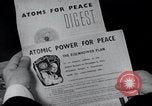
Voice of America broadcasts President's speech and USIS "Atoms for Peace" exhibits are presented worldwide
President Eisenhower of the United States addresses United Nations on December 8, 1953 about atomic bomb and atomic weapon dilemma in the nuclear age (part of Atoms for Peace initiative). Operators in radio transmission control rooms note down readings. View of time clocks of various places in the world including Honolulu, New York, London, Moscow, Calcutta, Bangkok and Tokyo displayed. The Voice of America broadcasts program in different languages by announcers. Scene of a family sitting in a living room as they listen to the president's speech on a console radio. People work at typing, printing, and translating the speech. USIA motion pictures service prepare newsreel of president's speech. A man views air mail of USIA films. Exterior views of several different United States embassy buildings worldwide. A guard standing outside the building. A Public Affairs Officer at the U.S. embassy in Japan, in Tokyo, meets with U.S. Ambassador to Japan Robert Murphy. USIA members seated around table for meeting, and, in Washington DC, creating publications about the Atoms for Peace program. People seated in a USIA library in Brazil read books and various USIA materials. Architects design 30 foot high Atoms for Peace exhibits. An exhibit being setup in a foreign country (possibly in North Africa). Exterior and interior views of the West Berlin, Germany Atoms for Peace exhibit. Prime Minister Jawahar Lal Nehru in India is seen arriving in a jeep to view the Atoms for Peace exhibit in India. Prime Minister Nehru inside the exhibit hall watching a presentation. In Japan, a woman operates remote-controlled robotic hands to hold radioactive materials, at a demonstration for Japanese citizens. In a city in Italy, a view of a mobile van unit carrying an Atoms for Peace exhibit. Scenes from a film "A is for Atom" that was translated into 30 languages and shown all over the world. Wide view of the Kremlin in Moscow, Russia, Soviet Union. A Russian radio commentator speaking at a microphone. Propaganda dramatization showing the Russian announcer attacking American plans for Atoms for Peace.
America test fires the M65 atomic cannon in the Nevada Test Site; 1953 East German uprising and Trieste Crisis in Europe
Major events of the year 1953. The first atomic artillery test fired in United States on May 25, 1953. The M65 atomic cannon moving in the Nevada Test Site (specifically Frenchman Flat). A mushroom cloud rises after the M65 Atomic Cannon, sometimes called Atomic Annie, is fired and atomic bomb explodes. The M65 atomic cannon test is done as part of the Upshot–Knothole series of nuclear tests. East German uprising of 1953 (“Volksaufstand vom 17. Juni 1953”). Riots in East Germany against the increase in work quotas and withholding of American food. East German police escort a man away during a riot. People protest in streets as police try to crush the revolt. A stack of StarLac boxes bound for East Germany with sign in front. Sign reads “First Food Relief Shipment to East Germany by M.S.A. United States Lines S.S. American Inventor”. East Germans line up to receive food relief from the United States. An East German woman receives a food aid pack from the United States. The Trieste Crisis of 1953. Sign in front of a house reads “Trsta ne damo”. Officials inspect a car in the United Nations Security Council-controlled Free Territory of Trieste. Students riot in the streets of Trieste over the issue of Adriatic area between Italy and Yugoslavia. (Cold War period.)
Refugees fleeing Korean War; Stalin's death in 1953, Workers strugging in East Germany with more work and less pay
Communist-backed North Korea at war with South Korea. Views of U.S. Navy warships firing on North Korean targets, U.S. Army tanks moving through a city in Korea, and U.S. soldiers scrambling in a fire fight. A U.S. Army chaplain hugs a dying American soldier and pats his face. The chaplain closely prays over the dying soldier. A U.S. Army officer lifts a shocked Korean child into a truck. Young Korean children, possibly orphans, eating food at a table. Korean civilians including women and children fleeing the war. UN council in a meeting regarding the Korean War. Soldiers from multiple nations mobilizing for the effort in Korea. View of Kremlin in Soviet Union. Scene of Stalin dead, lying in state surrounded by flowers around his casket. Other Soviet political leaders look on. Citizens pass by site where Stalin is memorialized. East German leader Walter Ulbricht speaking at a podium. Laborers in East Germany struggling as they work longer hours for less pay. Workers construct buildings. East German construction workers sitting idle on the scaffolds of a building under construction as they begin their strike in June 1953, initiating the Uprising of 1953 in East Germany.
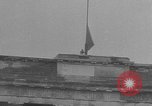
The Soviet Army suppresses uprising of 1953 in East Berlin and other cities in East Germany
The Soviet Army suppresses uprisings in East Germany during worker strike and civilian protest of 1953. Demonstrators haul down a red flag atop the Brandenburg Gate in East Berlin. Crowds at Potsdamer Platz disperse as gunfire breaks out. A wounded demonstrator is assisted by comrades during the protest. Soviet tanks rumble through the streets. Martial law is declared and orders of the Military High Command are posted in East Berlin. Demonstrators throw rocks at Soviet tanks on the street. Soviet tanks and troops block demonstrators. A map shows East German cities with uprisings: Dresden, Magdeburg, Frankfurt, Schwerin, Leipzig, Rostock, Erfurt, Chemnitz, and others. A poster dated 18 June, 1953 announces the execution of Willy Goettling as a leader of the uprising. A newspaper announcement reports the condemnation of Alfred Diener, of the city of Jena, as a provocateur. Konrad Adenauer, Chancellor of West Germany, presides over a public funeral for Germans who lost their lives in the Soviet suppression of East Berlin. Leaders of East Germany are seen and East German proceedings against alleged ringleaders of the uprisings. East German refugees fill a large open building. They carry belongings and sleep on the floor.
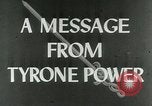
American film and stage actor, Tyrone Power appeals to the public during the 1953 Cancer Drive.
American film and stage actor, Tyrone Power opens the 1953 Cancer Drive. Tyrone holds the American Cancer Society symbol and begins his appeal to the public. He talks about cancer, the crusade to save lives, research programs and the need to become aware. He holds up an envelope model and appeals to the people to donate generously and send gifts for the cause. He holds up an American Cancer Society poster to increase awareness about cancer.
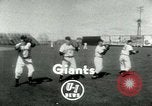
Baseball New York Giants Spring Training in Phoenix Arizona, 1953
New York Giants train in Phoenix Arizona prior to 1953 baseball season. This clip shows many of the prominent Giants from that time, minus Willie Mays, who was in the army that year. Shot of infielders Bobby Thomson, Daryl Spencer, Davey Williams and Whitey Lockman simultaneously turning and throwing. Shot of catchers Wes Westrum, Sal Yvars, Sam Caledrone, and two others. Shot of outfielders Monte Irvin, Jim "Dusty" Rhodes, Clint Hartung, George Wilson, Harvey Gentry, Don Mueller, Bill Taylor. Shots of pitchers Sal Maglie and Hoyt Wilhelm. Manager Leo Durocher confers with his coaches. Announcer notes return of star outfielder Monte Irvin, who missed most of 1952 with broken ankle. Irvin hits a pitch toward left field. Durocher talks at camera.