


 Francais
 Deutsch
 Italiano

Refine Your Search
+"Africa" +1944 stock footage and images
- Showing 25 to 30 of 35 results more
 Hide
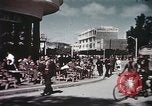
Moroccan city. No cars are seen, but some buses. People travel by burro, camel, bicycle, horse, carriage, and on foot.
Every day street scenes in a Moroccan city in North Africa. The street is very wide. Local residents walking; waiting for public transport. and siting in outdoor sidewalk cafe. Two American soldiers riding in a pedicab pulled by two bicycle riders. Many bicycle riders. Two Western women riding in an open carriage pulled by team of two horses. Moroccan man walking behind burro laden with sacks. Two Moroccan soldiers, or policemen, wearing uniforms with Fezes, walk past and give friendly salute to cameraman. Moroccan man on bicycle, stops to converse with Moroccan woman who is completely robed, to expose only part of her face. A Moroccan man rides a horse in the street, and another rides a burro. Nomads with camels and livestock rest at side of road. As two women sit, looking on, a man stomps some kind bread dough with his feet with dance-like movement. One of the women rises and does the same. (World War II period).
United Nations forces in Britain ready for action and the Allied Generals see new equipment in action.
Chiefs of Allied Invasion Command at the headquarters in England. American General Dwight D Eisenhower meets the soldiers. Military supplies put into action. Trucks, Jeeps and mechanized equipment are assembled. General Montgomery, Deputy Commander General Arthur Tedder and General Eisenhower see new equipment in action. Artillery fired. Aircraft in flight. Paratroopers in sky. General Montgomery, Master of air tactics, General Arthur Tedder and Liberator of North Africa, General Eisenhower. (World War II period).
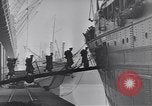
U.S. Army Service Forces transporting troops and supplies worldwide during World War II.
U.S. troops board a large troop transport ship via a gangplank. Troops on an intermediate deck of the ship. Some are sprawled out relaxing. View from above of more troops boarding a ship. Men and equipment on the pier below. American forces at various far flung places where the U.S. Army Services Forces facilitated their transport and logistic support. Fleeting glimpses of troops in: Ireland; Alaska; Trinidad; and South America. Troops jam the upper deck of a transport ship. Army Service Forces officers in a planning meeting. Naval officers on deck of a ship look through binoculars as U.S. Naval ships bombard the coast of Solomon Islands and landing craft carry marines in an amphibious assault. Next, a man is seen annotating a map of North Africa. Secret maps pertaining to Allied landings in Tunisia and Algeria. Animated map illustrates amphibious landings on North African coast, highlighting Casablanca, Oran, and Algeria. Landing craft carry troops and supplies that are piled up in the sand beach. Soldiers moving military supplies ashore, in fire brigade fashion. Soldiers working at desks in Offices of the Army Service Forces. Filing cabinet in background. Trucks on the move in remote locations. Supply ship being loaded at a terminal. Fuel drums and army vehicles a being loaded aboard ships. Officers seated at a conference table. Ordinary American enlisted soldiers in a griping session at an Army post in the United States. Camera pans over large formation of soldiers. Animated chart shows more than half of servicemen who are part of Army Service Forces (ASF), are unaware of that. Troops marching in review at a tropical location, where reviewing officers wear pith helmets. Chart illustrates lack of unit pride in ASF. Images of various ASF logos. Chart shows results of polling data from soldiers and service members. Signal Corps and Engineers elements of ASF have the greatest unit pride. But most think better of other branches of the Army. More troops marching, in steel helmets and carrying rifles with bayonets affixed. Troops marching overlaid by "50%" indicating that half don't believe their contributions to the war effort are significant. Troops lined up (for pay?). More charts expressing concern about low morale. A heavy gun firing. German paratroopers jumping from a formation of Junkers Ju 52 aircraft. Charts expressing prevailing U.S. troops view that Germany wouldn't be too hard to defeat. Chart showing lack of understanding about why the U.S. is fighting Germany. Image of President Franklin D. Roosevelt and Prime Minister Churchill seated in front of their key military officers at Casablanca Conference in World War 2. Chart shows U.S. soldiers believe that the greatest war effort is expended by the U.S. followed by Russia, with China and Britain providing little. Chart illustrates that only half U.S. troops want to get overseas and fight. Chart shows U.S. War Department films can correct this problem.

British soldiers on African front,and Japanese fleet advancing,and the activities in Asian countries during World War 2
A film about the war activities in Africa and Asia during the World War II. Aerial view of the North African Front. The British soldiers fire artillery. The soldiers carry an injured soldier on a stretcher. El Alamein, Egypt : Officers salute a convoy of jeeps. The Japanese soldiers aboard a ship in the Pacific ocean. A soldier loads his gun. The soldiers salute. A Japanese aircraft takes off. Hong Kong: Troops advance along the bombed area as Hong Kong falls. Thailand: An officer signs pact. A dead body in water near a damaged bridge. Men in a boat. The soldiers enter a damaged building. The Japanese occupation in the various parts of Asia. Animation depicts the Allied forces swept along the Pacific. Soldiers on a U.S. war ship.
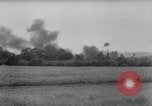
Winston Churchill, Jan Christiaan Smuts and Field Marshal Montgomery view Allied positions in France.
Allied troops in France during World War II. An Allied soldier watches through binoculars. Allied troops move into action. Troops walk in a trench. Army tanks in the background. A large crowd of French civilians gather as a French officer addresses them. French people show 'V' sign for victory. Prime Minister of the United Kingdom Winston Churchill, Prime Minister of South Africa Jan Christiaan Smuts and Commander of Allied 21st Army Group British Field Marshal Bernard Law Montgomery view Allied positions.
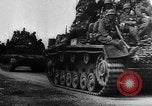
Montage of World War II images,covering Eastern Front, Pacific, and European theaters of operation
German troops advance on the Eastern Front during World War 2. Russians employ scorched earth policy . Oil tanks ablaze and dams and structures blown up. Germans lay siege to Stalingrad. A Soviet troops in urban combat in Stalingrad. A German soldier is shot and falls. Views of awful destruction. Animated map showing Leningrad and the Gulf of Finland and Lake Ladoga on either side. Views of Leningrad in snow. Citizens bundled against the cold, walk near historic structures. Food being distributed. Soviet troops in defensive positions. Animated map shows outbreak of Soviet forces in pincer movement that surrounds the German 6th Army. Two Soviet armies meet as they close the pincer. German Field Marshal Friedrich Paulus surrendering to Soviet forces on 31 January 1943. Troops of the German 6th Army make their way through the snow as they surrender. Battlefield cemetery, with markers of German soldier's graves. Numerous Soviet citizens, victims of the fighting, seen lying in the snow, as relatives grieve. Scene shifts to the Pacific theater with view of Japanese bombers flying over an installation flying the Rising Sun flag. Scenes of the Pearl Harbor attack. American workers fill yard near a war plant during shift change. Defense industry workers in the plants. Liberty ships being launched. American forces in amphibious assaults. U.S. forces engaged in North Africa and on Pacific islands. American soldiers at battlefield gravesite. General Dwight D. Eisenhower with General Omar Bradley and Allied military leaders, look over a map of Europe, following the June 6th invasion in Normandy. Fields filled with Sherman tanks and other war materiel, in England. The wing of an American airplane in D-day stripes as it takes off. Views from cockpit of an American bomber striking targets on D-day. B-17 bombers in formation at high altitude, leaving condensation trails in the sky. Pilots in cockpit of an American bomber, as they drop bombs. Allied fighters in D-day stripes peeling off to attack. Gun camera views of fighters strafing German targets. Explosions and fires.