


 Francais
 Deutsch
 Italiano
Refine Your Search
+"Alaska USA" +1934 stock footage and images
- Showing 7 to 12 of 20 results more
more Hide
Hide
Aircraft of the 1934 U.S. Army Air Corps Alaska Flight depart Fairbanks for Anchorage..
YB-10 aircraft of the U.S.Air Corps 1934 Alaska Flight heading to Anchorage, Alaska. View of one of the aircraft as it takes off from Fairbanks. View out the window of one B-10, as another moves into formation off its left wing. Views from various angles in the airplane. Views of Anchorage, below. aircraft in formation passing over the Anchorage airfield. The camera airplane setting up on downwind leg to the field. Glimpse out right side window over the wing as the aircraft is on final approach near the field. YB-10s parked on Anchorage airfield, with lots of spectators and well-wishers to greet the fliers. Another B-10 landing, as Lieutenant Colonel Henry (Hap) Arnold and Major Ralph Royce watch, along with other fliers. The newly arrived B-10s taxiing to park. Panning view of the airfield, with B-10s parked in a line and spectators standing scattered about in the field. Mountains in background
A YB-10 airplane of the U.S. Army 1934 Alaska Flight ditches in Cook Inlet after engine failure.
Engine failure forces a YB-10, of the 1934 U.S. Army Alaska Flight,to make a forced landing in Cook Inlet, two miles from Anchorage. View of the B-10 partly submerged in the water as men approach it in a small boat. The number 145 seen on the tail sticking out of the water. Boats moving near the stricken airplane and men wading in the water to assess ways of salvaging it. The aircraft on the beach after being pulled from the water. Men gathered around it starting repairs. A crane lifts a damaged propeller from the plane. Next, the crane lifts the right engine from the plane. View of the large crane with the engine suspended. A crewman walking under the nose of the repaired airplane. Another tapping a repair with a hammer.
Members of the U.S. Army Air Corps 1934 Alaska Flight complete their photo-mapping mission and are ready to fly home
The U.S. Army Air Corps (USAAC) Alaska Flight of 1934. The YB-10 aircraft of the project after completing their photo-mapping of 21 thousand square miles of Alaska. The aircraft have each been named for leading Alaskan cities and are fueled and ready to fly home. View of the YB-10 flown by Expedition Commander, Lieutenant Colonel Henry Arnold, displaying painted name "City of Fairbanks" and flag containing stars of Big Dipper and Polaris (North Star). The symbol of the expedition is also painted on the fuselages of all the airplanes, consisting of a totem pole topped by an Eagle with two arrows, superimposed on a map of Alaska. Names: Anchorage, Fort Yukon, Tanana, and Kodiak, are seen painted on airplanes. Aviators of the USAAC Alaska Flight pose for a picture in front of a YB-10 aircraft. Lieutenant Colonel Henry Arnold, Commander of the expedition, is in the center of the first row of men. To his right, is a pipe-smoking officer in a campaign hat, holding a puppy Husky dog. Arnold pets the puppy
View of typical Alaskan houses with flower and vegetable gardens in Fairbanks, Alaska.
Alaskan scenes recorded by photographer with the 1934 USAAC Alaska Flight. Typical Alaskan houses with plants around them. Flower and vegetable gardens. View from vehicle moving along dirt road with small evergreen trees on the sides. A man standing by U.S. Post box, where sign identifies office of Billy Root's Midnight Sun Transportation Company and reads: "for information just step inside and ask MAX."
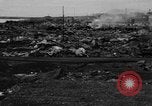
A fire in Nome, Alaska reduces the city to ashes.
Aftermath of a September 17, 1934 fire in Nome, Alaska. Debris spread across a large area after a massive fire swept the city of Nome in Alaska. Soldiers near a damaged car. A view of the area with debris all around. The 1934 Nome Fire began at Steadman Avenue between First and Third Avenues.
The Army Air Corps Alaska Flight support ship, "El Aquario," stops to refuel at Ketchikan, Alaska
Views of harbor at Ketchikan, Alaska, from deck of the "El Aquario," supply ship supporting the U.S. Army Air Corps Alaska flight project in 1934. Camera pans across the harbor showing a steamship at dock and the settlement town of Ketchikan. A passenger steamship is seen with smoke from her stack, underway. A smaller steam ship underway. Crew members of the El Aquario, fish from her bow. One pulls in a small fish. Another one poses with a large fish. views of glassy calm waters from the El Aquario, underway after refueling at Ketchikan, followed by scenes as she moves into more open waters. Hills with snow on their tops.