


 Francais
 Deutsch
 Italiano
Refine Your Search
+"Algeria" +1942 stock footage and images
- Showing 7 to 12 of 35 results more
more Hide
Hide
German air raids on an Allied airport at Souk El Arba in Algeria.
German air raids on an Allied airport at Souk El Arba in Algeria during World War 2. German dive bombers (Junkers) drop bombs on key targets. American soldiers retaliate. Soldiers put the casualties in armored U.S. ambulances. U.S. P-38s dogfight with German Junkers. U.S. C-47 transport planes loaded with supplies and fuel arrives to replenish Allied forces. (November 1942-December 1942).
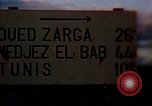
American convoy crosses the Tunisian Frontier in North Africa.
American convoy of U.S. Army M3 Grant tanks, half-tracks and jeeps rolls through Algeria near the Tunisian border during World War 2. Protective distance is maintained between the vehicles. The convoy passes through a French road barricade and leaves Algeria crossing the Tunisian Frontier. (November 1942-December 1942)
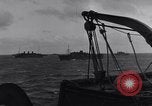
Allied Forces in Battle of Casablanca and North Africa in World War II
Operation Torch in World War 2. Allied invasion convoy off Casablanca, Morocco. American troops on ship's deck, cleaning and checking their rifles. Closeup of a wire from the Invasion Task Force Commanders, listing signals that will tell of the French forces' decisions. Closeup of U.S. troops boarding Higgins Boat from a transport ship. Rear Admiral H. Kent Hewitt on the USS Augusta (CA-31). U.S. President Roosevelt, Free French Commander, Charles de Gaulle, and French General Giraud, all issue calls for French forces not to resist Allied invasion. View of triple turret 8-inch guns on the USS Augusta. Sailors in their bunks. Suddenly guns from the shore begin firing on the invasion convoy. Shells explode in water near convoy ships, as sailors man battle stations and begin returning fire on Casablanca. French defenders signaled friendly attitude by directing searchlights vertically. British spitfire aircraft launch toward Algiers, from Gibraltar. British troops in an amphibious landing at Algiers on November 8, 1942. View of French Admiral Jean Darlan. Allied troops enter Algiers. American airborne troops parachute from C-47 transport aircraft over Oran, Algeria. Next section covers Battle of Casablanca: Allied warships fire at Vichy French ships and aircraft and more troops head to shore in landing craft. Sailors firing anti-aircraft guns from landing craft, at enemy aircraft overhead. A U.S. carrier-based SBD Douglas Dauntless aircraft as it descends in the sky. French sailors load 380mm guns on battleship Jean Bart and fire her guns. Glimpse of French Shore defense guns firing with shells exploding in waters offshore. Gunners aboard U.S. warship loading a heavy gun. Angered over British attack on the French Fleet in 1940, Admiral Daran refused to negotiate with the British. Inserted footage of French battleship Dunkerque exploding during British attack on French fleet at Mers-el-Kébir, July3, 1940. A tank driving ashore from a landing craft. Closeup of a French soldier (from the rear) firing his rifle at invading Allied troops. Allied medical corpsmen on the sandy shore, running with a litter. A jeep pulling a towed artillery field piece ashore from the surf. Medical corpsmen carrying a wounded on a stretcher. Allied troops fighting defenders in Casablanca. Animated map shows German invasion of Vichy France. View of Philippe Pétain, Head of Vichy France. View of Admiral Darlan saying goodbye to U.S. Lieutenant General Mark Clark after secret meeting of the two. Officers of German Armistice committees departing a North African city. Cheering crowds are happy to see them depart in a truck. French crowds cheering American troops. British Lieutenant-General Kenneth Anderson arriving at Algiers. French General Henri Giraud salutes. General Dwight D. Eisenhower salutes. Parading color guard with flags of France, Britain, and the U.S. Animated map shows German forces pouring into Tunisia. View of German troops on deck of a ship and at ship's anti-aircraft positions. General Eisenhower conferring with British and French allies. Camels used on rough terrain. American writes "Tunis Toonerville." in chalk. Allied troops sitting on floor of freight rail car with door open as old steam engine moves the train. Animated map shows German and Allied supply lines. A U.S. Douglas A-20 Havoc bomber landing on an airstrip. Numerous German warplanes parked in Tunisia. U.S. M2 tanks and other military vehicles moving along narrow mountainous roads. Locomotive transporting mules in stock cars. C-47 transport airplanes drop British and American airborne troops. Commandos disembark from ships at Bone, Algeria. Allied aircraft parked on a captured enemy airfield, under attack by German Dornier Do 17 and Heinkel He 111 bombers. A Parked American B-25. Allied soldiers firing small arms and anti-aircraft guns at German planes.
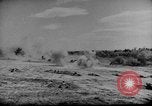
United States 1st Infantry Division soldiers fight against the Germans in Africa and later capture Sicily during World War II.
'The fighting first' about the role of United States 1st Infantry Division in various campaigns during World War II. A soldier of United States 1st Infantry Division. Combat boots of soldiers during the civil war and World War I. A map shows the 1st Infantry Division units moving across the Atlantic Ocean towards North Africa for Operation Torch in November, 1942. Soldiers of 1st Infantry Division go to England and loaded onto ships as they move to Africa. U.S. General Terry Allen aboard a ship. Infantry soldiers fire in Oran, Algeria. Aircraft in flight, explosions occur and a convoy of trucks on advance during the battle in Oran. 1st Infantry Division troops as part of US II Corps battle against Nazi General Rommel's armies in Tunisia, North Africa. Battle scenes against German forces in North Africa in a variety of locations, overlaid with this narration: "we damn near flunked out at the Kasserine (Kasserine Pass). But we learned the score and we started to teach Gerry a few things out of our book. We rammed our way back to Gafsa and down Rommel's throat at El Guettar, where we tore up his crack 10th panzer division." In 1943, men of 1st Infantry Division load onto ships and arrive in Sicily. Troops advance into a town in Sicily after capturing it. Damaged houses in a city in Sicily.
U.S. Army Quartermaster Corps prepare mortars, fire anti aircraft guns, and provide supplies during World War II.
Clip opens with brief World War I scene, circa 1917, of new American army recruits receiving army uniforms being issued by a U.S. Army Quartermaster. Clip then covers U.S. Army Quartermaster Corps' combat operations in various Theaters of Operations during World War II. Quartermaster Corps soldiers with rifles under the cover of a military truck during battle. Troops in trucks. An aircraft in low flight over a field. A U.S. Army truck. A Quartermaster fires an anti aircraft gun. Explosions occur and smoke rises. A British tank in a field. Soldiers beside a truck. Cans and barrels stacked on the ground. An enemy German tank in a field. Soldiers take cover. Quartermasters with guns in a trench. They come up the trench in prone positions. Dramatized battle scene with several Quartermaster corps casualties beside a wire fence. Soldiers prepare a mortar gun. An anti aircraft gun on an army truck. A soldier takes aim and fires a rifle during training. The Quartermaster flag hoisted on a pole. Actual footage shows aerial view of Bataan, and then ground views of groups of remaining U.S. Army soldiers around time of surrender of Bataan in April 1942. American soldier seen with their hands up and under guard of Japanese soldiers during Bataan surrender. Landing crafts arrive at a beach in North Africa. Supplies being offloaded at various battle fronts of World War 2. Soldiers and supplies off-loaded on the beach. Quartermasters seated on supplies boxes. Landing crafts arrive at a beach in the South West Pacific. Troops move across the beach. Troops disembark from landing crafts and move across a beach in Sicily, Italy. The Quartermasters unload boxes of supplies during various beach landings. They unload supplies and fire artillery on a beach head in Italy. Troops in trucks. A convoy of trucks loaded with supplies. Ammunition, ration and personnel in trucks move from Algeria to the front in Tunisia. Explosions occur and smoke rises. Trucks advance through smoke at night and in difficult conditions. Quartermaster General Major General E. B. Gregory speaks about the Quartermaster Corps. He says that the Quartermasters distribute goods to the army during training and combat. The movement of the Corps should be so regulated so as to deliver the goods at the right time in the right quantity.
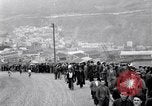
American and British Allied troops take over the city of Oran in Algeria, North Africa during Operation Torch, World War II
French people gathered along North African coast of Oran Algeria following invasion of United States and British forces in World War 2 (Operation Torch). The French seen showing no resistance and even relief. Two U.S. troops show a message from President Franklin Roosevelt. American troops take over Oran, Algeria. American Army convoy moves through the streets of Oran. Vichy French prisoners sit in an open area having layed down their arms without struggle. Group of U.S. soldiers talks to French soldiers.