


 Francais
 Deutsch
 Italiano
Refine Your Search
+"Atlantic Coast" +1942 stock footage and images
- Showing 1 to 6 of 7 results more
more Hide
Hide
John Edgar Hoover talks about German saboteurs captured in the U.S. and other enemy agents during World War 2.
Opening scene depicts (dramatized) the presence of German submarines off the Atlantic Coast, delivering Nazi German saboteurs of Operation Pastorius to Long Island, New York and to Florida in 1942. View of German submarines in the ocean. A scientist in a FBI laboratory examines explosives found when the sabotage attempt was uncovered, including blocks of TNT and explosives designed to look like lumps of coal. J. Edgar Hoover describes how the explosives were designed to target American citizens and war industries during World War 2. Paddy wagons with military guards standing on read door platforms are seen entering court facility in Washington DC. View inside the paddy wagons of German agents ("submarine saboteurs") being brought to military trial. View of the accused and the military officers of the court sitting in court during the trial. Military judges are seen seated during the trial proceedings. View of a wall of file cabinets and a hand reaching into a cabinet marked "secret." Past events show Adolf Hitler in meetings with his staff. An animated map shows Nazi symbol overlaying an outline of the United States. A United States flag in the background. The director of the FBI (Federal Bureau of Investigation) John Edgar Hoover in the United States. He sits at a desk in his office. He talks about enemy agents, Hitler's desire to punish the United States, and the victory of the United States over them.
Soldiers of the 1st Cavalry Division arrive at the Atlantic Coast during their training in the United States.
The 1st Cavalry Division moving along the Atlantic Coast in the United States. An armored car parked on a field. Soldiers standing near the car and discussing a document. A soldier looks at the document. Other soldiers standing in the background. A group of soldiers discussing a map. The soldiers board the armored car. The car moving on the street. Trees along the sides of the street. Motorcycles and scouts move over a highway along the coast. Soldiers get off from motorcycles and advance along the coast. Artillery pulled by a trailer. The soldiers take the artillery to position. Other soldiers firing rifles and machine guns, lying in prone position on the beach. Two soldiers watching the target. 37 mm guns loaded and fired. (World War II period).
U.S. Navy efforts to combat German U-boat activity off the Atlantic coast early in World War II
U.S. efforts to inhibit German U-boat activity near its waters early in World War 2. American patrol boats dropping depth charges off the U.S. Atlantic coast. A U.S. Navy blimp on the lookout for submarines. View inside gondola of the blimp. Bomb being loaded on a U.S. Navy patrol bomber. Catalina flying boat enters water, takes off, and flies low over an Allied ship at sea. View inside Catalina Flying Boat aircraft. Navigator aboard the Catalina measures on chart with pair of dividers. An American flag hangs over his work station. Pilot in the cockpit. Aerial view of Catalina Flyling Boat in flight. Pilot and copilot look out cockpit window. A U-boat on the surface of the water. The Catalina dives down towards the enemy sub. Inserted sequence shows bow of German submarine plowing ahead, followed by scenes below deck where German crewman hurry to their stations and the U-boat submerges. U.S. Navy Catalina flying boat flies low over water and drops two depth charges, that explode. Inserted view of a large depth charge explosion. Pilot and copilot looking out cockpit window act as if they had just sunk a submarine. View of Catalina flying boat on return flight.
U.S. Navy PT (Patrol Torpedo) boats patrol Atlantic coast during World War II.
U.S. Navy torpedo boats patrol the Atlantic coast during World War II. PT (Patrol Torpedo) boats in line astern look for enemy submarines with depth charges.
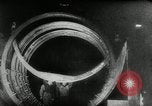
Production of a German submarine at a factory in North Atlantic coast.
Ribs of submarine being put into place. Plates being welded onto ribs. Conning tower being attached to hull. Conning towers on production line. Diesel engine on production line. Lathe making cut. Diesel engine being assembled. German submarine being slid down ways for launching ceremony. German submarine on trial run in North Atlantic. Skipper of German submarine. German submarine steps in sea.
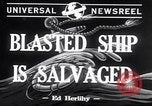
Newsreel 'Blasted ship is salvaged'
A damaged American merchant ship seen in the Atlantic Coast. The ship is split in two. Smoke seen rising up from the ship. Men are seen standing on the ship. Salvage of the damaged ship. The ship was sunk by a mine or a torpedo.