


 Francais
 Deutsch
 Italiano
Refine Your Search
+"Atlantic Ocean" +1918 stock footage and images
- Showing 19 to 24 of 39 results more
more Hide
Hide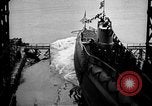
A mix of submarines from World War I to 1925
Sequence 1; The launching of the USS V-1 (later Barracuda SS-163) on July 17, 1924 from the Portsmouth Naval Shipyard in Kittery, Maine. Sequence 2; Two surrendered German U-Boats, most likely the U-117 (L) and the UB-148 (R) circa 1918/19. Sequence 3; The USS S-19 circa 1925 either looking to moor or pulling away to sea. Sequence 4; U.S. "L" class submarines ay Bantry Bay, Queenstown, Ireland circa 1918 World War 1, American submarines had to place an "A" before there name to avoid confusion with the British "L" class submarines. L to R are L-11 (bow), L-1, L-10, L-4 and L-9.
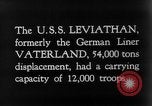
U.S. Navy troop transport operations in New York and New Jersey in World War I
The SS Leviathan, the largest ocean liner afloat, (former German ocean liner Vaterland, seized and renamed by the U.S. Government in 1917, as America entered World War 1). Tug boats assist the three-stacker Leviathan as she enters New York harbor. Tug boats working with another troop ship (two-stacker) in the harbor. Ferry boat in background. A sleek troop transport ship with two slanted stacks and rakish lines, accentuated by camouflage, in a New Jersey harbor.Two Navy troop ships underway with an airplane flying overhead. A column of U.S. Navy troop transport ships underway in the Atlantic ocean. A barrage balloon is seen overhead.

Scenes from WW1 include Woodrow Wilson, Franklin Roosevelt, troop deployment, munitions factory, ship building, WWI battle, and Armistice Day.
A title reading “1917”. An American ship sinks down in the Atlantic Ocean after it was torpedoed by a German U-Boat during World War I. United States President Woodrow Wilson signs the United States declaration of war on Germany. President Woodrow Wilson at work in his desk. A United States soldier blows a trumpet. United States soldiers crowd the deck of a ship sailing to Europe during WWI. The American Expeditionary Forces are waving as the ship sails away from the port. Franklin Roosevelt during World War I. American troops disembark from their ships after arriving in Europe. American women working in military supply factory. Women manufacture bullets using hand drills. A woman assembles munitions. Men building battleships at shipyard assembly line. Allied soldiers running in the battlefield to avoid being hit or bombed by the Germans. Bombs explode in the battlefield in Europe during World War I. Soldiers avoid bombs. A railway gun fires. An biplane falls in smoke after being hit. Explosion from tank in battlefield. Soldier rolls down to a trench. Explosion beside a rolling tank. A German soldier ducks in trench. An Allied soldier fires from a trench. A soldier behind him throws a grenade. Soldier with machine gun ducks from a trench. Tank rolls and fires in battlefield. Black explosion in battlefield. Soldiers run and avoid explosions. German soldiers fire a machine gun and throw grenades. Surrendered German prisoner soldiers march out as prisoners-of-war. American soldiers celebrate Armistice Day. View of the United States flag. Allied soldiers march in victory through ruined city. Americans celebrate Allied victory in World War I, filling with crowds in New York City. Americans hold banner saying, “Germany Surrenders”. Celebrating Americans in New York City, hold American flags and their hats triumphantly after Allied Victory in World War I.
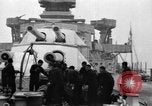
Montage of scenes involving U.S. Battleships in the World War I era
First scene shows foredeck and bridge of USS New York (BB-34) in World War 1. Second scene shows U.S. New Mexico-class Battleship underway. In the next scene, a sailor is signaling with a blinker from the bridge of a battleship ( Pennsylvania or New Mexico). Line of battleships in formation with the USS Texas (BB-35) leading. Quarterdeck view of U.S. Navy Pennsylvania-class battleship. View from deck of the battleship USS Texas or USS New York, looking forward. The final scene is a view from the quarterdeck of the battleship USS Pennsylvania (BB-38) looking out toward the SS George Washington (ID Number 3018) as they travel to France with President Woodrow Wilson on board in December 1918, for the Paris Peace Conference.
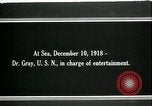
Entertainment on the USS George Washington leaving for the Paris Peace Conference.
Fun and entertainment on USS George Washington for the U.S. delegates leaving for the Paris Peace Conference. Dr. L.H.Gray, in-charge of the entertainment group seen addressing the crowd. Passengers climb onto various parts of the ship to watch the boxing and wrestling bouts. Boxers seen boxing in the ring. (World War I; World War 1; WWI; WW1)
President Woodrow Wilson with Admiral Grayson on their trip to France for the Paris Peace Conference.
President Woodrow Wilson seen with his personal physician, Navy Rear Admiral, Dr. Cary T. Grayson, on the bridge of USS George Washington . They are on their trip to France for the Paris Peace Conference, shortly after the end of World War 1.