


 Francais
 Deutsch
 Italiano
Refine Your Search
+"Atlantic Ocean" +1927 stock footage and images
- Showing 7 to 10 of 10 results more
more Hide
Hide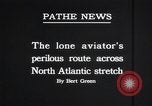
Charles A Lindbergh's route from New York to Paris across the North Atlantic stretch
Charles Lindbergh flies from New York to Paris. A map shows Lindbergh's route from New York to Paris across The Atlantic Ocean. Depicts his time of departure from New York and time of arrival in Paris.
Charles Augustus Lindbergh welcomed by huge crowd in New York
Crowd and fleet of small crafts at harbor in New York. Colonel Charles Lindbergh welcomed by huge crowd in streets of New York City. Confetti and ticker tape showered down the canyons of Lower Manhattan in New York during parade for the famous pilot to celebrate his solo flight across the Atlantic Ocean. Throngs cheer Charles Lindbergh.
Bad weather forces woman pilot Frances Grayson to abandon her third attempt to fly to Denmark; she returns to Old Orchard Maine
Sikorsky S-36 amphibious aircraft parked at beach in Maine. Crowd surrounds aircraft named "Dawn". Aircraft in flight over Atlantic Ocean after take off from beach. Sikorsky S-36 amphibian aircraft the "Dawn" then seen returning and landing on water back again at Old Orchard after shortened 500 mile flight due to weather. Men on beach direct aircraft. Female pilot Frances Wilson Grayson (niece of President Woodrow Wilson) exits aircraft after bad weather forces the aviatrix to abandon her third attempt to fly to Denmark. Close up view of Frances Grayson. (Grayson was flying together with pilot Wilmer Stultz and navigator Brice Goldsborough.)

Charles Lindbergh takes off from Roosevelt Field for his famous solo flight from New York to Paris.
People gathered early on a misty morning at Roosevelt Field, Long Island, New York, to watch as Charles Lindbergh attempts to make a solo flight across the Atlantic Ocean in his airplane, The Spirit of St. Louis. The plane starts its takeoff role between groups of spectators, raising dust. The spectators move to get a better view as the plane continues, out of sight in the fog and mist. It is not clear where the plane is, although engine sound has changed. Spectators strain to see it through the mist. Then, some cheers are raised when the crowd realizes that Lindbergh has successfully taken off in his heavily laden airplane. The opening caption refers to Curtiss Field, where the Spirit of St. Louis was test flown and reportedly maintained in Hanger 16. there, from May 12th through the 20th. However, for the Paris flight, the plane was towed a mile to Roosevelt Field where, heavily loaded with fuel, it could take advantage of the longer runway for takeoff. (Note: Both fields were originally part of the old Hempstead Plains Field renamed Hazlehurst Field when taken over by the U.S. Army in 1917. U.S. Geological survey maps of 1918 show three areas named, respectively, Hazelhurst Aviation Field No. 1; Aviation Field No. 2; and Camp Albert L. Mills, abutting it. Field No. 2 was renamed Mitchel Field on July 16, 1918. The eastern part of Field No. 1 was dedicated as Roosevelt Field, on September 24, 1918. After the war, the western part of Field No. 1 became known as Curtiss Field, associated, as it was, with the Curtiss Aeroplane & Motor Company located there.)