


 Francais
 Deutsch
 Italiano
Refine Your Search
+"Atlantic Ocean" +1943 stock footage and images
- Showing 25 to 30 of 55 results more
more Hide
Hide
USS Frament (DE-677) is refueled from a U.S. Navy tanker ship during shakedown cruise
Destroyer Escort USS Frament (DE-677) during shakedown cruise in the Atlantic Ocean.It undertakes refueling from a U.S. Navy tanker ship while they are both underway. Sailors aboard the Frament and the tanker, set up fuel lines between the two, and the refueling operation commences.
One Auxiliary Motor Minesweeper is equipped at dock while another is underway in the ocean.
Mine sweeping training off the coast of Norfolk, Virginia. United States Navy Auxiliary Motor Minesweepers (YNS) underway in the Atlantic off the coast of Norfolk, Virginia. Bow of YNS with men on deck. Equipment loaded onto YNS. Another YNS underway in the Atlantic Ocean.
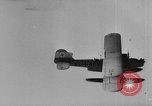
Nazi twin-engined amphibian biplane bombers drop bombs on submarine
Naval combat in European Theater during World War II. Two German twin-engined amphibian biplane torpedo bombers in flight over the Atlantic Ocean during World War II. A submarine is sighted, underway on the surface. On board a bomber, a crewman pulls up a lever and bombs are released from the plane. Bombs destroy the submarine.
German U boat fires deck guns at Allied ship during World War II. Submarine crash dives and survives depth charge attack
German submarine on surface, shoots Allied freighter with its deck gun,in the Atlantic Ocean.German submarine underway on surface. Crew sees Allied freighter and mans deck gun. They fire and hit freighter, which billows smoke and starts to sink. Alarm is sounded. Crew rushes down the hatch as submarine crash dives. View of engine room in submarine and other compartments, as depth charges explode around it. Crew operates manual pumps and secures compartments as water rushes into the submarine. After the danger has past, the submarine surfaces and the Captain climbs on deck.
U.S. Army Air Force pilots fly P-40 airplanes off the USS Ranger, to captured Vichy French airport in Morocco during World War II
Seventy five U.S. Army Curtiss P-40L airplanes are ferried across the Atlantic Ocean to within flying range of Morocco, North Africa, by the Aircraft Carrier, USS Ranger (CV-4), during World War 2. U.S. Army Air Force pilots prepare to fly the P-40s to the former Vichy French Anfa Airport near Casablance, captured by the Allies in Operation Torch. The Army pilots and support personnel are seen being briefed on the flight deck. Navy deck crews help move a P-40 into position. USAAF 57th Fighter Group commander, Colonel Frank H. Mears shakes hands with a navy officer from the cockpit of his P-40. Carrier officer seen signaling for take off. Colonel Mears takes off. More P-40s follow. Navy officers and sailors watch the departing P-40s and give thumbs up for approval. The P-40s buzz the carrier as they form up to depart.
U.S. Signal Corps officers and soldiers use mine detectors, modern radars, and meteorological equipment during World War II.
The role and contribution of the U.S. Army Signal Corps in combat and war. U.S. shuttle ships loaded with signal communication supplies for U.S. and Allied troops in the European Theater make their way in the Atlantic ocean. The Squier Laboratory at Camp Alfred Vail in Fort Monmouth, New Jersey. A technician works on signal communication equipment in the laboratory. U.S. soldiers use mine detectors in the European Theater during World War II. The mine detectors detect metallic, non-metallic mines, wooden box mines, and mines in glass containers. Artillery soldiers bury large microphones into the ground in advance zones. The microphones relay back information on enemy artillery. Soldiers receive the information on radio sets. U.S. aircraft on a training flight simulating real combat situation: The aircraft lost in heavy rain and rough weather, looking for the location of Boston. The pilot switches on a modern advanced radar. The radar waves pierce thick clouds, are reflected by Earth's surface and display an image on the scope. The image shows the clear location of Boston harbor directly under the aircraft. U.S. bombers attack over the Channel coast on D-Day (6 June, 1944). U.S. soldiers employ meteorological equipment for long range weather forecast in the European Theater during World War II. Soldiers release a hydrogen balloon into the sky. Another soldier uses an apparatus to take readings of atmospheric conditions behind enemy lines. An aircraft drops an automatic weather station called SCM-18-TI by parachute into enemy territory. The timed mechanism sends out weather data in codes. The interior of the automatic weather station lying open in a field.