


 Francais
 Deutsch
 Italiano
Refine Your Search
+"Atlantic Ocean" +1953 stock footage and images
- Showing 1 to 6 of 9 results
United States Navy helicopter lands on the flight deck of USS Mississippi (AG-128) in Atlantic Ocean.
Guided Missile Terrier for the USS Mississippi (AG-128) in Atlantic Ocean. Sailor with green flag waves a helicopter in and it lands on the flight deck of USS Mississippi (AG-128). It is a HUP-2 of Helicopter Utility Squadron (HU-2) (nicknamed the "Atlantic Fleet Angels," under the command of CAPT. Richard S. Roberts from 1953-1955). Partial view of another HUP-2 helicopter in foreground. United States Navy helicopter lands on the flight deck of USS Mississippi. Admiral Robert Bostwick Carney gets into a helicopter. USS Wisconsin (BB-64) underway. A helicopter airborne in foreground. Side view of USS Wisconsin and bow.
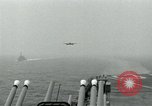
British Royal Navy Supermarine Attacker F1 aircraft practice touch and go landings on the angled deck of the USS Antietam (CVA-36) in 1953.
British Royal Navy Supermarine Attacker F1 aircraft is seen approaching to land on the U.S. Aircraft Carrier, USS Antietam (CVA-36) during British Navy practice carrier operations using her angled flight deck, in 1953. Anti-aircraft guns on the Antietam are seen in foreground. The aircraft bounces upon touchdown and immediately continues in a touch and go landing. Another (or the same) Supermarine aircraft repeats a similar touch and go landing. A third British Attacker aircraft approaches to land, but rounds out too high and simply goes around. The next one seen executes a perfect touch and go but the one behind it fails to "touch" before continuing, as does the next one trying a touch and go. The next one makes a smooth touch down before proceeding to go. The final scene shows a Supermarine Attacker F1 aircraft touching down and staying there, in a full stop landing employing arresting gear.
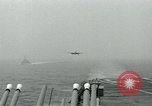
British Royal Navy Supermarine Attacker F1 aircraft makes arrested landing on the angled deck of the USS Antietam (CVA-36) in 1953. Several Hawker Seahawk planes shoot touch and go landings on the Antietam
British Royal Navy practice carrier operations aboard the United States aircraft carrier USS Antietam (CVA-36) in 1953. A Supermarine Attacker F1 aircraft lands on angled deck of the Antietam employing arresting gear. Several British Royal Navy Hawker Seahawk aircraft make repeated touch and go landings (10) on the Antietam. The last Seahawk plane makes an arrested landing.
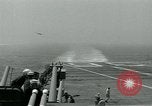
British Royal Navy aircraft operating aboard the United States aircraft carrier Antietam in Atlantic Ocean.
British Royal Navy de Havilland Vampire jet aircraft makes an arrested landing on the American Aircraft Carrier, USS Antietam (CVA-36). Sailors clear the arresting gear and surround the aircraft momentarily. Next, the aircraft is seen ready for takeoff. The aircraft tilts forward as the pilot applies power, holding the brakes. Upon signal from Carrier Yellow Shirt crew member, the pilot releases his brakes and commences his takeoff roll. Brief view of British Naval officers conversing on the deck of the USS Antietam.
British Royal Navy Vampire aircraft makes arrested landing and then commences take off roll from the U.S. aircraft carrier Antietam (CV-36) during practice operations in 1953.
British Royal Navy de Havilland Vampire jet aircraft makes an arrested landing on the short angled deck of the American Aircraft Carrier, USS Antietam (CVA-36). Once the arresting gear is removed, a large group of sailors push on the wings of the aircraft to move it backwards into position for takeoff. The jet maneuvers slightly on the deck, then the pilot sets its engine to max power holding brakes and then releases them to begin a takeoff roll.

People in the English colonies led by George Washington moving against the English Army during the American Revolutionary War.
The history of the United States. A pictorial map shows the path followed by Christopher Columbus in 1492 across the Atlantic Ocean. He found a group of islands where other explorers from Spain, Portugal, Netherlands, England, Italy and France found two continents. The representation of the area in the northern continent over which the English and the French fought and the French were defeated. The French gave up their colonies and in 1763 they belonged to England. People in the English colonies at work. English officials during a meet. The workers rebelling against English troops. Farmers, who became soldiers, moving with guns. The army led by George Washington moving against the English Army. The thirteen colonies of the English became independent, during the American Revolution, leading to the birth of American nation.