


 Francais
 Deutsch
 Italiano
Refine Your Search
+"Augsburg Germany" +1945 stock footage and images
- Showing 1 to 4 of 4 results
Bombed Berghof residence; German leaders surrender to Allies; stolen art collection retrieved after German defeat.
Ruins of Hitler's Berghof residence in Berchtesgaden after bombing by Allied forces near the end of World War 2 in Europe. Goering's stolen collection of paintings and art pieces taken from all over Europe. The stolen collection was hidden in air raid shelters and loaded on battle trains. View of U.S. soldiers retrieving the stolen works of art. Book 'Mein Kampf' written by Adolf Hitler in Landsberg prison. Portrait of Adolf Hitler with a Nazi symbol. German military officials including General Herman Gred Von Runstedt, Field Marshal Albert Kesselring, and Hermann Goering surrender to the American Army. Views of Hermann Göring after having been flown from Austria to U.S. Army headquarters in Augsburg, Germany on May 9, 1945, where he is seen handing over his handgun. Göring talking to U.S. 7th Army officials.
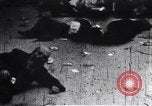
Atrocities committed by Nazis against Jews in Germany, submitted as evidence "Exhibit USA-280" during the Nuremberg Trials
Portions of a damaged film. Excerpted from original shown during the Nuremburg trials and submitted as "Exhibit USA 280." Nuremberg trial transcripts of 13 December, 1945 include the following excerpted descriptions of the footage spoken by U.S. Commander William J. Donovan: "This is a strip of motion pictures taken, we believe, by a member of the S.S., and captured by the United States military forces in an S.S. barracks near Augsburg, Germany...We have not been able to establish beyond doubt in which area these films were made...The film offers undeniable evidence, made by Germans themselves, of almost incredible brutality to Jewish people in the custody of the Nazis, including German military units. It is believed by the prosecution that the scene is the extermination of a ghetto by Gestapo agents, assisted by military units...This film was made on an eight millimetre home camera...The pictures obviously were taken by an amateur photographer...it is burned...This is a silent film....I wish to...direct the Tribunal's attention to certain of the scenes. Scene 2: A naked girl running across the courtyard. Scene 3: An older woman being pushed past the camera, and a man in S.S. uniform standing at the right of the scene. Scene 5: A man with a skull-cap and a woman are manhandled. Scene 14: A half naked woman runs out of the crowd. Scene 15: Another half-naked woman runs through the house. Scene 16: Two men drag an old man out. Scene 18: A man in German military uniform, with his back to the camera, watches. Scene 24: A general shot of the street, showing fallen bodies and naked women running. Scene 32: A shot of the street, showing five fallen bodies. Scene 37: A man with a bleeding head is hit again. Scene 39: A soldier in German military uniform, with a rifle, stands by as a crowd concentrates on a man coming out of the house. Scene 44: A soldier with a rifle, in German military uniform, walks past a woman clinging to a torn blouse. Scene 45: A woman is dragged by her hair across the street.
U.S. 7th Army Commander General Alexander Patch talks to French officials liberated by his unit in Augsburg, Germany.
Former French officials in Augsburg, Germany after their liberation towards the end of World War II. Exteriors of a building shows U.S. 7th Army Commander General Alexander Patch talking to French officials liberated by his unit. The group includes French Generals Maxime Weygand and Maurice Gamelin, French politician Paul Reynaud, former French Prime Minister Édouard Daladier and Madame Caillan who is the sister of French General Charles de Gaulle.
United States ambassador to France, Jefferson Caffery arrives in Augsburg Germany, received by Lieutenant General Patch (WW2)
United States Ambassador to France Jefferson Caffery arrives in Augsburg, Germany during World War II. A C-47 plane of the United States Army Air Force lands on a runway strip. Jefferson Caffery descends from the plane. He is greeted by Lieutenant General Alexander M. Patch at the airfield. They sit in their cars.