


 Francais
 Deutsch
 Italiano
Refine Your Search
+"Austria" +1916 stock footage and images
- Showing 7 to 12 of 15 results more
more Hide
Hide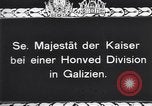
Kaiser Karl I of Austria, reviews troops of the Royal Hungarian Honved Division in Galicia during World War I
Kaiser Karl I reviews troops of the Royal Hungarian Honved Division in Galicia, Austria-Hungary, during World War 1.. Troops stand in formation. The Kaiser talks to a soldier. Soldier also replies. The Kaiser turns back to another soldier and salutes. (WWI; WW1)
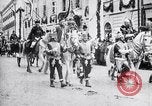
Coronation parade for Emperor Karl I of Austria, being crowned Karl IV of Hungary
Coronation parade of Emperor Karl I of Austria, who is also being crowned as Karl IV of Hungary. ( As Emperor of Austria-Hungary he holds both titles) Procession passes on the street in Budapest. Emperor Karl is seen riding a large white horse. Royal horse guards parade with the Emperor. Officials, and nobles in traditional dress, take part in the parade
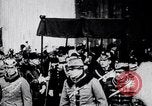
Coronation of Emperor Karl IV (Charles IV) of Austria-Hungary
Coronation procession of Emperor Karl I (Charles I) of Austria, who, as Emperor of Austria-Hungary, is now also being crowned Karl V (Charles IV) of Hungary. The procession arrives at Mathias Cathedral (Mátyás Templom Budapest, Szentháromság tér 2, 1014 Hungary) on Holy Trinity Square, Budapest, Hungary. Guests arrive to attend the ceremony. Through the dense crowd, Emperor Karl walks behind the Crucifer toward the Cathedral entrance, followed by Cardinal Prince Primate of Hungary János Csernoch, a Bishop, and nobles. After the coronation, a great celebratory parade ensues. The Emperor rides on horseback wearing the Crown and cloak of St. Stephen, and rides up a ramp to a landing where he can be seen by all in attendance.
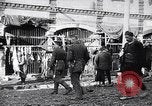
Bulgarian and Austria-Hungarian troops in Skopje (Skopie) during World War I.
The Macedonian front during World War I. Street scene with merchant stalls that shows various nationalities, including Turks, and soldiers of Bulgaria and Austria-Hungary in Scopje, Macedonia during World war 1. Row of shops displaying wares, including butcher shop. Scene shifts to what slate describes as a new neighborhood district. Seen is the old stone bridge (Kameni Most) over the Vardar River in the city center, where local people are seen in everyday pursuits, moving wagons and carrying bundles on the street and over the bridge. Soldiers cluster around a striped booth at the foot of the bridge. Another scene shows troops entering a camp area along a river. Some are digging trenches. Smoke rises from camp fires. Wagons of military supplies being pulled by horses and oxen and gathering at a railroad siding (box cars in background). A staff car drives into the area, displaying a German flag on its hood and the German Eagle crest on its door. It skids about momentarily in the mud. Supplies being loaded into the railroad box cars under supervision of German officers. Troops marching into an encampment, where others are being served food from a German field kitchen. Rifles are stacked in a large mound. Soldiers line up and appear to be receiving their pay at a paymaster window in a building. Troops in full field gear march, in a loose column, out of the encampment. German infantry in pointed helmets (Pickelhauben) marching, out of camp, through mud toward the front lines.
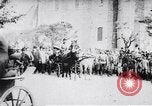
Emperor (Kaiser) Karl I and Empress Zita, of Austria, ride in a carriage and greet people in Gyongyos (Heves County), Hungary
Emperor Karl I (Charles I) of Austria-Hungary and wife Empress Zita ride in a carriage and greet people in Gyongyos (Heves County) in Hungary. Emperor Karl I waves from carriage. Horse-drawn carriage proceeds slowly as numerous soldiers and citizens surround it on three sides and accompany it.
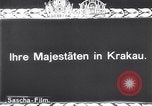
Her Majesty, Empress Zita, of Austria, visiting Krakau (Krakow) Poland, during World War I
Crowd surrounds carriage, as Empress Zita of Austria steps into it to depart during her visit to Krakau (Krakow) Poland, where a Regiment of the Austro-Hungarian army was headquartered during World War 1. Flags fly in the area. The Empress's carriage is drawn by a pair of matched white horses. (WWI; WW1)