


 Francais
 Deutsch
 Italiano
Refine Your Search
+"Berlin Germany" +1919 stock footage and images
- Showing 1 to 6 of 27 results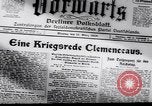
View from Berlin Germany, of events leading up to, and subsequent to, the Armistice in World War I.
Succession of Berlin, Germany, newspapers shown, from 1918 through 1919, chronicling progress of war towards the World War 1 Armistice, and subsequent problems and conditions in postwar Germany. Newspaper of November 12, 1918 addresses concerns about the conditions and the price of the truce. Crowd stands on a road covered with snow around statue of the Kaiser, with scaffold around it. Crowd in a square in War Bond rally. One of crowd carries a Communist red flag. Newspaper refers to gunfire in Berlin from Unter den Linden to Friedrichstrasse. Newspaper announces the Kaiser's abdication, which is then illustrated by reversed footage showing the Kaiser walking backwards and being lifted into his automobile, which then drives away backwards. Returning German soldiers are happy to see the war end, and sing in their returning trucks. An officer inspects war trenches that are now empty. Newspaper announce increasing domestic problems . Newspapers raise issue of German prisoners of War held in foreign countries. Troops are seen moving in streets and at checkpoints in Germany.
Post War unrest in Germany following World War I. Martial law is declared. Artillery and soldiers in Berlin, Germany.
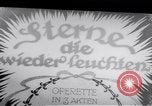
Clip opens with scene from a play in Berlin entitled: The Star Shines Again. German officer stands on a stage and gives speech. Following street scenes and newspaper headlines illustrate the increasingly desperate conditions developing in postwar Germany following World War 1, culminating in declaration of martial law by the Ministry of Defense. Scenes of civil unrest and use of martial force to control the population during the German Revolution of 1918-1919. German soldiers and artillery in the streets work to control unrest of German citizens. Massive crowd of German citizens running and dispersing in panic on streets of Berlin. Newspaper headlines describe the unrest.
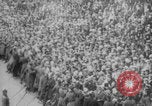
The Spartacist uprising (Spartakusaufstand), also known as the January uprising (Januaraufstand), Berlin, Germany
The Spartacist uprising (Spartakusaufstand), also known as the January uprising (Januaraufstand) in January, 1919 in Berlin. Aerial view of crowds running in a plaza. People engage in street fighting and damaging cars. A truck full of soldiers arrives at the scene. German soldiers patrolling street. Barricades on the street. German soldiers on lookout as men clear barricades. Men carry the body of a dead man, possibly Karl Liebknecht, in a bedsheet. German soldier behind street barrel barricade. Crowd walks on sidewalk at Alexander Str. behind barbed wire.
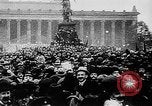
Montage of scenes from immediate Post-World War I Germany and into the 1930s
A crowd of Gernan civilians is seen gathered in front of the Alte Nationalgalerie in Berlin, Germany. Glimpses of Leaders, of the German Communist Spartacus League, including Rosa Luxemburg. Scenes of unrest during the Spartacist uprising (Spartakusaufstand) in January, 1919. Scenes of post-World War poverty, hardship and deprivation for German citizens during time of hyperinflation, with German people shown living in improvised housing, cooking outdoors, scavenging for coal. A sign is displayed for the Winterhilfswerk (WHW) Winter Relief program run in the 1930s by the Nationalsozialistische Volkswohlfahrt (National Socialist People's Welfare). It states its aim against Hunger and Cold (Gegen Hunger u Kalte). Uniformed persons with swastika arm bands, including Joseph Goebbels, and Hermann Goering, of the National Socialist German Workers' Party (Nazi Party), are seen surrounded by enthusiastic German citizens. Closeup of hot meal being dispensed and people eating. A sign in the background refers to the People's Welfare Program. People gathered in an outdoor food dispensing station, under a banner reading: "Berlin isst heute sein eintopfgericht" (Berlin is eating its stew today). Another glimpse of hot food being ladled into a dish. Adolf Hitler stands and gives a haranguing speech from a table where Nazi party members are seated. A banner on the front of a steam locomotive announces Winter Aid donation related to East Hannover (Winterhilfe Spende gau Ost-Hannover). Another sign refers to the 1936-1937 Winter Relief program (WHW) donation related to East Hannover (Gau Ost-Hannover Gifhorn W.H.W. Spende). Railroad train box cars are seen transporting contributions, from various places in Germany, to the program.
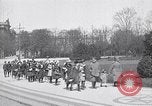
People and school children walk at Brandenburg Gate in Berlin, Germany, demonstrating against the terms of the Treaty of Versailles
School children and teachers demonstrate against the Treaty of Versailles peace terms in Berlin, Germany. A group of women and children walks on path. School children walk, in-line from the Brandenburg Gate (Brandenburger Tor, Pariser Platz, 10117 Berlin, Germany). People walk in sidewalks of the Unter den Linden boulevard. Some vehicles pass through the Brandenburg Gate. The Victory column (Platz der Republik 10557 Berlin, Germany), then located in its former location in the Königsplatz (now the Platz der Republik), can be seen in the background from Pariser Platz.
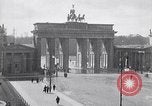
People at Brandenburg Gate in Berlin, Germany.
People walk at Brandenburg Gate in Berlin, Germany. People walk on pathway along road at gate. Two men walk on road. Vehicles pass through the Brandenburg Gate (Brandenburger Tor, Pariser Platz, 10117 Berlin, Germany). The Victory column (Platz der Republik 10557 Berlin, Germany), then located in its former location in the Königsplatz (now the Platz der Republik), can be seen in the background.