


 Francais
 Deutsch
 Italiano
Refine Your Search
+"Berlin Germany" +1945 stock footage and images
- Showing 229 to 234 of 243 results more
more Hide
Hide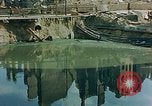
Reflection of bomb damage in the water of a polluted canal in Berlin.
Bomb damage in Berlin after World War II. The reflection of bomb damage in water of a polluted canal. The canal is in the heart of Berlin. Ruins of building all around.
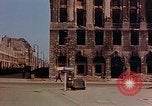
Unter den Linden shows heavy bomb damages in Berlin after World War II.
Bomb damage in Berlin after World War II. Unter den Linden boulevard shows bomb damage to buildings all along the street, as seen in point of view shots from a slowly moving vehicle. Ruins of buildings. Rubble on the streets .

United States P-47 Thunderbolt plane strafes town and a tank and ammunition carrier
Destroyed infrastructure in Berlin during World War II. United States P-47 Thunderbolt plane dives in to strafe a town. U.S. P-47 strafes tank and ammunition carrier. Burning vehicles and town. U.S. P-47s strafes town. Mountains in the background.
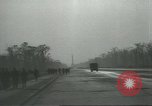
Berlin under Soviet Occupation at end of World War 2
Group of U.S. soldiers wave American flag to stop a U.S. Military Police jeep. A Sergeant gets out of the jeep and greets the GIs. He then gives each of them a carton of cigarettes. Remainder of the scenes show Soviet occupation forces and Berliners subject to Soviet authority. A Soviet woman soldier directing traffic. Russian soldiers pose for pictures in front of the Victory Column in Berlin. View of the golden winged victory statue on top of the column. Three pillars displaying pictures of Stalin and two other Soviet leaders. Soviet soldiers walking near the Brandenburg Gate. Several quiet streets. Elderly German citizens sitting on a bench in front of a granite memorial to Kaiser Wilhelm I. A street filled with destroyed cars, broken buildings and rubble everywhere. Several German citizens struggle to move a laden wooden wagon. A Russian woman soldier directs traffic. Local citizens queue up for water. They read a paper posted with a message from the Supreme Commander of the Armed Forces of the Soviet Union. A line of citizens passing bricks to help with rebuilding.
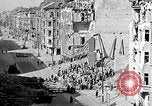
Berliners work together to clean up streets and sidewalks of their city at the end of World War II in Europe
In Berlin, at the end of World War 2, in Europe, a large group of ordinary people gather at a hill of debris where a building once stood. Men and Women use shovels to dig dirt from sidewalk and place it in buckets, that others pass up the hill, in a bucket brigade. Closeup of people filling the buckets at the base of the pile of debris. The bucket brigade consists mostly of women. They transfer the filled buckets up the hill and empty ones down via a separate group of volunteers. The buckets are emptied at the top of the heap. Some women transfer large fragments of concrete to one another. The entire project seems intended to clear more space in the sidewalks and streets. View from a high point reveals skeletons of tall buildings and other groups doing similar work to clear rubble from the city walks and roads.
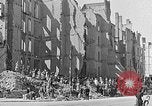
Citizens of Berlin (mostly women) form bucket brigades to clean up streets and sidewalks of their city at the end of World War II in Europe
At the end of World War 2, in Europe, citizens of Berlin (mostly women) cooperate in a bucket brigade to clear rubble from their walks and streets. Lacking any machinery, they use shovels to fill buckets and pass them up the hill of debris at the base of bombed out buildings. A train passes below damaged roadway where camera is located. Camera pans to the cleanup site, where dozens of people are occupied. Closup of a man using a mason's hammer to break concrete slabs so they can be moved by hand. Women inside the walls of a demolished building, where they empty the buckets and throw the concrete slabs.