


 Francais
 Deutsch
 Italiano
Refine Your Search
+"Berlin Germany" +1953 stock footage and images
- Showing 1 to 6 of 29 results
Damaged Italian consulate building in Berlin, Germany during the uprising in 1953.
Damaged buildings in Berlin, Germany. Wreckage of former Italian consulate at Margareten Strasse during the uprising of 1953. A sign in German. Other damaged buildings.
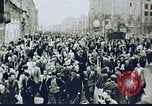
Strikes and demonstrations on 16 and 17 June, 1953 in East Berlin by East German workers.
People on strikes and demonstrations in East Berlin, Germany. Also called the Uprising of 1953 in East Germany. People standing on top of buildings. Buildings and radio tower of RIAS (American Radio Station in Western Sector of Berlin) which was spreading news of the workers general strike. Motorcars pass by. East German demonstrators throw things into fire protesting excessive work schedules. People watch fire. Flames of fire. Sign at the border of East and West Berlin, warning "You are leaving the American Sector." More scenes of the protests in East Berlin, from other news sources. Rioters throw east German police uniforms out of a window toward a crowd. Soviet Russian Soviet army tanks and troops enter the areas of unrest. At TC: 01:48, two protestors are seen sliding an iron pipe into the tread of a tank. East German Leader, Walter Ulbricht at a podium, backed by a huge replica of a white dove, and, elswhere, standing with associates. East German communist organizations, including police, marching in attempts to dispel notions that East Germans are oppressed. Huge poster of German worker rejecting American Marshall Plan, with slogan, "Yankee Go Home." Light tank and armored car parked beside a building. Closeup of soldier gripping machine gun atop a tank. Army trucks and troops in center of a city square. Voice of America commentator broadcasting news of the events from the RIAS station in West Berlin.
East German women being airlifted by a British European Airways aircraft in Berlin, Germany.
An Allied airlift in West Berlin, Germany. British European Airways office at Berlin Tempelhof Airport. Women refugees from East Germany sign flight papers. Refugee women in a waiting room as they look at an aircraft. Two women smiling. The women board a British airplane (G-AMSR). A clerk marks a British European Airways bulletin board listing the number of refugees who left the area on March 8th, 1953.
Scenes of Berlin divided by newly built Berlin Wall; Unrest in the years after division into East and West Berlin, Germany
The divided city of Berlin, Germany caused by the erection of the Berlin Wall. Shows early scenes of the Berlin Wall being built. Opening scene shows camera pan from Brandenburg Gate down to street level where East German construction workers are using a jack hammer and hand digging a trench across the middle of the street to serve as foundation for the Berlin Wall. A Soviet guard watches over the construction workers. East Germans and Soviet Russians walking with a spool of razor wire, putting up barbed wire barricades along other sections of the dividing border. German citizens gathered along the wall as it is built in a field area. Several young men in suits being pushed and harassed by a guard on the East German side of the Berlin Wall. View of a railroad train track that has been cut, and workers digging a deep trench at the site to build the wall right through the run of railroad track. East German refugees walking through a checkpoint area, desperate to leave east Germany before total closure of the border occurred. Refugees gathered in crowded shelters with mattresses on the ground. Young German children and babies sleeping on mats. Views of barbed wire crossing railroad track runs. Animated map showing routing of aircraft for the Berlin Airlift in response to the Berlin Blockade by the Soviet Union in 1948. Views of various aircraft flying overhead, bringing supplies to citizens during the blockade. Relief supplies and food being unloaded at airport for citizens. People waving white handkerchiefs in the air to express thanks as a Berlin Airlift airplane passes overhead. Scene changes to 1953 riots on the streets of East Berlin, Germany, with crowds of protestors throwing rocks at a Soviet tank and views of a building on fire with smoke pouring from its windows. Next scenes show West Berlin scenes as a juxtoposition of the East Germany scenes. Views of successful German industry and commerce in West Berlin. People working in West Berlin. Newly built tall buildings in West Berlin. German people shop in stores. A boy adds a bar of chocolate to a shopping basket. Men working in large industrial plants and factories. Large Siemens equipment in use in an electrical transmission component factory. A scientist or engineer looking through a microscope like device.
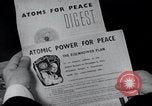
Voice of America broadcasts President's speech and USIS "Atoms for Peace" exhibits are presented worldwide
President Eisenhower of the United States addresses United Nations on December 8, 1953 about atomic bomb and atomic weapon dilemma in the nuclear age (part of Atoms for Peace initiative). Operators in radio transmission control rooms note down readings. View of time clocks of various places in the world including Honolulu, New York, London, Moscow, Calcutta, Bangkok and Tokyo displayed. The Voice of America broadcasts program in different languages by announcers. Scene of a family sitting in a living room as they listen to the president's speech on a console radio. People work at typing, printing, and translating the speech. USIA motion pictures service prepare newsreel of president's speech. A man views air mail of USIA films. Exterior views of several different United States embassy buildings worldwide. A guard standing outside the building. A Public Affairs Officer at the U.S. embassy in Japan, in Tokyo, meets with U.S. Ambassador to Japan Robert Murphy. USIA members seated around table for meeting, and, in Washington DC, creating publications about the Atoms for Peace program. People seated in a USIA library in Brazil read books and various USIA materials. Architects design 30 foot high Atoms for Peace exhibits. An exhibit being setup in a foreign country (possibly in North Africa). Exterior and interior views of the West Berlin, Germany Atoms for Peace exhibit. Prime Minister Jawahar Lal Nehru in India is seen arriving in a jeep to view the Atoms for Peace exhibit in India. Prime Minister Nehru inside the exhibit hall watching a presentation. In Japan, a woman operates remote-controlled robotic hands to hold radioactive materials, at a demonstration for Japanese citizens. In a city in Italy, a view of a mobile van unit carrying an Atoms for Peace exhibit. Scenes from a film "A is for Atom" that was translated into 30 languages and shown all over the world. Wide view of the Kremlin in Moscow, Russia, Soviet Union. A Russian radio commentator speaking at a microphone. Propaganda dramatization showing the Russian announcer attacking American plans for Atoms for Peace.
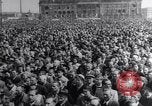
Status of Berlin during growing separation of East Berlin and West Berlin in 1961.
Rally of communists and youth in East Berlin. Small socialist flag on table. A boy reads during a rally. Historical view of parade by German soldiers in 1930's Berlin Germany. Russian tanks repel people on streets during anti-Communist protest of 1953. Aerial view of Brandenburg Gate area and refugees fleeing in thousands from East Berlin to West Berlin. Revitalized West Berlin, with new construction. A building in construction and another new building seen. Modern stores with show windows displaying abundant goods including cameras and foods. People at a a busy food or deli counter and in sidewalk cafes and restaurants. Busy streets of West Berlin with early 1960s automobiles. Enduring flame monument in West Berlin Inscription on the pedestal reads 'Freiheit Recht Freide' meaning Freedom, Rights, Peace. At a conference with allies including Britain in 1960 Soviet Premier Nikita Khrushchev walks down steps and gets into car. British Prime Minister Harold MacMillan with others walks down steps. Animated Khrushchev addresses gathering in Russian, forcefully and defiantly. MacMillan responds encouraging peaceful negotiations and no force. Newly elected Mayor Willy Brandt of West Berlin addresses people. United States President John F Kennedy with Premier Khrushchev, Secretary of State Dean Rusk and others at meeting in Vienna Austria. British flag at Headquarters of Berlin British Sector. Military police jeep stops near a sign. Soldier looks through binoculars at East West border of Berlin before Berlin Wall was substantial. During free elections in West Berlin people put their vote in ballot box. Box opened and counting of votes progresses. People see results on board. Nearly empty streets of East Berlin. Destroyed buildings of East Berlin still not repaired after World War II. The Spittelmarkt area, formerly a busy shopping market, now deserted and desolate. Mayor Brandt meets refugees and speaks over the microphone.