


 Francais
 Deutsch
 Italiano
Refine Your Search
+"Burma" +1944 stock footage and images
- Showing 13 to 18 of 178 results more
more Hide
Hide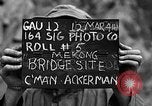
A roadway which leads to Mekong Bridge and U.S. soldiers in a jeep on Burma road in Burma.
Mekong Bridge in Burma during World War II. Huge mountains in the background. Views of the Mekong River. A roadway which leads to Mekong Bridge. Several U.S. soldiers in a jeep on Burma road.
Soldiers of U.S. 475th Infantry cook flapjacks on trench spades in Burma during the Burma Campaign of World War II.
U.S. 475th Infantry in Tali, Burma during the Burma Campaign of World War II. U.S. soldiers in a jungle. They cook flapjacks on trench spades. A soldier eats using a spoon.
OSS Morale Operations led by American in Burma for psychological warfare to demoralize the Japanese troops.
OSS (Office of Strategic Services) film on Project Gold Dust gives details of the psychological warfare techniques used by OSS Morale Operations (MO) Unit and Kachin guerrillas in Burma during World War II to demoralize Japanese troops obstructing linkage to Burma and the Ledo Road. Kachin guerrillas including North Burmese killer tribesmen prepare for an operation. They are recruited, trained and led by an American officer. MO Detachment 101 troops. Burmese load shells, guns and artillery. 1st Field team of MO OSS personnel joins Detachment 101. An aircraft lands. The guerrillas board the aircraft and are transported all over Burma. Development of MO. A message from an American officer commanding a company of Kachin comes for Major Boldt. The message is dispatched to the Major and a distribution officer delivers it to the chief. A Production and Intelligence officer works. They discuss strategy about MO material best suited to reach the Japanese. The MO intelligence officer contacts Detachment 101 research and analysis branch. They discuss the accuracy and details of the operation. They go to interrogate a Japanese 18th Division soldier held prisoner. MO and the distribution officer discuss the strategy. Radio Major Haan consults Kachin. A detailed report is prepared and given to a pilot for dispatch. The message is given to Major Boldt. The MO staff at work. A lieutenant interrogates Japanese prisoners and gains their cooperation. The MO discusses Project Gold Dust. A forged surrender order to be given to Japanese. Production of the leaflets of forged order. Press prints the leaflets in the mobile production van. The leaflets are cut, dispatched and packaged. Burmese plant the forged order in a town. A lieutenant reads a report on the spread rumor. He talks to an Anglo Burmese woman. The rumor is spread in the town. Burma Jungle 101 patrol distributes the leaflets. A carrier pigeon for Major Boldt is sent. An aircraft arrives to pick up the prisoners who have surrendered.
The inspection of Chinese troops by the President of China Chiang Kai-shek in Burma during World War II.
China's President Chiang Kai-shek inspects the Chinese troops in Burma during World War II. Soldiers march on a street. An aircraft takes off. China's leader and United Nation's Supreme Commander for South East Asia Chiang Kai-shek along with his wife Soong May-Ling and General Mountbatten inspects Chinese troops in Burma. President Chiang and General Mountbatten looks through binoculars. The President of China Chiang Kai-shek and his wife in an American jeep along with other officials to inspect China's Army mobilizing for attack. The soldiers march. President Chiang addresses the soldiers. An American aircraft supplies the guns and ammunition via parachute to the Chinese soldiers fighting in the jungles of Burma against the Japanese soldiers. Chinese soldiers in jungle with their weapons. The soldiers attack their enemies. The heroes of the Burma's battles receiving medals from U.S. Army General Joseph Warren Stilwell.
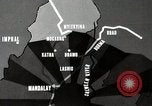
American and Chinese forces advance and capture Japanese held Bhamo in Burma, during World War II
Animated map shows American and Chinese forces advancing from Myitkyina to Bhamo, while British forces move to Mogamng to Katha, in Burma during the India-China-Burma campaign of World War 2. Mandalay, Lashio, the Burma Road, and Salween River are also shown on the map. Chinese troops are seen with pack animals moving along road marked by sign reading: "Bhamo Road." Chinese and American troops cross the Irrawaddy River by Pontoon bridge. A heavier item (M3 Lee medium tank) moves via a raft. M3 tanks also cross at affordable locations. Advancing troops move to extreme sides of road for security. Aerial view of Bhamo, on river's edge. Allies employ artillery and U.S. Army Air Forces P-39 Bell Air Cobra planes drop bombs. A Republic P-47 airplane is also seen dropping bombs. Chinese troops fire Browning M1917 machine guns and automatic rifles, as they advance upon the town. Another aerial view of smoke rising at various places in Bhamo. Lieutenant General Daniel Isom Sultan, Commander India-Burma theater, speaks about subsequent advance to the Ledo Road.
Colonel Seagrave's medical unit gives treatment to wounded soldiers in Northern Burma.
Activities of Colonel Seagrave's medical unit in Northern Burma. Animated map shows Northern Burma. Dr. Gordon S. Seagrave, The Burma Surgeon performs an outdoor operation. Wounded soldiers and casualties are moved out by Burmese nurses for treatment. Doctors operate on injured people. Chinese medical personnel take training at American center for Chinese Army in India and they operate. (World War II period).