


 Francais
 Deutsch
 Italiano
Refine Your Search
+"California USA" +1945 stock footage and images
- Showing 1 to 6 of 22 results more
more Hide
Hide
City views of San Francisco; United Nations Conference on International Organization held in San Francisco, California (WW2)
A documentary on The United Nations Conference on International Organization that continued from April 25, 1945 to June 26, 1945 in San Francisco. A plane in flight and ships are seen in San Francisco Bay. 1940s San Francisco city views: Aerial views of Golden Gate Bridge. People on streets on San Francisco, with streetcars, buildings, pedestrians, and mid 1940's cars seen. Aircraft parked at a USAF Base as delegates from 50 countries arrive. Delegates like Jan Christian Smuts from South Africa, Vyacheslav Molotov from Russia, U.S. secretary of State Edward Stettinius arrive in San Francisco. Delegates register for the conference. United States flag on a building. Interior of the War Memorial Opera House serving as the initial meeting hall. Delegates seated. U.S. President Harry S. Truman addressing the general assembly remotely, as delegates listen through radio speakers in the opera house. Narrator recalls words of Franklin Roosevelt and recorded audio of Roosevelt is heard where he urges continuation of the work first begun by the defunct League of Nations. View of various working committees and smaller groups of the organization meeting during the Spring of 1945. Representatives debate and review concepts initiated at the Dumbarton Oaks conference in Washington DC in 1944 during World War II. Delegates addressing those assembled and signing documents that create the United Nations.
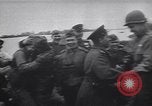
End of World War II and signing of UN charter in San Francisco, United States
United States and Soviet Union soldiers celebrate their victory as world War 2 comes to an end in Germany. "Elbe Day": Soviet and American soldiers meet at the River Elbe on 25-26 April, 1945. View of Nazi swastika being blown up at Zeppelinfeld in Nuremberg Germany in 1945. Scenes of celebration in the streets of Paris with French civilians cheering American and French soldiers and celebrating the end of World War 2. French women kiss soldiers. Crowd gathered in Times Square in New York celebrating VE-Day (Victory in Europe Day). Foreign Ministers of fifty nations arrive at San Francisco to sign the United Nations Charter. United States President Harry S. Truman addresses the delegates at the closing ceremony of the conference on June 26, 1946. Ships bring American soldiers back home, including some wounded, after World War 2. Women and families on dock at harbor wave and smile at arriving troop ship with American soldiers returning home. Also seen are soldiers of other countries including Soviet Russian soldiers returning to their families at a train station, with smiling and tearful family reunions. Cemeteries with headstones honoring soldiers who died in the war. Military hardware being scrapped to make peacetime goods. Views of explosive charges being set and military aircraft being blown up for scrap. Piles of scrapped military vehicles. A woman in a factory organizes newly manufactured clothes irons. Workers in a factory perform final assembly on newly manufactured ovens and stoves for homes.
Organization of United Nations being defined at United Nations Conference on International Organization in San Francisco
Animated charts of United Nations Organization as determined by delegates of 50 countries working at the UN Conference on International Organization held in the spring of 1945 in San Francisco. Delegates from different countries attend meeting, can also be seen in conversation. Delegates and officials in San Francisco art gallery, observing Norman Rockwell's four freedom paintings. United Nations Relief and Rehabilitation administration (UNRRA) supplies being loaded aboard a ship in San Francisco.
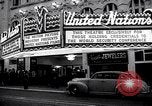
Delegates of United Nations Conference watch motion picture on surrender of Germany and work toward defining UN Charter.
Exterior of a United Nations theater in San Francisco, with movie theater marquee indicating its use exclusively for pass holders attending the United Nations Conference on International Organization. Inside the Delegates of United Nations conference gather during the 2nd week of the conference to watch footage of the German surrender at Reims, signed by General Alfred Jodl. Projectionist and movie projector in booth of theater are shown. View of men and women in movie theater watching movie, including an elevated side view of people watching the movie, and views of the theater screen and movie playing, with backs of heads of people in foreground. Delegates talking and attend meeting in San Francisco, California as they continue work leading toward defining the UN Charter and founding the United Nations organization. Footage from the San Francisco Conference vote, chaired by Anthony Eden of Great Britain, approving the Charter of the United Nations on June 26, 1945
Judge Louis E. Goodman dismisses Justice Department's civil action to denaturalize ILWU President, Harry Bridgers.
Opening scene shows dimly lit hallway of Federal District Court building in San Francisco. Camera focuses on a courtroom door inscribed as " U.S. District Court, 258, Louis E. Goodman." Officials are seen escorting International Longshoreman's Union (ILWU) President, Harry Bridgers, along a hallway, accompanied by many photographers. Bridger's lawyer, Carol Weiss King and her co-counsel, wearing dark rimmed glasses, are seen standing in the hallway. Closeup of them. He holds up a copy of legal papers. View from further down the hall as Bridgers stops briefly to converse with them. Another closeup of Bridger's lawyers. (Note: Harry Bridgers was prosecuted for his labor organizing and supposed subversive status by the Justice Department in the 1930s, 1940s, and 1950s, with the goal of deportation. This was never achieved. Bridges became a naturalized citizen in 1945. A final effort by the Justice Dept. to deport Bridges ended in 1955 when Judge Louis E. Goodman dismissed the department's civil action to denaturalize him)
President Harry S. Truman reads prepared speech after dropping of atomic bomb on Hiroshima Japan during World War 2.
U.S. President Harry S. Truman delivers a speech following the dropping of the atomic bomb on Hiroshima, Japan, during World War II. U.S. President Harry S. Truman seated at desk in cabin of a ship. He reads prepared speech stating that a single American aircraft dropped one atomic bomb on Hiroshima and destroyed its usefulness to the enemy. He reminds listeners that the Japanese began the war from the air at Pearl Harbor. He speaks about the U.S. Armed Forces and the production of atomic bombs in the United States. The President states that the U.S. is now prepared to completely destroy every productive enterprise of Japan, by bombing Japanese docks, factories, and communications. Truman states that the U.S. shall completely destroy Japan's power to make war. President Truman notes that acceptance of the Ultimatum of July 26th issued at Potsdam, could have saved the Japanese people much suffering. But it was rejected by Japan's leaders. He states that the U.S. have spent more than two billion dollars on the greatest scientific gamble in history and have won. This is due to the greatest achievement of organized science in history.