


 Francais
 Deutsch
 Italiano
Refine Your Search
+"California United States USA" +1961 stock footage and images
- Showing 1 to 6 of 21 results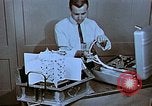
Launch of Systems Nuclear Auxiliary Power 9A generator after successful tests.
Technicians work at AEC (Atomic Energy Commission) facility on SNAP (Systems Nuclear Auxiliary Power) generators to be launched in June and November months of year 1961. Design of SNAP generator is explained and shows generators at a pole and carried by a rocket in space. SNAP 9A modified by an added AC-DC converter. AEC personnel in fields to test missile launch effects of SNAP 9A. Simulated missile explosions are carried out to check if fuel capsule can withstand fire and explosions. After successful tests, SNAP 9A is launched from Vandenberg Air Force Base in California.
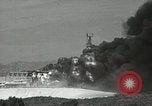
Atlas missile 27E launches and blows up at Vandenberg Air Force Base, California.
Atlas missile 27E launches at Vandenberg Air Force Base, California. Missile blows up soon after its launch. Fire and black smoke rises from the explosion.
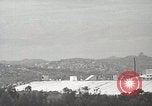
Atlas missile 27E launches with huge explosion on the ground at Vandenberg Air Force Base, California.
Atlas missile 27E launches at Vandenberg Air Force Base, California. Missile ready for the launch. It falls with a large explosion on the ground. Fire and black smoke rises from the explosion.
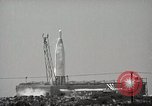
Atlas missile 27E explodes soon after its launch at Vandenberg Air Force Base, California.
Atlas missile 27E launches at Vandenberg Air Force Base, California. View of Atlas 27E ready to launch. Large explosion on the ground soon after its launch. Fire and black smoke rises from the explosion. (Note: This was the ninth E-series Atlas launched and the first from the West Coast. The missile suffered combustion instability in one booster engine, the resultant asymmetrical thrust causing it to tip over and explode on impact with the silo wall. OSTF-1 suffered extensive damage and did not host another launch for nine months.)
Atlas missile 27E ready to launch from a launch pad at Vandenberg Air Force Base, California.
Atlas missile 27E launches at Vandenberg Air Force Base, California. View of a launch pad and Atlas 27E ready to launch.

U.S. Air Force Boeing B-52 carrying a X-15 rocket-powered aircraft of the National Aeronautics and Space Administration (NASA)
United States Boeing B-52 Stratofortress takes off from Edwards Air Force Base. The B-52 carries X-15 rocket-powered aircraft. The X-15 rocket-powered aircraft releases. X-15 aircraft in flight reaching 2,905 MPH. The X-15 landing on the dried lake bed at Edwards Air Force Base. Pilot, Major Bob White, seen climbing out of the cockpit of the X-15, and talking to NASA officials.