


 Francais
 Deutsch
 Italiano
Refine Your Search
+"Cape Canaveral Florida USA" +1959 stock footage and images
- Showing 19 to 23 of 23 results
Gantry crane rolls away from Atlas Missile at 5C at Cape Canaveral, Florida.
Man focuses light on gantry crane with Atlas Missile 5C in it at Cape Canaveral, Florida. Crane rolls away leaving the Missile on launch pad. Atlas Missile ready to launch.
Technicians standing in gantry crane work on Atlas Missile 5C, at Cape Canaveral, Florida.
Technicians standing on ground watch Atlas Missile 5C, at Cape Canaveral, Florida. Men in gantry crane compartments work on the missile. The crane rolls away from Atlas Missile. View of tip and base of the Missile.
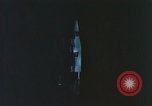
Failed nighttime suborbital test of ICBM Atlas D missile at Cape Canaveral Air Force Station, Florida
Atlas D missile 7D is seen, at night, on pad LC-14 At Cape Canaveral Air Force Station, Florida, ready for a suborbital test. Camera tracks it through lift off and through thin cloud layer. At TC: 00:54, screen goes dark. At TC: 01:02, camera picks up rocket flame again, as it passes through some cloud. The missile seems to be falling at this time. At TC: 01: 47, it explodes in a fireball and disappears. (Note: Reportedly, this launch failed due to a malfunction of one of the hold-down arms on LC-14 which damaged plumbing in the missile and allowed helium pressure gas to escape during ascent. The common bulkhead between the propellant tanks collapsed after the pressure difference between them became too great. Also notable because the Mercury astronauts were invited to watch the launch.)

Maiden flight of America's Intercontinental Ballistic Missile Titan I at Cape Canaveral, Florida.
Maiden flight of the first Titan I missile at Cape Canaveral, Florida. America's Intercontinental Ballistic Missile (ICBM) at the launch pad. Engineers and scientists make the readings. The 90 foot,2 stage ICBM being launched. Large cloud of smoke and gases around the missile. Missile moves into the space. Smoke trail seen.
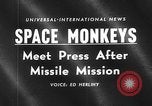
Successful space tour of two monkeys Able and Baker aboard the nosecone of the Jupiter Missile from Cape Canaveral, Florida.
The Monkeys Able and Baker's tour to outer space from Cape Canaveral, Florida. Rhesus monkey Able and Squirrel monkey Baker in the space suits. Scientists place the monkeys aboard the nosecone of the Jupiter missile. Scientists make the preparation and the missile is launched. The monkeys travel for 300 miles in space. The nose cone is recovered at sea. Monkeys are taken out of the cone. A press conference organized at the headquarters of NASA for the space monkeys.