


 Francais
 Deutsch
 Italiano
Refine Your Search
+"China" +1938 stock footage and images
- Showing 55 to 60 of 63 results more
more Hide
Hide
Japanese invasion of Shandong province during the Sino-Japanese War
Railroad train cars carrying Republic of China (ROC) troops arrive at a railroad station, likely in Jinan, in Shandong province during the Sino-Japanese war. ROC troops alight in the railroad station. Japanese planes fly over Shandong, also known as Shantung. Chinese soldiers and civilians run towards safety. Civilians evacuate from Japanese attack. A wounded Chinese man lying in road. Injured Chinese men walk on the street. Chinese soldier pulls out a shell from artillery. Chinese nuns and nurses tend to patients’ injuries. Chinese soldiers run through bombed streets and buildings in Shandong.

Canton conquest by Japanese during the Second Sino-Japanese War
Japanese conquest of Canton (Guangzhou), China in the Second Sino-Japanese War. Imperial Japanese Army (IJA) soldiers march past destroyed building. Japanese soldiers find a small hot spring pool. Two Japanese soldiers share a hot spring bath together. One of the soldiers is wearing a hachimaki headband.

Women soldiers in Chinese Army.
Wreckage and rubble after the Japanese air raid on Canton (Guangzhou), China during the Second Sino-Japanese War. Chinese women soldiers move up a pile of rubble and march to the war front. They climb up a hill and fire at Japanese positions. Girls assembled as an officer instructs them.
Bombing of Chungking (Chongqing) by Japanese during the Sino-Japanese War
Japanese bomb the city of Chungking (Chongqing), China during the Sino-Japanese War. Bombs from fall in Chungking. Firefighters spray water into Chungking’s burning buildings. Chungking houses and streets on fire after Japanese bombing. Firemen extinguish fires in Chungking.

Japan's possible shortages of material for clothing in World War 2. Japanese domestic production of cotton, wool, and silk
Illustrated discussion of Japan's limitations in natural resources prior to World War II. Workers shown in textile mills which employed more than half of Japan's factory workers prior to the war, satisfying domestic and export needs. Analysis of the natural resources. Cotton thread is rolled on the spindles in the Textile mills in Japan. Textile mills produce fabric in Japan. Japanese women work in the textile mills. Bales of raw cotton imported from Japanese possessions in Korea and Formosa, and from the United States,India, Brazil and China. They are transported via horse carts and manually pushed on small rail carts to storage buildings for stockpiling. People cultivating some of the small amount of cotton grown in Japan. Horses and cattle used to pull plows in rice paddies. Pigs used as scavengers. Woolen fabric is produced from wool. Some of Japan's very few sheep being sheared for wool. Women working in fields of mulberry trees where silk worms flourish on their leaves. Views of the silk being spun onto spindles in a factory. Silk fabrics being stacked. Illustrated summary highlights Japanese domestic shortages of cotton, wool, and leather needed for clothing.
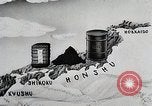
Japanese natural resources related to Second Sino-Japanese war and World War II
Animated map illustrating shortage of indigenous raw materials in Japan. As stockpiles vanish during Second Sino-Japanese war, Japan's domestic sources supply only 10% of the nation's needs for war. Animated sequence shows lack of steel, aluminum, copper, and power generation for the conduct of war. But one of the nation's greatest resources is the population of skilled Japanese workers, who are shown at various high tech jobs, as well as on the farms and in the fishing industry. Japanese workers are seen who work for the Zaibatsu (four ruling families of Japan). Banks of Japanese women typists and women in a factory. Young women painting faces on a "Kewpie doll." A Japanese family at dinner time. Women engaged in fabric spinning. Animated graphic illustrates Japan's war-related resources for World War 2, by showing a Japanese soldier standing astride map of Japan with lines extending to sources of needed raw materials from Japanese possessions in Korea, Manchuria,Formosa, China,Indochina,Malaya, and its network of Pacific Islands. Final scene displays copy of Los Angeles Times newspaper with headline reading: "Jap Supply Lines Blasted." It also features a story that appears to refer to the U.S. 6th Army invasion of Leyte in the Philippines, in October, 1944 (when General MacArthur waded ashore and stated,"I have returned"). (Note: Although produced during World War 2, this film shows prewar scenes of Japan. The animated illustrations and maps and, of course, the newspaper shown at the end, date from World War II.)