


 Francais
 Deutsch
 Italiano
Refine Your Search
+"China" +1941 stock footage and images
- Showing 61 to 66 of 70 results more
more Hide
Hide
U.S. propaganda film depicts Japanese people and culture, and describes early diplomacy efforts with Japan (WW2)
A United States World War II propaganda film depicts Japanese psychology and living habits. Japanese mythology explains the origin of the Imperial Family. Japanese people celebrate the 2600th anniversary of mythological founding of Japan in 1940. Men, women, and children parade with Japanese flags. A man wearing Sendaihira hakama formal wear leads crowd chanting. A huge crowd gathers for the celebration. United States Secretary of State Cordell Hull visits Japan. Secretary Hull arrives in a conference to discuss about peace in the Pacific Theater. U.S. President Franklin Roosevelt speaks about the diplomatic efforts to maintain peace in the Pacific Theater. President Roosevelt seated on a ship with General Douglas MacArthur on one side and Admiral Chester Nimitz on the other. Japanese Ambassador Kichisaburō Nomura hands a document to Ambassador Hull after the attack on the Pearl Harbor had begun one hour earlier (unbeknownst to the meeting attendees). The document states the Japanese Government's wish to continue negotiations for peace. Scenic views in Japan. Japanese people on bridge in a scenic garden. A Japanese man carries his son on his back. Japanese women wearing kimonos hold parasols. A woman tucks her child to sleep. Japanese soldiers in China committing atrocities against Chinese civilians. Shovel scoops up soil to bury dead Chinese civilians. Two men shot at point blank range. Bodies of slain Chinese children seen following attacks. Japanese general disembarks from a plane and salutes. “We must know them as they are.” the narrator reminds audience.
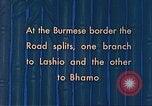
A split in the Burma Road with one branch leading to Lashio and other to Bhamo in Burma.
The Burma Road, a vital link between Lashio, Burma and Kunming, China during World War II. Animated map shows a split in the Burma Road on the Burmese border with one branch leading to Lashio and other to Bhamo in Burma. A bridge over a river. Burmese laborers pull carts loaded with supply crates at a rail road station in Lashio.

Chinese officials inspect the ruins of the Intercontinental Company near the Burma Road in Bhamo, Burma during World War II.
The Burma Road, a vital link between Lashio, Burma and Kunming, China during World War II. Chinese officers walk down the stairs of a building. Mr. Chen and other Chinese officials inspect ruins on the way to Bhamo, Burma soon after the bombing of the Intercontinental Company by the enemy. The officials examine a wrecked plane. The bombing interrupts the traffic on the Burma Road. Chinese laborers repair the Burma Road after the bombings. Cars and trucks move along the Burma Road. Animated map of the Burma Road highlights Bhamo in Burma.

Everyday life and diversity of Polynesian people in Hawaii before the attack on Pearl Harbor during World War II.
Various Polynesian people and everyday life in Hawaiian Islands before American involvement in World War 2 and the attack on Pearl Harbor. Women from dominant ethnic backgrounds in Hawaii introduce themselves, including women from Korea, Portugal / Portuguese, China, Phillipines / Filipino, Native Hawaiian, Caucasian / Anglo, Japanese. Narrator describes it as a melting pot. Polynesian children on a long staircase in a village. Group of Hawaiian school children walking to school with some girls wearing Japanese style clog sandals. Diverse crowd of citizens walking on sidewalks of a downtown area of Honolulu near stores and shops. Hawaiian police officer directs traffic. 1930's cars seen on streets. Children in scout uniforms including Girl Scout and Boy Scouts salute. Groups of Hawaiian children playing and relaxing, and seen at desks in school classroom. Graduation ceremony at a high school in Hawaii as graduate young men and women walk by on a stage. Colorful traditions and customs of various cultures in Hawaii are shown. People wearing leis. Women doing various dances including hula and other dancing styles. The Aloha Tower in Honolulu Harbor and scenes of various women from different backgrounds each saying Aloha.
Allied ships arrive at Chinese coast for supply of weapons and equipment during World War II.
A promotional documentary justifying Japanese involvement in World War II. Allied ships arrive at Chinese coast for delivery of weapons and equipment. Flags on the ships.
Japanese troops and tanks advance on a Chinese territory during World War II.
A promotional documentary justifying Japanese involvement in World War II. Japanese cavalary, infantry, and tanks advance in Chinese territory. Formation of Japanese aircraft in flight.