


 Francais
 Deutsch
 Italiano

Refine Your Search
+"China" +1945 stock footage and images
- Showing 67 to 72 of 139 results more
 Hide

Japanese surrender at Tsing-Tao in China (WW2)
United States Military Police stand at a race track during Japanese surrender at Tsing-Tao in China during World War II. People seated in Grandstand. Houses on a hill in the background. Troops stand in formation. Jeeps in line with the troops. Crew stands in front of M 4 tanks. Documents marked 'Act of Surrender' lay on tables with pens and paper weights made from cartridges. Major General Shepherd of 6th Division of U.S. Marine Corps. Japanese General signs a document.
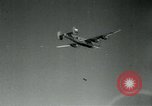
B-24 bombers of U.S. Army Air Force drop bombs on enemy positions, at China-Burma-India Theater in World War II.
U.S. Army Air Force combat operation in China-Burma-India Theater during World War II. B-24 bombers of the U.S. Army Air Force flying above enemy positions drop bombs on them. Bomb falls towards its target leaving smoke trail behind. Explosion and smoke on the ground. Planes among clouds. Each plane has a unique identification number.
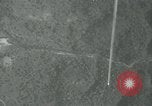
Dropped bomb from U.S. Army Air Force hits and explodes enemy positions, in China-Burma-India Theater in World War II.
U.S. Army Air Force in action in China-Burma-India Theater during World War II. B-24 bombers of the U.S. Army Air Force drop bombs at enemy positions . Bomb drops towards its target leaving smoke trail behind. Explosion at the target railroad or a bridge among dense trees.
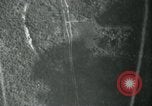
Array of smoke trails left by bombs dropped by the United States Army Air Force in China-Burma-India Theater in World War II.
U.S. Army Air Force attacks enemy railroads and bridges in China-Burma-India Theater during the World War II. Bombs dropped by the -24 bombers of the U.S. Air Force leave a smoke trail behind. An array of straight smoke trails left by the dropping bombs.
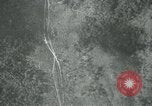
Railway track and road attacked by the U.S. Army Air Force in China-Burma-India Theater during World War II.
U.S. Army Air Force attacks enemy positions in China-Burma-India Theater during World War II. The target of the attacks is a railway track and a road running alongside each other. Bombs dropped in a sequence by the B-24 bombers of the U.S. Arnt Air Force leave smoke trail behind.

Key enemy positions and supply lines targeted and bombed by United States Army Air Force, China-Burma-India Theater
U.S. Army Air Force attacks enemy positions in China-Burma-India Theater during World War II. The target of the attacks are the railway tracks, roads and bridges built over a river which are the supply lines of the enemy forces. Bombs drop towards the target leaving a smoke trail behind them.