


 Francais
 Deutsch
 Italiano
Refine Your Search
+"China" +1954 stock footage and images
- Showing 25 to 30 of 38 results more
more Hide
Hide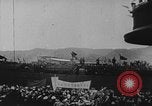
Liberated Chinese prisoners defecting to Taiwan arrive in Taipei from Korean prison camps.
Chinese prisoners, originally from Mainland People's Republic of China, are seen aboard U.S. Navy LST ships, including LST 616, as they reach Keelung harbor in Taiwan. They have been liberated from Korean prison camps and are part of a mass group of 14,000 Chinese soldiers defecting to Taiwan, Republic of China. Large crowd cheers on dock for the "anti-Communist Heroes." The crowd waves flags and carries banners. Band plays music. Chinese prisoners disembark from ship. They are greeted by General Chiang Ching-kuo and other Chinese officials. Prisoners march with flags. Men and women give a warm welcome to prisoners. Chinese officials speak at mike in auditorium. Prisoners lined up holding bouquet. Vice Minister of Foreign Affairs and other Chinese officials address men in auditorium. U.S. Major General, William C. Chase, Commanding General of the American Military Advisory Group on Taiwan, speaks to them. Chinese prisoner speaks on mike. Prisoners with clenched fists. American crew of ships which escorted Chinese prisoners to Taiwan presented with gifts. Chinese troops with flags march on streets of Taipei. They get on trucks. Crowd waves to leaving Chinese prisoners. Large crowd lined up on streets. Chinese girls in white clothes ride bicycles. Prisoners on trucks shake hands with people. Premier Chang Chun and other Chinese officials await the arrival of Chinese prisoners in Presidential mansion. Premier Chang Chun and other Chinese officials wave hats to arriving prisoners. Trucks on road. Crowd and children wave flags and cheer to welcome prisoners. Prisoners arrive to barracks on field.
Freed Chinese and Korean prisoners of war in trucks driving along streets of Seoul, Korea are cheered by a crowd.
Liberated Chinese and Korean prisoners arrive in South Korea after the Korean War. The group includes 14,000 former communist Chinese (People's Republic of China) soldiers who are defecting to Taiwan (Republic of China) and are welcomed as "anti-Communist Heroes." The liberated prisoners leave stockades of Neutral Nations Repatriation Commission. Freed prisoners carry flags and get into trucks which pass along streets of Seoul. A crowd cheers for the prisoners.
UN Secretary General Dag Hammarskjold meets Premier Zhou Enlai in Beijing to seek release of imprisoned airmen.
People’s Republic of China officials at an airfield. A DC-3 passenger aircraft taxis in and parks. United Nations Secretary General Dag Hammarskjold hurries down steps of the aircraft and is greeted by Chinese officials. Hammarskjold shakes hands with many of them, and then drives off in a car. The Secretary General is on a mission to secure the release of fifteen American fliers being held by the Chinese, who do not consider them Prisoners of War to be repatriated, following the Korean War. He is seen later at a dinner reception in a hall with many Chinese officials in attendance. Chinese Premier Zhou Enlai and Secretary General Hammarskjold spend considerable time conversing, with help of translator. They toast with several other officials and appear to have a relaxed and pleasant meeting.
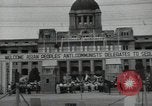
Asian Peoples Anti-Communist's meeting in Seoul, Korea.
'Welcome Asian Peoples Anti-Communists Delegates to Seoul' written on a building in Seoul, Korea. A large crowd of participants gathered. Children wave and clap. A girl presents flowers to Madam Chiang Kai-Shek. Delegates around a stage. The crowd cheers. A military band plays. Flags of Nationalist China and South Korea are seen in the crowd.

Director Streibert speaks on the purposes of the USIA and Soviet influence; scenes from a Soviet anti-American propaganda film
Theodore Cuyler Streibert , Director of the U.S. Information Agency, speaks on the purposes of the Agency (USIS). The Director seated at a table. He states that there is much misunderstanding about the United States, throughout the world, and Communist entities wish to take advantage of this to spread misinformation about the U.S. As the leading world power for peace, he says the U.S. must tell the world the truth about America. This is the mission of the USIA. A map portrays Soviet dominated areas within the so-called "iron curtain,"encompassing 800 million people. Another map illustrates targets of Communist propaganda employed to facilitate North Korea's aggression against South Korea. A graph illustrates propaganda spending by the Soviet Union and Communist China, primarily to spread misinformation about America. Segments of a Soviet propaganda film about the U.S. are shown. It begins with a map of the U.S. and then shows the Statue of Liberty. Camera pans over Manhattan, showing skyscrapers. A narrator disparages American commercialism, materialism and sensationalism. A lion is seen sitting in a convertible car, looking over a young woman's head. Next are scenes of an American beauty contest, and of women performing precision water skiing. Then an airplane is seen crashing on landing and a car is seen burning. View from trolley car moving along Broadway, from Times Square, in Manhattan, New York City, at night. A follies-style Broadway show. Show girls in bathing suits, walking past the camera. Show girls performing on stage. Another nighttime view of Times Square. Dogs being manicured by groomers. Outdoor soup kitchen scene from the Great Depression in the 1930s with unemployed men receiving food. Hobos or homeless men at a railroad siding. Milk and grain being spilled from containers during a labor and pricing dispute. Scenes of slum area tenement houses with wash drying on lines strung between the buildings. Men playing bocce ball in the yard of an apartment house. Camera pans up the Empire State Building from street level view. African American drummer with other band musicians performing in a civilian band, and scenes of African American musicians in a U.S. Army band. Poor African Americans in the South, at home and doing wash outdoors. Mounted police maintaining order in scenes of a fire and public protest or labor strife (circa 1935) interposed with views of the Statue of Liberty. A Soviet propaganda poster about the Korean War, shows an American soldier walking away from a dead Korean woman whose small child clings to her. Fires burn and a burning airplane falls from the sky in the background. A propaganda cartoon shows "warmongers of the west" being counterbalanced by a Soviet fist on a pair of scales.
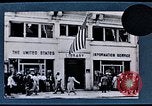
USIA film describing its Libraries and Cultural Centers abroad
Segment of U.S. Information Agency film describing its libraries and Cultural Centers that provide public information abroad. View of a USIA library displaying its name in English. Another USIA cultural center and library in Burma. Buddhist monks attend a lecture by the USIA. An Asian boy writing on desk. People assembled for lectures and discussions in such centers in various countries. Patrons surround a USIA traveling library in Burma. Visitors viewing displays in a USIA center. Chart showing USIA information centers closed by Communist Governments in Bulgaria, Romania, Czechoslovakia, USSR, China, Hungary, Poland. Map showing Hakodate, Japan, where 40,000 residents signed a petition to keep a USIA library open.