


 Francais
 Deutsch
 Italiano
Refine Your Search
+"Czechoslovakia" +1943 stock footage and images
- Showing 1 to 6 of 10 results more
more Hide
Hide
Analysis of the German labor force from 1939 to 1943 (WW2)
Analysis of the Germany's labor force, military strength and effects of World War II on manpower. German soldiers march. Men work in factory on equipment and machinery. Women work in factory. A cemetery of World War 1 soldiers in Germany. Narrator explains how loss of man power from world War 1 deaths, and subsequent lower birth rate leads to war production worker needs being filled by many young German women and even German boys and girls working in industrial factories also. Wounded German soldiers being treated in field during World War 2. A map points Germany, Sudetenland and Austria. Graphs examine labor force by sex, age and military replacement availability; compare the labor force according to sex from 1939-1943; detail the increase of work force through the women part time workers and the veterans. Women weld equipment in a factory. Men do mining work. Narrator speaks of foreign workers (such as from Poland, Netherlands, Czechoslovakia, Yugoslavia), and how some now serve "under economic pressure and compulsion" (as forced labor or slave labor). Views of forced labor crews working digging earthworks. Laborers also work on building or repairing railroad stations and track work. Lines of prisoners of war, also used for labor, walk under German guard as lines of German uniformed troops walk in the opposite direction. Graphs compare the labor force in agriculture, industry, trade services, transport and government.
Scenes of Czechoslovakia beginning in 1918 and gradually moving into the era of World War II
Close-up images of a slide projector as it is turned on and as its Kodak zoom lens moves forward. A picturesque Czech town is seen with numerous historic looking buildings. View of Červená Lhota (Red Village) Castle in South Bohemia. (It has bright red roof tiles, not seen in black and white photos.) A town square and buildings nearby, including one that appears to be a cathedral. A bucolic hillside scene with sheaves of wheat stacked in groups and a village in far background. Farmers moving loaded wagons with teams of oxen. Farming scenes. Local people gathered around a church building, in a rural setting. Closeups of several young girls with their heads covered. A priest conducting mass at a section of the church with altar and backdrop open to the outdoors. Many women are attending and most have their heads covered. Closeup of a woman drinking from a bottle and girls at a marketplace. Girls and a man dressed in traditional costumes. A couple in traditional costumes. Glimpse of bridge over the River Vitava in Prague, Czechoslovakia. Glimpse of isolated church spire in area near city. Pedestrians and horse-drawn carts and wagons moving over the Charles bridge in Prague. Woman with baby in carriage and other pedestrians walking past Statue of Francis Borgia. on the bridge. View from bridge overlooking Wenceslas Square and statue of St Wenceslas, Prague. A tram moves below. Time moves to 1937. Police directing traffic and pedestrians at a busy corner in Prague. People at a flower stall. Glimpse of Adolf Hitler and Hermann Goering. People boarding and riding on trams. Children holding bouquets of flowers. A heavy gun barrel being raised. A backyard with line of wash and children playing in the field. Year is now 1938. German soldiers move a large artillery piece into position on a road. Agreements being signed related to the German annexation of the Sudetenland, portion of Czechoslovakia containing Germans who were incorporated into Czechoslovakia after World War I ). German troops moving into the Sudetenland. Czechs and Germans signing Munich Agreement documents, German forces driving into a city. Hitler meeting with Czech officials. Hitler heading a group including Hermann Goering and other high ranking German officials, as they walk along a road in a Sudetenland city where citizens welcome them enthusiastically. Momentary glimpses of persons being mistreated. Sudden change of scene to persons posing, including some in concentration uniforms. Hitler being overwhelmed by flowers. Empty street scene with flowers discarded on the road. Year advances to 1942. Concentration camp inmates pose behind barbed wire. Year, 1943. A young Jewish woman is seen with Jewish Star of David and word "Juden" displayed on her jacket and the number 671 on a tag around her neck. Year advances to 1943-1944. View of inmates crammed into a concentration camp barracks room.

Allied forces prepare for D-Day, also known as 'Operation Overlord' (WW2)
'Eve of Battle' depicts the Allied invasion of Europe during World War II. Slave labor from Nazi Germany-invaded countries construct Atlantic Wall. German artillery and fortifications in the Atlantic Wall. Nazi German soldiers marching in groups. Nazi leader Adolf Hitler shake hands with Italian fascist leader Benito Mussolini. Allied leaders Franklin D. Roosevelt, Winston Churchill and Joseph Stalin sit together during the Tehran Conference in December 1943. Exiled Allied leaders such as General Charles de Gaulle of France, Queen Wilhelmina of the Netherlands and Dr. Edvard Beneš of Czechoslovakia inspect Allied troops. Various Allied troops from Poland, Norway, England, United States, and Czechoslovakia prepare to launch an invasion in France. Eisenhower along with other officers plans the European invasion. Allied ships and aircraft on their way to Europe. Allied bombers drop bombs over Nazi German U-boats. Naval battle begins and explosions occur, smoky docks. In England war supplies unloaded. Supplies include weapons, military equipment, and food. A tank and locomotive trains being loaded into a ship bound for Europe. Allied aircraft take off at night. A man directs an aircraft taking off. Allied bombers bombard German targets resulting into fiery flare in Europe. British children playing jump rope as a supply train pass by in the background. Tanks and fighter planes transported by train. Supply boxes unloaded and stacked for transport to the battle front.

Portion of Trial of Nazi war leaders during Nuremberg Trials in Nuremberg Germany. Audio only.
Audio only. Nazi war leaders on trial in Nuremberg Germany. Coverage on how the charges will be grouped. The speaker focuses on three major issues: international situations and aspirations for expansion of Germany between 1943-1945; conquering of Austria and Czechoslovakia, and improvement of military and political positions.
Life in Britain on eve of War. Chamberlain, Hitler and Mussolini signing the Munich Agreement during World War II.
An Allied propaganda film to solidify Anglo-American solidarity within the ranks as well as to counter Nazi propaganda aimed at weakening the alliance shows British soldiers in Great Britain during World War 2. 1938: in the United States New York Yankees win the pennant in baseball; scene of Yankees team members shaking hands. View of aviator Douglas Corrigan nicknamed Wrong Way Corrigan after his accidental flight from New York to Ireland instead of California as planned. View of trains on the 6th Avenue Elevated (or Sixth Avenue El) before that service was halted in Manhattan New York City. British citizens go about their daily life. Derby horse race in a stadium. A British boy and his father shovel dirt for a backyard garden. Players play a football (soccer) game at Wembley Stadium in England as spectators cheer the 1938 FA Cup Final with Preston North End taking the Cup versus Huddersfield Town as George Mutch scores the winning goal. Scenes in Germany: People cheer for German Chancellor Adolf Hitler and give Nazi salute. Newspaper headlines about Czech occupation. Graves in a cemetery. British Prime Minister Arthur Neville Chamberlain, Adolf Hitler Italian Prime Minister Benito Mussolini sign the Munich Agreement. Despite a peace agreement Hitler invades Czechoslovakia. People read 'Military Training Act, 1939'. British soldiers march along a road. View of Adolf Hitler smiling and laughing. Artillery is fired. A poster reads 'Britain Declares War on Germany'. Airplanes in flight and drop leaflets over Germany. German airplanes in flight. Parachutists jump from the airplanes. Hitler talks to officers and considers the war to be over. Radio news broadcast of the British declaration of war on Germany by Neville Chamberlain. Many different British citizens and families shown in living rooms and work places gathered around radios to listen to the so called "We shall fight on the beaches" speech of Winston Churchill on June 4, 1940. Clip includes scenes from 1938 through 1940; from a film produced in 1943.
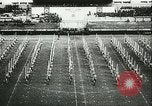
Nazi soldiers and civilians watch a gymnastic exhibition at a stadium in Prague, Czechoslovakia.
A gymnastic exhibition in Prague, Czechoslovakia. A large number of people gathered in a stadium. Men perform a drill with logs of wood. A Nazi officer watches the drill. German soldiers applaud. Athletes race down a track during a field and track event. Spectators cheer the participants. Men perform gymnastics on the field. (World War II period).