


 Francais
 Deutsch
 Italiano
Refine Your Search
+"Czechoslovakia" +1946 stock footage and images
- Showing 1 to 6 of 44 results more
more Hide
Hide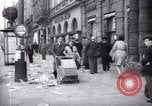
People in front of the Communist Party headquarters in Prague, Czechoslovak on the 1946 Parliamentary Election evening.
Election eve in Prague, Czechoslovakia. Pavements covered with election literature. Czech citizens voting on the election day. Several views of people reading results of the elections on posters placed in the streets. Facade of the Social Democratic Party Headquarters - number 3. Facade of the headquarters of the Communist Party - number 1 written on a large linen. A poster shows a child arising from a sickle and a hammer. A tramway decorated with the number 1 passes in front of the Communist Party headquarters and the oldest tower in Prague.
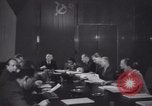
Communist Interior minister Václav Nosek speaks at the Comite Directeur meeting in Prague, Czechoslovakia.
Meeting of the Comite Directeur of the Communist party in Prague, Czechoslovakia held after the 1946 Parliamentary Elections. Communist Interior minister Václav Nosek speaks and exposes the political situation. Mr. Nosek talks to another member of the committee. Mr. Nosek talks while Prime Minister Klement Gottwald listens. Gottwald smokes and talks at a table.
Hungarian troops enter Uzhorod, Czechoslovakia after Hungary takes over the town as a result of the Munich Pact.
Hungary gains control over Uzhorod, Czechoslovakia after the First Vienna Award. Czech civilians load their belongings onto carriages and leave the town as they head towards the interiors of Czechoslovakia. Soldiers load equipment on to vehicles and move away on carts or on foot. Picture of Miklós Horthy, the Regent of Hungary. The Coat of Arms of the Kingdom of Hungary (1920–1946). Hungarian cavalry units enter the city.
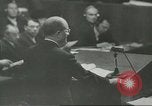
Munich agreement leading to invasion of Czechoslovakia by Germany signed under Adolf Hitler's rule
A memorandum expresses Adolf Hitler's desire to invade Czechoslovakia. Munich Pact discussed during the trial of Nazi leaders for war crimes in Nuremberg, Germany in 1946. Footage from 1938 as Adolf Hitler and other leaders from Britain, Italy and France sign Munich Agreement or Munich Pact that leads to annexation of Czechoslovakia by Nazi Germany. Czech President Emil Hacha arrives to meet the German leaders.
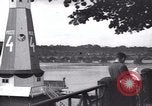
A poster of four political parties with their coat-of-arms on the Charles Bridge in Prague prior to parliamentary elections.
Election posters in Prague, Czechoslovakia prior to the 1946 Parliamentary Elections. A man reads a newspaper on a side of the Vltava River. On his left is a wooden tower with an election poster for the national-socialist party, urging vote. View of St. Vitus Cathedral (III. nádvoří 48/2, 119 01 Praha 1-Hradčany, Czechia). The Charles Bridge (Karlův most, 110 00 Praha 1, Czechia) with large posters. In the background is Rudolfinum Palace (Alšovo nábř. 79/12, 110 00 Staré město-Staré Město, Czechia). A tramway across the bridge. Posters with crossed words 'CHAOS' and 'TEROR' on the bridge. Passengers on the bridge. A large poster on which the four political parties with their coat-of-arms are united for the same purpose 'United in the War, United in the Peace'.
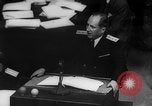
View of the Nazi Concentration Camps and its victims, and other atrocities committed by Nazi forces in World War 2.
Images and testimony related to the Nuremberg Trials held at the Palace of Justice in Nuremberg, Germany in October 1946. Flashbacks of a variety of Nazi crimes against humanity during the years of World War II. Reference to testimony of Kenaris and Hans Frank in describing Nazi policies and methods for exterminating Poles and others. Pictures recording the implementation and results of Nazi policies; atrocities and murder of victims in Ouradour Sur Glane in France, in Bande in Belgium, in the Catacombe of San Callisto in Italy and in Czechoslovakia. Nazi German soldiers seen leveling and destroying the town of Lidice in Czechoslovakia in 1942, after massacre of many residents, in retaliation for the assassination of SS Reich Protector Reinhard Heydrich. Corpses of the victims of the Nazi concentration camps, including Auschwitz, in 1945. Bones of humans in crematory ovens. Cramped starved women camp victims inside barracks. Stacks of luggage and suitcases of victims at a concentration camp, along with locks of hair, stacks of toothbrushes. Shaving cream brushes, shoes, clothing, and finally, piles of bones of camp victims. Testimony of Rudolf Franz Ferdinand Höss (sometimes spelled Höß or Hoess or Hess) describes concentration camps at Auschwitz in Poland. As scenes of victims in hospitals are shown, testimony of Rudolf Hoess is read, describing medical experiments include lowering the body temperature, injecting the body with poisons and infectious diseases and subjecting the body to high altitude pressure chambers. Shows pile of mutilated corpses.The "Arbeit Macht Frei" sign over the camp entrance of Auschwitz. Scenes of dead victims of Nazi brutality in the concentration camps.