


 Francais
 Deutsch
 Italiano
Refine Your Search
+"Dachau Germany" +1945 stock footage and images
- Showing 37 to 42 of 63 results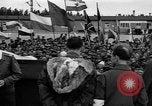
Captain David M. Eichhorn, Jewish chaplain of U.S. XV Corps, conducts services in Dachau, Germany.
First Jewish religious services on grounds of liberated Dachau Concentration Camp, Germany, late in World War 2. Captain David M. Eichhorn, Jewish chaplain of U.S. XV Corps, conducts services in Hebrew. People gather to listen to his speech. People stand holding flags.
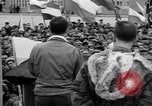
Captain David M. Eichhorn, Jewish chaplain of the U.S. XV Corps, addresses people during a ceremony in Dachau, Germany.
First Jewish religious services at liberated Dachau Concentration Camp, Germany, World War 2. Captain David M. Eichhorn, Jewish chaplain of the U.S. XV Corps, conducts services and addresses a crowd. People gather to listen to his speech. People stand holding flags.

Scenes at an Orphanage in Dachau, Germany, at end of World War II.
The time is at end of World War 2. Slate describes this film as the Orphanage at Dachau. A bucolic scene shows horse-drawn wagon moving along country road, with twin spires of a church, visible in the background. Camera zooms in on church spires and roof, and then to a sign near the door reading,"DP Childrens Center, UNRRA, Team 182." (DP means Displaced Persons, UNRRA stands for United Nations Relief and Rehabilitation Administration.) At the entrance, itself, a sign reads:"Ausländer Kinderstation, UNRRA, Ausschuss 182 (Foreign children's ward, UNRRA, committee 182). Children run down the stairs of the building and are seen, next, outdoors in a grassy churchyard of the camp, where they form a circle, hold hands, and dance and sing. Scene shifts to indoors in a high-ceilinged room filled with daylight from several large windows where the children sit for a nourishing mid-day meal. Men in military-like uniforms pass trays of food to children standing in line. A similarly-dressed woman helps several very small children down the stairs. A line of babies sit at a long table and are fed by a Nun in habit. Closeups of the babies trying to feed themselves. Next scene shows a Nun washing the babies, in a nursery, with cribs in the background. View of many pre-school age babies seated on the floor playing together with toys. Outside, in the grounds, school age boys play football (soccer), while schoolmates watch from the sidelines and cheer.
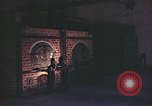
Crematory and tattooed inmates at the Nazi Dachau concentration camp in Germany after World War II.
Dachau concentration camp in Dachau Germany, after World War II. The oven of the crematory at the concentration camp. A prisoner of this camp. His sleeve raised up to show a tattooed serial number on his arm.
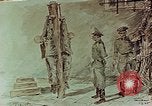
Paintings depicting torture done to prisoners at the Dachau concentration camp of Nazis in Germany
Dachau concentration camp of the Nazis in Dachau Germany, shortly after end of World War II in Europe. Paintings depicting the torture done to the prisoners at this camp. Painting of men hanging from arms tied with a rope as Nazi officials look at them. Another painting shows opprobrious beating by Nazi officials, of a prisoner with his hands and upper body lying on a table and legs put into cold water.
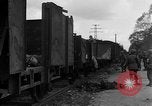
Stack of naked bodies at crematorium and pile of prison uniforms removed from dead at Dachau concentration camp in Germany.
Scenes of Nazi atrocities at the Dachau Concentration Camp in Germany at the time of its liberation in World War 2. Bodies of victims heaped in railroad cars at railroad siding in Dachau, Germany. Faces and emaciated bodies of dead prisoners. Stack of naked bodies at crematorium. Huge pile of prison uniforms, hats, and other type of clothing removed from dead. Railroad car filled with bodies of victims. The United Nations flags over liberated camp. Flags of France, Belgium, Yugoslavia, Netherlands, Poland, Russia, England and United States.