


 Francais
 Deutsch
 Italiano
Refine Your Search
+"East Germany" +1956 stock footage and images
- Showing 1 to 5 of 5 results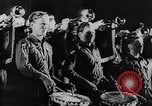
Scenes of communist East German GDR rallies, then unrest in Uprising of 1953 and Hungarian Revolt of 1956
Civilians gather on streets of Berlin and celebrate the socialist DDR (GDR) government in East Germany around 1949 or soon after. Uniformed band plays during a ceremony in East Germany. The spectators and a group of uniformed party leaders stand, cheer, and clap. A east German teenage girl kisses the flag. Next scene shows unrest and protests with burning flags in the streets of Berlin, East Germany, during the Uprising of 1953. Crowd burns a flag and then tears at another flag to destroy it. Crowd marches in the street in protest. Scenes of Soviet tanks rolling. Next scene shows a protest rally during the Hungarian Revolution of 1956. Narrator mentions revolt in Poland also. Large number of civilians march on roads and cut the center emblem out of a East German flag during protest.

Newsreel "Reds withdraw, cut down troops in East Germany" shows demobilization of some Soviet forces in East Germany
American officers and other NATO Military in Brandenburg to watch a partial withdrawal of the Soviet Army as it demobilizes and reduces forces in East Germany. Russian photographers take pictures. A number of obsolete and propeller driven planes are part of the demobilized equipment. The first contingents of 50,000 Soviet troops depart.
Images pertaining to advance of communism during 20th century, especially in East Germany
Statue of Karl Marx on his grave stone in Highgate Cemetery, London. A picture of Karl Marx. Scenes in Russia around the time of the Russian Revolution circa 1917 and creation of the Soviet Union. Soviet soldiers walking slowly in loose formation. Bolsheviks standing with a large banner. Images spanning many years thereafter: Damaged shops on a street. "One way" street signs in several languages. Large gathering of people carrying signs reading: "Frieden" (Peace, in German). A sign reading: "HALT, Landesgrenze" marking a German provincial boundary. A sign in German, designating the customs border at Furth im Wald, Bavaria ("Zollgrenz-Bezirk, Furth i.Wald"). East German border guards setting obstacles and sentry paths at barbed wire barriers (constituting the Berlin Wall, early on). Picture of Günter Litfin, a twenty-four-year-old tailor, who swam across the Spree Canal to West Germany on 24 August 1961. View of him being fatally shot from across the border, by East German guards, as he is being pulled into West Germany (the first such fatality at the East West German border). Animated map of the world with label references to Berlin,1961; Havana, 1959; Budapest, 1956; Coyoacan, 1940; and Kronstadt, 1921.
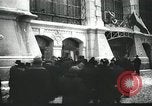
Czechoslovak coup with Communists coming to power; anti-Communist demonstrations in various European nations over 10 years
U.S. propaganda piece about threats by communists against various European countries. The Czechoslovak coup and demonstrations. Czech citizens moving on a street in Czechoslovakia during a strike forcing conservative elements to resign from the cabinet. Scenes of police brutality and beatings against strikers. Communists take over the police. Czech President Edvard Benes with conservative politicians in a government building. Huge crowd on a street. Police clashing with crowd. Czech Prime Minister Klement Gottwald with officials. President Edvard Benes, facing possible civil war or invasion by the Soviet Union, accepts a Communist cabinet. He is seen signing documents to that effect on February 25, 1948. Other officials beside President Benes during the signing. View of the first President of Czechoslovakia Tomas Masaryk's son, Jan Masaryk, who remained the Foreign Minister, and did not agree to the new government. Two days later Jan Masaryk is discovered dead. The body of Jan Masaryk in a coffin. Edvard Benes, who resigned in June 1948 after refusing to sign the communist constitution, is seen walking slowly outside the Parliament using a cane. A guard saluting Benes. View of the body of Edvard Benes, who died in September 1948, laying in a coffin. Mourning citizens offering flowers and cry. Officials bearing the coffin. Shift several years later to street strikes in East Germany in 1953. People during a strike and riot in Poland in 1956. Russian tanks moving on a street and Soviet soldiers are seen. Elevated view of panic and Polish citizens fleeing soldiers. October 1956: Student demonstrators on street in Budapest Hungary during the Hungarian Uprising of 1956. Soviet Russian red star is toppled by crowds from a building roof in a sign of defiance. Russian troops respond with tanks on the streets in Hungary. Crowd fights back. Russians retreat. Crowd overwhelms local police. Imre Nagy, Prime Minister of Hungary, ascends steps. Hungarian crowd on streets burn communist books and papers. Russian tanks invade Hungary to crush revolt. Tanks fire guns on Hungarian street. Imre Nagy's execution announced June 17, 1958.
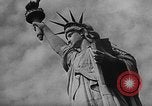
Scenes contrast between life in United States and that in totalitarian states
Statue of Liberty. Picnic for union workers. Sign reads, "Amalgamated Shirts and Pajama Workers of America, Local 343 Picnic" College graduation ceremony. Americans voting. Signs read, "Polling Place. Stalls open 6 A.M. - Close P.M." and "No Loitering or Electioneering Between This Point and The Poll." A woman enters a curtained voting stall to vote. Aerial view of early U.S. interstate highway exchange. Suburban neighborhood development in California, with elevated view of houses in suburbs. A pastor performs a wedding ceremony in a church. An American family picnics on bank of a stream. Students at a U.S. college campus. Parishioners coming out of a church. U.S. Congress in session. U.S. Capitol building exterior with tree branches. In contrast: Military parade in Communist East Germany, with tanks. A sign reads: "Peace, Prosperity, good fortune" (in German). Civil unrest in various countries, possibly Hungarian Uprising or Hungarian revolution in Hungary in 1956: People during a riot or demonstration and a city bus is seen crashing through trees and into a building on a busy downtown city street; Street riots; protest gatherings. Contrasting scenes: Peaceful U.S. metropolitan street scene; Farmer plowing field with tractor; Cowboys herding steers; driver in tanker truck with "Cyclone Rocket" logo on the door, welders at a shipyard.