


 Francais
 Deutsch
 Italiano
Refine Your Search
+"Eastern Front" +1941 stock footage and images
- Showing 61 to 66 of 68 results more
more Hide
Hide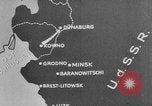
German troops on a tank as they march forward in Daugavpils, Lithuania during World War II.
German troops at the Eastern Front during World War 2. Animated map illustrates Eastern Prussian-Lithuanian border and German troop's movement into Daugavpils. Troops march forward with their vehicles. Soldiers fire artillery and quickly cross the road. Villagers give flowers and waves to the advancing German troops. A soldier on a tank.
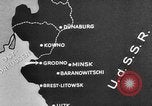
German Army forces invade and occupy Grodno, Poland, destroying buildings and setting houses on fire during World War 2.
German troops on the Eastern Front, invading Grodno, Poland (now Hrodna Belarus) during World War II. A map illustrates Eastern Prussian-Lithuanian border and German troop movements into Daugavpils, Kaunas, Brest-Litovsk and Grodno. German troops on horseback and carts on a road, passing by damaged and burning buildings in the village. German Wehrmacht soldiers fire artillery. Smoke arises due to explosion. A German officer points out a target. An industrial chimney collapses. German forces march forward and round up Russian Army prisoners. A wrecked Soviet tank. A dead body lying near a disabled tank. German troops sitting atop a tank as it moves. Elevated view across the Old Bridge spanning the Neman River toward the city of Grodno, with many buildings burning. The Grodno Catholic church of the Discovery of the Holy Cross (Bernardine), also called the Church of the Finding of the Holy Cross, seen rising from the city, with damage to its main steeple. Houses and buildings in the city burning, as German troops move through the city. Brief view of the The Jesuit Cathedral of Grodno (now The Jesuit Cathedral of Hrodna) behind burning buildings, as a German soldier passes by on a motorcyle with sidecar.
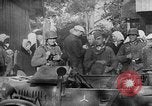
German troops are welcomed as they enter Kaunas, Lithuania , during World War Two.
German forces entering the outskirts of Kaunas, Lithuania, during their surprise offensive on the Eastern Front during World war 2. Three German soldiers stand next to a parked staff car in a town. Several local women in bonnets and babushkas stand behind them.A Panzer III tank breezes past between them and the camera. Lithuanians and ethnic Germans (Volksdeutschen) wave their hats in welcome and one gives a Nazi salute, as a Panzer I tank enters the town. Soldiers on motorcycles and another Panzer I tank follow. Soldiers ride horses pulling artillery caissons camouflaged with tree branches. Soldiers ride in them. Closeup, near the ground, of horses, their trappings and the caissons they pull. Scene shifts to soldiers loading war materiel onto flat raft ferries at a river bank. Soldiers work to load a 105mm light howitzer, model 18, onto a ferry. A ferry carrying several caissons being pushed across the river by a ferryman in a small boat using a long-shaft outboard motor. Another ferry is seen carrying horses and infantrymen. A line of soldiers walk their bicycles along a path beside the river towards a spot where several large river steamer boats are docked. Substantial buildings of old town Kaunas stand on the other side of the river. Camera pans across the cityscape, showing twin spires of the Catholic Church (Jesuit) of St. Francis Xavier and associated buildings. View from riverbank as German soldiers descend its slope and walk towards a riverboat. The arch of a suspension bridge is seen in background. Troops cross a long plank to board the riverboat. View of soldiers gathered on deck of the riverboat. The German flag and the Lithuanian flag, just beneath it, are seen flying atop a tall structure at the port. Later, as German soldiers disembark from riverboats, they are greeted by women, in what appear to be nurses uniforms, who distribute flowers to them. The soldiers proceed along a paved road beside the river. The arched suspension bridge, shown earlier,is now seen to be part of the bridge connecting Old Town with Aleksotas across the Nemunas river. It consists of several arches, but only one is standing, and the rest destroyed. The infantry on bicycles speed down an incline on the road.
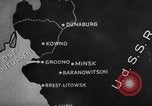
German Forces attack villages and defenses near Grodno, Belorussia, during Operation Barbarossa in World War II
German offensive on the Eastern Front in Operation Barbarossa, during World War 2. Three German soldiers ride into a burning village, near Grodno, Belorussia, in, what appears to be, a fully tracked armored personnel carrier. They are followed by some armored cars and other vehicles. Huge flames and clouds of smoke obscure the background. The entire place is in flames. German troops on horseback pull artillery and caissons. Camera pans over flaming buildings. Several mounted soldiers move slowly along the village street, as fires rage. Hundreds of disarmed Soviet troops rush across a bridge and toward the rear as German troops march past them toward the battle front. Camera focuses on the blazing buildings as one structure collapses. Huge numbers of German infantry march slong a dirt road. Some of them carry shovels. Camera pans across line of horses pulling artillery pieces and caissons. Closeup of German General of Artillery, Wilhelm Fahrmbacher as he orders a gun crew to direct their 105mm artillery piece toward a line of bunkers. Soldiers manning a truck-mounted weapon accompanied by infantry, move along a dirt road. Another glimpse of the howitzer gun crew. A soldier crawling along, in underbrush and others running across the field. The 105 howitzer crew firing some more (and the soldiers holding their ears). Troops hurrying across open fields and then attacking concrete bunkers (one carrying a hand grenade). Notable closeup images of the German infantrymen fighting their way into the bunker complex. Soldier with hand grenade moving past the remains of a concrete wall. (Only steel reinforcement is left.) He and a comrade clamber down into the bunker proper. Infantry riflemen scour damaged bunkers for Soviet defenders. Some emerge and surrender.
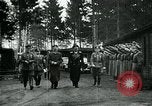
Brief film of Hitler and senior Nazi German military officers at the Wolfs Lair (WW2)
Adolf Hitler is seen strolling toward his rustic Eastern Front Headquarters building, at The Wolf's Lair (Wolfsschanze), near Rastenburg in East Prussia during World War II. He is accompanied by General Wilhelm Keitel, Admiral Karl Doenitz (Dönitz) and an unidentified Nazi German officer. They are wearing long winter coats and gloves. The Camp staff stand in formation rendering the Nazi salute in front of the building. Hitler steps forward and leads the way into the building.
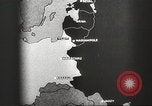
German Operation "Barbarossa," the invasion of the Soviet Union in World War II
German troops advance in Transcarpathian Oblast, Ukraine, during World War 2. Map shows the Polish-Ukrainian (Soviet Union) border. Narrator refers to the Battle in the East (the Eastern Front). German armored forces, camouflaged with branches of shrubbery, attack to the East, primarily from Poland, in Operation Barbarossa. Stug III self-propelled assault guns are seen, as well as towed artillery pieces moving along rural roads in agricultural areas. German officers look through binoculars. Spire of a church seen in distant rural village. German artillery firing at close to zero elevation. A small village with houses burning. Closeup of German tank commander looking out from his top hatch. German soldier receiving first aid for cut on face. German infantry engaging defenders in house-to-house combat with small arms. Houses ablaze in the village.