


 Francais
 Deutsch
 Italiano
Refine Your Search
+"Eastern Front" +1941 stock footage and images
- Showing 7 to 12 of 68 results more
more Hide
Hide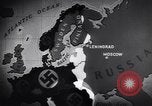
German Operation Barbarossa on the Eastern front in World War II
Animated map shows extent of German controlled areas in Europe following their conquest of the Balkans in World War 2. Norway is under their control and German forces threaten Leningrad and Moscow. A soviet defense line is shown on the map. The German attack is shown to come from 5 directions on June 22, 1941, with the launch of German Operation Barbarossa. A sky filled with German Heinkel He 111 bombers is shown. German Panzer III tanks with 75 mm guns. Army trucks carry German troops into battle. German soldiers on motor cycles and infantry advance under fire. Animated map shows principal German targets as Leningrad, Moscow, and Kiev. It then shows beginning a drive from the North to encircle Leningrad. Arrows show where German Marshal Fedor von Bock's forces drove 480 miles into Soviet territory. Slates identify cities being overrun by German invaders, including: Pskov, Novgorod, Brest-litovsk, Minsk,Mogilev, and Vitebsk. On July 17, 1941, a German tank is seen entering Smolensk, past the Dnieper River threatening Moscow, itself. To the south, German forces, under Marshal Gerd von Rundstedt, cut deep into the Ukraine. Newspapers world-wide consider the Soviet forces close to defeat. Slate shows communique from the German High Command stating: "The issue in the East is already settled. Smolensk is the last halt on the road to Moscow." German infantry marching. Scene shifts to heavy artillery being fired by Soviet forces in a snowy scene clearly later in the year. Animated map shows German forces very close to Moscow on October 15, 1941, forcing the Soviet Government and all foreign missions to move to Kuibyshev, 700 miles to the east. Adolf Hitler, in a speech on October 3, 1941, states that the enemy is broken and will never rise again. Animated map shows 500 thousand square miles of Soviet territory occupied by German forces. Views of fires burning in Russia. Damaged and abandoned Soviet industrial plants. A German guard atop a hill looks down on thousands of Soviet people in the occupied areas of Russia. Damaged and abandoned Soviet T-26 tanks. Glimpse of damaged Soviet aircraft and field artillery. Headline in New York World Telegram newspaper reads: "Berlin Admits Russ War May Last Winter." Another headline reads: "Red Army Holds Push On Moscow." Weary German soldiers traveling in horse-drawn wagons, pulling field artillery. Soviet and German war planners are seen at work. Slate quotes Adolf Hitler saying: "A single blow must destroy the enemy, without regard for losses... A gigantic all-destroying blow." German armor moving along a road. Animated map shows this technique in the German invasions of Poland, France, the Balkans, and Yugoslavia. In contrast, the Soviet planners are seen, as map illustrates how they intend to take advantage of the vast area of their land by holding lines of defense an falling back as necessary to keep engaging the invaders across interior of the Soviet Union. Soviet infantry are seen marching along a road. German troops riding atop their tanks. Soviet troops forcing German invaders into close combat in her cities. Soviet soldiers running in a city and firing heavy machine guns. Bomb damage and rubble inhibit German armor mobility in cities. Cities where this kind of Soviet resistance prevailed were: Rostov, Kharkov, Kiev, Kursk, Smolensk. German troops leaving a city with heavy black smoke rising in the background. More views of cities where Soviet troops are engaged German forces in House-to-house battles, including: Odessa, where the Old Opera Theater building is shown sandbagged and relatively undamaged. The Odessa NI tank, created from an STZ-3 agricultural tractor.
German Operation Barbarossa on the Eastern front in World War II.
View of the city, Pskov, on the Veilakaya river. A steel bridge is seen and city across it with smoke rising. German troops march in loose formation over a bridge in Novogorod. Views of German camouflaged tank (with shrubbery) and other armor and troops entering Soviet cities of Brest-litovsk, Minsk, Mogilev, and Vitebsk. View of German Panzer III tank heading toward the camera as it enters a narrow street in Smolensk. Animated map shows progress of these German advances and highlights German forces under German Field Marshal Gerd Von Runstedt cutting deep into the Ukraine. Headline on Chicago Daily News reads: "Nazis Claim Knock-out Victory" with subtitle line reading,"Moscow line cracks." Other newspapers reflect conviction that Soviet forces face imminent defeat by Germany. Slate shows communique issued by the German High Command, stating: "The issue in the East has already been settled. Smolensk is the last halt on the road to Moscow." More views of marching German troops. A battery of Soviet artillery firing from a snow-covered field. Animated map shows German forces moving close to Moscow. Foreign diplomats are moved from Moscow to the city of Kuibyshev. Hitler speaking on October 3, 1941, saying "This enemy is broken and will never rise again." Animated map depicts 500 thousand square miles of Soviet territory occupied by December, 1941, and compares it to the entire west central United States encompassing the states of : South Dakota, Iowa, Nebraska, Kansas, Missouri, and Oklahoma. Fires raging in agricultural area of the Soviet Union. Destroyed Soviet industrial plants, and huge numbers of Soviet citizens under German occupation. Views of destroyed Soviet armor, aircraft and artillery pieces. As season changes, German forces are seen in rain gear moving slowly through cold rainy weather. Some walk beside horses and other ride on horse-drawn caissons along with artillery pieces. Segments of film show contrast between the German military strategies. The German forces would plunge deep into enemy territory and create an area of conquest. This is illustrated by a slate bearing Adolf Hitler's statement that, "A single blow must destroy the enemy, without regard for losses, a gigantic destroying blow." An animated map illustrates the success of this approach by the Germans in Poland, France, and the Balkans. German Generals seen planning the same "Blitz" strategy against the Soviets. Film shifts to the Soviet strategy, showing their idea of building stronger defense, as they fall back, taking advantage of the great size of their territory. Views of Soviet troops on the move. View of Shells knocking out a German tanks. Panzer III tanks advancing. Panzer VI tanks completely covered by German troops catching rides. Soviet field artillery and machine guns firing in cities, forcing German soldiers to leave their vehicles. Soviet cities bombed out and burning, with debris and obstacles limiting the ability of armor to navigate in them. Montage of battle scenes cities of Rostov, Kharkov, Kiev, Kursk, Smolensk, all thwarting the Nazi blitz into the Soviet Union. Battles being waged in cities. (World War II; WW II; World War 2; World War Two)
Various scenes of Soviet Forces headed toward the Eastern front and engaging German forces in counter attacks (WW2)
Film opens showing heavy artillery firing at nighttime. Marshal of the Soviet Union, and Chief of the Soviet General Staff, Aleksandr Mikhaylovich Vasilevsky, is seen alone in a room, reviewing a map. He uses a pair of dividers to make a measurement. Next, antiaircraft guns fire at night, as many searchlights point up in the night sky. A view of the Kremlin. A formation of Cossack cavalry crossing a bridge in winter. Snow on the bridge and surrounding area. A formation of soviet troops,dressed in cold weather gear, marches single-file across snow and ice. Soviet Army tractors towing 152mm howitzer field guns on a snowy road. A contingent of Soviet soldiers, in white helmets, marching toward the front, in the snow, followed by some horse-drawn equipment on sleighs or sleds. Artillery tractor towing a 152mm howitzer field gun. Open trucks carrying Soviet solders. More views of Soviet troops headed to the front, in the snow, passing residential buildings on the way. Soviet soldier looking through binoculars as German Junkers 88 bombers fly overhead. Soviet gunners employing several different types of antiaircraft guns. A Soviet armored car moving across the snow, and a tank destroyer moving near woods. A downed German bomber with dead crew member lying in the snow, nearby. Soviet pilots on a flight line looking over their orders. A line of fighter planes is parked on the snow in the background, including Lavochkin-Gorbunov-Gudkov LaGG-3 and other aircraft. Soviet airman in gunner's canopy on a bomber. Bombs being loaded and fused aboard Soviet bomber. Machine gun belt ammunition being loaded on an Ilyushin IL 4 aircraft. A flight line of IL 4 bombers parked in the snow. Two Soviet Petlyakov Pe-2 dive bombers in formation. Bombs falling through the air and exploding on snowy targets below. More Pe-2 bombers and bombs falling. View from underneath an artillery spotters balloon as it is retrieved by Soviet soldiers. Views of various pieces of Soviet artillery in the snow. Slate announces "December 6, 1941, Moscow strikes back!" (during Battle of Moscow in World War II). Various views of Soviet artillery being fired and shells exploding. Glimpse of the artillery spotter and balloon. A soldier lying frozen in the snow. Countless scenes of all kinds of Soviet artillery firing from various places interspersed with views of mounted Cossacks moving along a snowy trail in a wooded area. Soviet troops heading to tanks and other armor, hidden in the woods. They climb aboard them. Senior Soviet officers confer in the field. Air crews boarding IL 4 bomber aircraft and starting engines. Bombs exploding. Tanks moving. (One knocks down a tree.) The bombers taking off. Soviet soldiers watching.

Events on the Eastern front early in World War II; Nazi Germany battles Russia
Goosestepping German troops on the march and German Panzer I tanks moving in formation across a field in World War 2. A formation of German Fieseler Fi 156 Storch airplanes in flight overhead, accompanied by two He-111 bombers. German paratroopers jumping from Ju-52 aircraft. Grand Admiral Erich Johann Albert Raeder head of the German Navy, making a statement. Bucolic scenes of European farm country and grape vineyards, with local people harvesting crops and grapes. Soviet troops marching on parade to a military band on the sidelines in Red Square, Moscow, soviet Union. Soviet motorcycle soldiers armed with light machine guns. Soviet T-26 light tanks in formation. Glimpse of Red Square, with St. Basil's Cathedral and other famous buildings. Soviet troops crossing a river on inflated boats. A long column of T-26 tanks moving along a dirt road. Sky filled with variety of Soviet warplanes, including four-engine bombers (with fixed landing gear) to bi-wing aircraft. Soviet paratroopers jumping from a Tupolev ANT-6 bomber. They climb out on the huge corrugated wing and slide off. View out past the tail of an ANT-6 bomber. Soviet Union and Japan conclude a neutrality pact. Views of the pact being signed by Foreign Minister Vyacheslav Mikhailovich Molotov for the Soviet Union and by Japanese Foreign Minister Matsuoka and Ambassador Yoshitsugu, for the Japanese, in Moscow on April 13, 1941. Joseph Stalin is observing in the center of the scene.
Axis forces on bicycles, horses and foot advance and battle on Eastern Front during World War II.
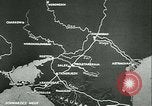
A map of the Eastern Front from the Caucuses North. A Romanian Paratroop officer looks through binoculars from a trench. Another Romanian soldier with him. Many spent cartridges on ground in front of them. Romanian infantry advancing through fields and brush. They employ flame throwers. German soldiers load and fire artillery and guns. Smoke due to the explosions. Burning tanks. Soldiers on military vehicles cross a field. Soldiers on bicycles. Wrecked and charred military vehicles. A half track of Panzer Grenadier Division Grossdeutchland moves along. Soldiers survey the area. Burning tanks on the road. Burning and bomb damaged buildings. Hens and chicks among the rubble. German infantry advance through the burning rubble of buildings. A Pz.IV tank of 23.Pz.Div advances. An amphibious craft in the water. The German cavalry and soldiers on bicycles cross a raised road by a river bank. A sign identifies the embankment as Manyisch Damm, at Grenze, the boundary between Europe and Asia. Soldiers on horses and foot march. Smiling German soldiers.
German anti-aircraft and Panzer tank attacks on Soviet Union forces of Eastern Front during World War 2
German antiaircraft units fire at soviet bombers in Eastern Front during World War II. Von Kleist and Guderian Panzer Divisions roll past burning villages in Soviet Union just 500 kilometers from Kiev, Ukraine. General Guderian speaks with the officers. Soviet tank units surrender. 65,000 Soviet prisoners march under German guard.