


 Francais
 Deutsch
 Italiano
Refine Your Search
+"Eastern Front" +1941 stock footage and images
- Showing 43 to 48 of 68 results more
more Hide
Hide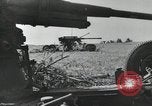
German troops under fire from Soviet forces at a railroad yard, and railway track being repaired on Eastern Front.
The Russian campaign of World War II. Idle Russian artillery in a field, and corpse of a dead Soviet soldier beside an artillery gun. German soldiers moving on a small rail cart along a railroad track, as seen from on board the moving small rail car. The cart is stopped and the soldiers moving along the side of the rail track.The soldiers at a railroad yard. Point of view of a German soldier looking out from a partially covered position and firing a machine gun at enemy Soviet soldiers. Elevated view of the railroad yard with a group of soldiers walking through it. German soldiers moving through the wooden gate of a building in a town. German soldiers again moving on a rail cart on a rail track. Damaged buildings on the side of the marshalling yard. Damaged buildings and debris scattered on the ground. German soldiers in a repair crew replacing rails and changing the gauge of the rails on the yard. The crewmen at work on the rail track. A locomotive moving on the track. German soldiers aboard the locomotive.
A 1942-1943 film report to the American public about the progress of World War II in Europe and the Pacific.
Opening slate at start of film reads: "1942--1943 The Turn of the Tide." A column of British armor enters Bengazi, Libya, led by several troops in tankettes. Next seen are a Lee Medium Tank, M3 followed by an infantry tank, a jeep, another infantry tank and another Lee M3 Medium tank. Closeup of local people greeting the troops with upraised hands giving the "V" for victory sign. Another Lee M3 tank passes close by the camera. Black smoke is rising in the background. Scene changes to a half sunken ship near another burning in the harbor. Another view of this from further away above port buildings. Closeup of three smiling British soldiers leaning over a cartoon on a tank, of Winston Churchill (As a bulldog smoking a cigar and wearing a cap with the word "Victory" written on it). A crumpled captured flag with swastika on it. British Field Marshal Bernard Montgomery stands atop a vehicle (unseen) and looks through binoculars. Below, a column of British supply vehicles is making its way along a path in the desert. Two tanks coming toward the camera through sand. Animated map shows Nazi territory being threatened by the Allies from the Mediterranean, the USSR, and the English Channel. Views of Soviet infantry advancing against German forces in the snow of winter on the eastern front. Soviet troops firing updated 76-mm divisional gun model 1902 hidden in woods. Shells exploding in snow-covered field as Soviet BT series tanks advance. Various Soviet artillery firing from fixed gun batteries and from woods. A shell striking in distance. Fallen German soldiers lying on snowy field. Makeshift battlefield crosses marking graves of fallen German soldiers. German steel helmets lined up in the snow. A sign, posted on a birch tree, lists the names and birth dates of 16 German soldiers from the 3rd Panzer Division (3Pz-Pi-BH.39) buried at this site on November 28, 1941. Scene shifts to Joseph Stalin addressing Soviet troops in Red Square, Moscow, Russia. All the soldiers in formation seem to be singing (unheard). Film switches to animated map again. This time delineating the Eastern front being pressed by the USSR, and showing area of the 2nd Soviet winter offensive in 1943. Change of scene from Europe to the War in Asia, against Japan, shows General Douglas MacArthur after arriving by a B-17 bomber at a Pacific island American base. He ascends a steep hill in a jungle area, accompanied by other officers. Closeup of MacArthur. American infantry moving in single file in New Guinea, as a field piece fires a round in the direction they are headed. U.S. artillerymen load shells into a 105mm howitzer gun. A fire burns as mop-up operations begin on New Guinea. An Australian soldier is seen firing a Bren gun in jungles. Other Australian soldiers fire a mortar that explodes, raising earth and dust. More views of shells exploding near Allied soldier advancing. A soldier with fixed bayonet makes a fake charge toward the camera. Views of Japanese prisoners of war guarded in an outdoor compound. Japanese dead soldiers on Guadalcanal. An animated map shows new battle lines in the Pacific, closing in on Japan, with pressure from China, the USSR, and the Pacific islands being captured by the U.S. Arrows are added showing new pressure from American naval fleets and from British and American bombers out of Australia and captured islands.
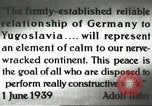
Tripartite Pact signed by Germany, Italy and Japan in Berlin, Germany. Ensuing attacks by Germany and Japan in World War II
This film is a scattering montage of World War 2 scenes from 1939 through 1945. Part of an agreement between Nazi Germany and Yugoslavia is shown in English. It is dated June 1, 1939 and ostensibly signed by Adolf Hitler. Next, German Ju 87, Stuka dive bomber aircraft are shown peeling off from formation, on April 6, 1941, to attack Yugoslavia. Bombs bursting on the ground. Closeup of a Stuka airplane in a dive, making its characteristic whine, and dropping bombs. Bombs exploding just outside some concrete walls. German infantry running along railroad tracks and entering backyard of house in a village. German soldiers observing from overlooking hill; climbing over rubble; and marching along a road toward a village. Animated map showing German invasion areas early in World War II, extending through most of Europe and into Norway, by 1941. Animated map shows further invasions into France, Belgium, low countries, the Balkans, and Eastern front towards the Soviet Union. Map highlights Tokyo, Rome, and Berlin. Delegations walking in hall of Reich Chancellery in Berlin, to sign Tripartite pact, on September 27, 1940. The group is led by by Count Galeazzo Ciano (Italian Foreign Minister, and Mussolini's son-in-law); Joachim von Ribbentrop, Germany's Foreign Minister and Japan’s Ambassador Saburō Kurusu. The diplomats are seen, next, standing near a table as Adolf Hitler enters rendering Nazi salute. He shakes hands with Count Ciano and Ambassador Kurusu. Hitler is seated to watch the proceedings. Von Ribbontrop is seen signing for Germany. Next scenes show German armored units heading East in Operation Barbarossa (June of 1941). A sign identifies the town of Eydtkau (Eydtkuhnen) on the German-Lithuanian border. German armor and artillery moving eastward. German troops destroying international crossing barriers. German troops firing siege guns. Montage with glimpses of German battle scenes showing tanks, guns, rockets in action with attendant explosions, fires, and destruction. Formations of German warplanes in flight, including Junkers Ju-52s that carry troops, including paratroops. View from above of Junkers Ju-87 Stuka dive bombers in formation. Battle of Britain scenes, with view of St. Paul's Cathedral in London, England (which miraculously survived the Blitz). The Tower Bridge in London, seen through a haze following blitzkrieg. German Junkers 87 Stuka dive bombers peeling off from formation to attack. British anti-aircraft searchlights shining beams skyward. Diving bombers illuminated by the lights. Anti-aircraft guns firing. Nighttime scenes showing gunfire flashes, explosions, tracer bullets and fires in London. British fire brigades fighting fires in London buildings as some collapse from the German bombing during the so-called "Blitz." Scene shifts to Pearl Harbor, December 7, 1941, as a Japanese bomb explodes on a U.S. Navy warship. The USS Arizona billowing smoke and listing as it succumbs to Japanese bombing. Another view of the Arizona sinking. Smoke rising from Battleship Row, at Pearl Harbor. Glimpse of postwar Nuremberg trial.
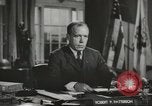
American Undersecretary of War speaks to difficulties facing Allies in confronting Germany and Japan in World War II
Undersecretary of War, Robert Porter Patterson, Sr. speaks about a report from the General staff outlining the needs for combating Germany and Japan in World War 2. He cites Operation Husky, the invasion of Sicily, as an example of what will be needed. He continues to narrate in the background as an animated map appears showing the buildup of supplies and Allied forces in North Africa; Allied air forces flying 60 thousand sorties over Sicily and, the direct amphibious assault using 3,200 vessels. Map also depicts opposing forces of 12 (“unwilling”) Italian Divisions and 3-1/2 German Divisions. View of Allied troops carrying some of their 31 thousand casualties on stretchers from field ambulances. Allied medics attending to the wounded. Some are seen lying on stretchers in a row on the ground near a wall. Interior of a field hospital where surgeons and other medical personnel treat the wounded. Animated map shifts to Europe with Germany at its center, showing , in contrast to Sicily that was only an “outpost,”, the heavily fortified perimeter of Axis controlled areas; the axis industrial might; and the disposition of 300 German Divisions (mostly on the Eastern front) defending the region. Next, the map illustrates Japan’s defended regions in the Pacific Image returns to Undersecretary Patterson i n his office, speaking of the Allied offensives planned for next year (1944), and emphasizing their challenge and difficulty. Scene shifts to General Jonathan Wainwright and his garrison at Corregidor, in the Philippines, surrendering to Japanese forces in 1941. Japanese military camera pans over the Americans being taken prisoner. Other Americans and Filipinos are seen being marched together under guard. Scene shifts to classic views of the Japanese attack on Pearl Harbor, Hawaii, on December 7, 1941. View of Japanese soldiers executing two Chinese civilians in 1937. Dangling bodies of persons hung by Nazis during Operation Barbarossa in Russia, in 1941 A Russian soldier comforts a little girl as he escorts her across a snowy landscape. Time bomb left by German forces retreating from Naples, Italy, in 1943, blows up a Post office building . Views of damage to building and bodies of victims. American Military Police assisting a victim. American soldiers carrying an injured civilian on a litter. Scene shifts to British Foreign Minister, Anthony Eden, Soviet Foreign Minister, Vyacheslav Molotov, and U.S. Secretary of State, Cordell Hull, entering a hall in the Spiridonovka Palace, during the 1943 Moscow Conference in Russia. Close-up of the American, Soviet, and British flags on a table. View of many delegates seated around the table. Close-up of Molotov, Eden, and Hull signing conference document.
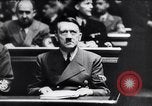
Hitler addresses Reichstag in Berlin, Nazi army advances in Soviet Union, and signing of Atlantic Charter during World War II.
Adolf Hitler addresses the Reichstag in Berlin on December 11, 1941 declaring war operations against the United Kingdom, Soviet Union, and United States. Marshall Hermann Goering, Sharp and other Nazi leaders listen to him. A map shows eastern front with Nazi German Armies advance in Soviet Union. Battle scenes between German and Soviet armies. German soldiers capture a Soviet prisoner of war. German soldiers fire artillery during a battle. View of German tanks advancing and firing on a battlefield. Ruins of a wrecked, smoking Soviet tank. Scene shifts to United States President Franklin Roosevelt and British Prime Minister Sir Winston Churchill at Atlantic Conference aboard ship "Prince of Wales" for signing of Atlantic Charter. The Allied leaders are seen singing "Onward Christian Soldiers" during a service.
Soviet Russia mobilizes to defend against German offensive (Operation Barbarossa) in World War II.
Film opens showing Adolf Hitler, in World War 2, with Field Marshal Walther von Brauchitsch, Army Commander-in-Chief, and other top military members, planning for Operation Barbarossa (Attack to the East toward the Soviet Union). As he walks away from the table, he speaks briefly to Grand Admiral Erich Raeder, head of the Kriegsmarine (German Navy). Next Hitler and Marshall Hermann Goering are seen strolling and conversing at the Eastern Front headquarters, "the wolf's lair," (Wolfschanze) near Rastenburg, East Prussia (now Poland). Scene shifts to the Soviet Union, where Joseph Stalin is seen speaking at a podium. A large outdoor audience, including some soldiers, is gathered to listen. Images showing the Soviet people responding to defend against the German Nazi invasion. Closeup of Soviet soldiers with shouldered weapons. The nearest is holding a PPSh-41 submachine gun. Closeups of Soviet women and men in military uniforms. Soviet citizens heading to enlist in the military. Soldiers marching loosely n a city street. Patriotic singing is heard in background. A formation of Soviet women marching. Some carry furled banners. Soviet women carrying simple farm implements, marching in a rural part of Russia and joining others who are working to prepare anti-tank ditches and barriers in the countryside. Views of hundreds of people working on this project. Weapons being provided to rural Soviet guerrillas who will operate behind enemy lines. Anti-aircraft guns being set up overlooking a harbor. Closeup of Soviet soldiers manipulating controls on a camouflaged anti-aircraft gun and others maneuvering a four-barreled anti-aircraft machine gun. Local farm family members on makeshift towers keeping watch over huge fields of wheat. Soviet farmers harvesting the wheat with scythes. An armed farmer shielding his eyes as he searches the skies for German airplanes. Closeup of a man cutting wheat with a scythe as women gather the sheaves behind him. Motorized harvesters at work in a field of wheat. Closeup of a woman operating one. Tractors used in harvesting. Women and children gleaning what remains behind in the harvested fields. Farmers driving their cattle East (away from advancing Germans). Evacuating Soviet people employ a scorched earth policy, burning their homes, barns, and anything that might be of value to advancing German forces. Views of burning houses. Soviet industrial enterprises working around the clock producing war materiel. Seen are petroleum facilities; a large plant expelling coke; coal pouring into a barge; men at work at a steel furnace; ribbons of hot steel moving out of rollers; a huge manufacturing plant in operation. Next, a Soviet Kliment Voroshilov (KV) tank is seen moving across a field. Soviet Russian Polikarpov I-16 fighter planes in flight. A large formation of German Dornier DO 17 bombers in flight high overhead. Soviet forces retreating. Views of fallen German soldiers, fires burning, and remnants of a downed German bomber. German prisoners of war marching under guard and others surrendering with hands in the air. Closeups of some German prisoners. A Russian Petlyakov Pe-2 aircraft parked in snow with engines running. Fallen German soldiers lying in the snow along a roadway, in Winter of 1941-42. A Russian Kliment Voroshilov (KV) tank maneuvering in the snow. Russian Bt-7 Light Cavalry Tanks proceeding toward the front in Springtime, 1942.