


 Francais
 Deutsch
 Italiano
Refine Your Search
+"Eastern Front" +1943 stock footage and images
- Showing 13 to 18 of 39 results more
more Hide
Hide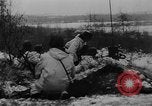
German Army soldiers fire at Soviet forces during eastern front battle in World War II.
German Soldiers fire at Soviet Russian enemy positions in a snow covered field in the Soviet Union, Eastern Front, during World War 2. Artillery fire at targets across field. The German soldiers wear warm uniforms in white camouflage for winter. They talk amongst themselves during the advance.
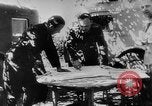
German reconnaissance plane takes off on Eastern front during World War II. German forces mount offensive with heavy weapons.
German offensive on the Eastern Front of World War II. Nazi officers look at a map and discuss plans for attack on Soviet positions. A German reconnaissance plane takes off from an air base. German Stug III Assault Gun being re-armed. Nazi soldiers loaded on Panther tanks advance, with a Sdkfz.251halftrack in Kursk markings, to the battle field. SS commander in Sdkfz.222 armored car. Pz.IV tank of 2.Pz.Div. ("Das Reich") with skirts operating in village. Heavy firing takes place. StuH42 105mm artillery mounted on tank fired. Explosions occur and smoke rises.
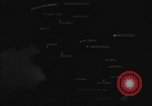
Spring thaw of snow leads to muddy conditions for German forces on eastern front, World War 2
A map shows various cities of Russia, Soviet Union. Snow and ice covered fields melting at the end of winter and start of spring. Soldiers walking on boards to cross creeks of running water. German army vehicle driving in standing water from melting snow. German soldiers walking through deep mud while pushing a stuck vehicle.
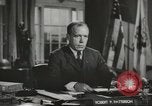
American Undersecretary of War speaks to difficulties facing Allies in confronting Germany and Japan in World War II
Undersecretary of War, Robert Porter Patterson, Sr. speaks about a report from the General staff outlining the needs for combating Germany and Japan in World War 2. He cites Operation Husky, the invasion of Sicily, as an example of what will be needed. He continues to narrate in the background as an animated map appears showing the buildup of supplies and Allied forces in North Africa; Allied air forces flying 60 thousand sorties over Sicily and, the direct amphibious assault using 3,200 vessels. Map also depicts opposing forces of 12 (“unwilling”) Italian Divisions and 3-1/2 German Divisions. View of Allied troops carrying some of their 31 thousand casualties on stretchers from field ambulances. Allied medics attending to the wounded. Some are seen lying on stretchers in a row on the ground near a wall. Interior of a field hospital where surgeons and other medical personnel treat the wounded. Animated map shifts to Europe with Germany at its center, showing , in contrast to Sicily that was only an “outpost,”, the heavily fortified perimeter of Axis controlled areas; the axis industrial might; and the disposition of 300 German Divisions (mostly on the Eastern front) defending the region. Next, the map illustrates Japan’s defended regions in the Pacific Image returns to Undersecretary Patterson i n his office, speaking of the Allied offensives planned for next year (1944), and emphasizing their challenge and difficulty. Scene shifts to General Jonathan Wainwright and his garrison at Corregidor, in the Philippines, surrendering to Japanese forces in 1941. Japanese military camera pans over the Americans being taken prisoner. Other Americans and Filipinos are seen being marched together under guard. Scene shifts to classic views of the Japanese attack on Pearl Harbor, Hawaii, on December 7, 1941. View of Japanese soldiers executing two Chinese civilians in 1937. Dangling bodies of persons hung by Nazis during Operation Barbarossa in Russia, in 1941 A Russian soldier comforts a little girl as he escorts her across a snowy landscape. Time bomb left by German forces retreating from Naples, Italy, in 1943, blows up a Post office building . Views of damage to building and bodies of victims. American Military Police assisting a victim. American soldiers carrying an injured civilian on a litter. Scene shifts to British Foreign Minister, Anthony Eden, Soviet Foreign Minister, Vyacheslav Molotov, and U.S. Secretary of State, Cordell Hull, entering a hall in the Spiridonovka Palace, during the 1943 Moscow Conference in Russia. Close-up of the American, Soviet, and British flags on a table. View of many delegates seated around the table. Close-up of Molotov, Eden, and Hull signing conference document.
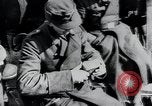
German troops transport supplies into flooded area of Russia on Eastern Front during World War 2.
German troops in a flooded area of Russia. Infantry units arrive through train. They sit in motor barge to travel through water. Supplies transported on boat, wrapped in hay. Troops unload supplies and provisions on shore. They unwrap supplies and bring out bottles. Drink ladeled from barrel and given to other troops. Horses pull rubber rafts in water. Fodder for horses is carried on rubber rafts. Field officer travel in a motor launch. Troops bail water from their barracks. Troops climb up on tree platform and sit in observation post.
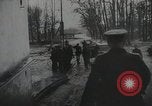
Spanish General is decorated and German and Italian military leaders coordinate defense of Italy during World War 2
Commander of the German 18th Army, Colonel General Georg Lindemann, arrives to personally recognize Spanish Army General Emilio Esteban Infantes, commanding officer of the Spanish "Blue Division" (German 250th Infantry Division) for successfully repelling attack by the Russian 55th Army, in the Battle of Krasny Bor on the Eastern Front in February, 1943. Other officers help General Esteban Infantes to place an Iron Cross decoration around his neck. Scenes of German General Field Marshal Albert Kesselring reviewing Italian and German troops in Italy at an airfield and presenting award to some of the soldiers. In next scene, Benito Mussolini enters a room and then is seated in the first meeting of the leaders of the new Fascist Republican Party, including Alessandro Pavolini and Italian Minister of War Rodolfo Graziani. Next segment covers arrival of German Field Marshal Erwin Rommel to Italy, touring fortifications and inspecting defenses in Italy. He is seen reviewing port lookouts and defense points with German artillery. In once scene he passes an elderly Italian civilian and gives him the Nazi salute, which is returned weakly by the Italian. Next segment covers further expansion of Italian defenses, with the laying of barb wire by troops, including one soldier cutting his pants knee on the barbed wire. Also shows demolition of trees using dynamite. Explosions as trees are blown up. Then shows placement of new artillery guns and positions. German soldier reviewing a map while on phone receiving enemy position information. German soldiers in hills fire artillery at enemy position in a valley.