


 Francais
 Deutsch
 Italiano
Refine Your Search
+"England" +1944 stock footage and images
- Showing 91 to 96 of 413 results more
more Hide
Hide
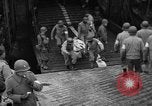
Wounded prisoners on litters are carried down from an LST (Landing Ship Tank) in Portland, England.
German prisoners in Portland, England during World War II. Wounded prisoners are carried on litters. Wounded prisoners and U.S. soldiers, wearing bandages, walk on an LST (Landing Ship Tank). They disembark from the LST. Litter cases of U.S. soldiers and prisoners are carried. One wounded on a litter with an eye patch. Two soldiers carry a wounded man. A group of prisoners sitting on the ground.
Wounded prisoners and U.S. soldiers are transfered from an LST to ambulances in Portland, England.
German prisoners in Portland, England during World War II. U.S. soldiers carry wounded prisoners on litters. They disembark from an LST (Landing Ship Tank). Litter cases of U.S. soldiers and prisoners are transfered from the LST to ambulances.
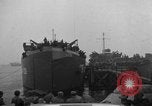
German prisoners walk down the ramp of an LST and come ashore in Portland, England.
German prisoners in Portland, England during World War II. An LST (Landing Ship Tank) is anchored at a sea shore. A ramp is lowered from the LST. The prisoner walk down the ramp and come ashore. Ambulances on the shore. The prisoners stand in two queues and march.
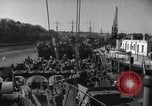
Several LCI(L) Craft docked and LCVPs and other boats in Weymouth harbor, England, prior to D-Day in World War II
Large Landing Craft Infantry LCI(L) docked in Weymouth, England, the day before D-Day, in World War 2. Seen are LCI(L)s numbered: 493, 495, and 491, part of Flotilla 10, operated by the U.S. Coast Guard. Small boat traffic in the channel includes Landing crafts Vehicle, Personnel (LCVPs) and other boats.
U.S. troops aboard and an LST and LCI(L) docked in England, 3 days before D-Day in World War II
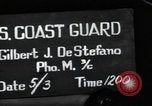
American troops of the U.S. Army 1st Infantry Division, eating lunch aboard a Landing Ship Tank docked at Weymouth, England, three days prior to D-Day. As they finish, they rinse their mess kits in hot water. A number of troops seen eating lunch as they sit on deck of large landing craft infantry LCI(L) number 88, which belongs to Flotilla 10, operated by the U.S. Coast Guard. (Note: Slate has wrong month. It is June 3rd)
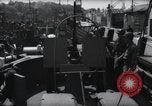
U.S. soldiers talk with Coast Guard gun crew about their 20 mm antiaircraft gun, aboard LCI(L) docked in England before D-Day
A U.S. Coast Guard gun crew near a 20 mm antiaircraft gun aboard a Landing Craft Infantry LCI(L) docked at Weymouth, England, 3 days before D-Day. U.S. troops ask questions about the gun. (World War II period).