


 Francais
 Deutsch
 Italiano
Refine Your Search
+"England" +1944 stock footage and images
- Showing 127 to 132 of 413 results more
more Hide
Hide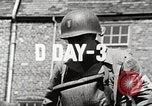
U.S. troops are ferried from Weymouth England, to transport ships in preparation for Normandy invasion in World War II
U.S. army troops board LCVPs (Landing Craft, Vehicle, Personnel) at pier in Weymouth, England, to be ferried out to transport ships anchored offshore, in preparation for the D-Day invasion of Normandy, France, during World War 2. Several large Landing Craft Infantry are seen tied up at the docks, including LCI(L) numbers 84 and 49. Views of Higgins Boats (LCVPs) heading out. Markings on one identify it as belonging to the Attack Transport ship USS Charles Carroll (APA-28). The Higgins Boats come alongside the USS Charles Carroll and troops of the U.S. 29th Infantry Division board her.
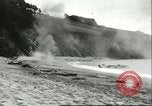
British and American troops practice amphibious assaults at a beach near Dartmouth, England
Allied troops practice amphibious landing at Blackpool Sands, a beach near Dartmouth, Devon, England during World War II. Smoke on the beach. Landing Craft Vehicles (LCVs) beached at the coast. British and American soldiers on the beach. Allied officers watch amphibious landing practice. A radio operator with equipment. A loud speaker system is dug in on the beach as the operator observes the advancing troops. American soldiers with helmets and packs pour out of LCV boats and advance across the beach. Some soldiers hit the ground as shells explode near the beach. The soldiers advance on the beach. They crawl.
American troops practice amphibious assault landings near Dartmouth, England, during World War II.
Allied troops practice amphibious landings at Blackpool Sands beach, close to Slapton Sands, near Dartmouth, England, during World War 2. Landing craft underway at sea head beachwards. The craft arrive at the beach and American soldiers debark. Another group of landing craft arrive at the beach. U.S. troops near the landing craft. Ships underway at sea.
U.S. Army Rangers board British landing craft in Weymouth, England during World War II
Pre-invasion activities of United States Army Rangers (2nd Battalion) in Weymouth, England during World War 2. The Rangers eating doughnuts (donuts) and drinking coffee. They march along Weymouth Esplanade to an embarkation area. Royal Hotel Weymouth and St. John's Church seen in the background. They are checked as they move past the pier. The rangers get into British Landing Craft Assault (LCA) at the pier. (The officer seen with a white bar on front of his M1 helmet, is First Lieutenant Robert T. Edlin, who was the first American soldier to board a Landing craft at Weymouth for the Invasion of Europe.) LCAs underway at harbor en route to a transport. An LCA filled with troops.
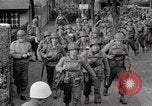
U.S. Army Rangers in Weymouth, England, prior to the D-Day invasion of France in World War II
Pre-invasion activities of United States Army Rangers in Weymouth, England during World War 2. The rangers walk past an American Red Cross tent, adjacent to Greenhill Gardens, Weymouth, where they receive coffee and doughnuts before sailing. A sign at the tent reads: "From the folks back home through the American Red Cross." A U.S. guard and a British guard patrol Weymouth Seafront, beside a gun emplacement on the esplanade in front of the Jubilee Clock Tower. An insignia on the ramp of Landing Ship Tank 357 (LST-357) reads '357' and shows a stork carrying a baby with the words 'We Deliver'. The ramp is raised.
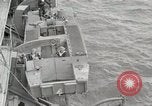
An LCA is suspended from the deck of an LST and rangers aboard LCAs alongside a British transport in Weymouth, England.
Pre invasion activities of United States Rangers in Weymouth, England just prior to the Normandy invasion. A Landing Craft Assault (LCA) is suspended on davits from the deck of the British Landing Ship, Infantry (LSI), HMS Prince Baudouin, and lowered to the deck level where U.S. soldiers board the craft. U.S. Rangers board LCAs at a pier. A Landing Craft Infantry in the background. HMS Prince Baudouin anchored at sea. LCAs alongside the ship. (World War II period).