


 Francais
 Deutsch
 Italiano

Refine Your Search
+"England" +1944 stock footage and images
- Showing 247 to 252 of 418 results more
 Hide
U.S. amphibious forces practice at Slapton Sands, England before the Normandy invasion in World War II
View from port side of a U.S. landing ship tank (LST) underway in the English Channel during World War 2. Ahead is another ship and three landing craft vehicle personnel (LCVPs) on the horizon. Scene shifts to stern of a boat in which two U.S. Coast Guard officers are seen, with Slapton Sands in the background. One smokes a cigar. Next, another view from the port side of the LST shows two officers standing on the deck. The ship approaches the shore and beaches at Slapton Sands. Targets and guide flags are seen on the sand along with a large sign designating Beach "B." A huge hill dominates the background. Closeup of the Coast Guard officer smoking his cigar. Next, a landing craft tank (LCT) number 140 and a Higgins Boat from Troop Transport PA-25 are seen hitting the beach. Closeup of U.S. Coast Guard officer observing through binoculars. A truck driving out of a landing craft utility.
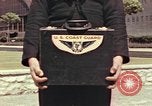
American soldiers board LCVPs at pier in Weymouth, county of Dorset, England, prior to D-Day, during World War II
Landing craft ferry Allied troops from pier in English port as they prepare for invasion of France during World War II. Two United States Coastguardsmen pose with members of British Women's Royal Navy Services (WRENS). Some British soldiers seated in a park with civilians on benches in the background. LCVPs ( Landing Craft Vehicle Personnel) tied up at the pier in Weymouth, Dorset. American soldiers are assisted by U.S. Coastguardsmen as they board LCVPs, which pull away from the pier as they are filled (ferrying troops out to transport ships). Several Landing Craft Infantry (Large) are seen in the port, including LCI(L)s 494, 92, and 490. View of Weymouth from a boat flying a green flag, in the bay.
Allied amphibious forces loading onto ships in preparation for the invasion of Normandy in World War II
Allied troops and equipment being loaded on ships in preparation for the D-Day invasion of Normandy, during World War 2. U.S. soldiers riding in landing craft as they position in the Harbor,Portland, England. Troops wave to the camera. U.S. Coast guardsman at the helm of a landing craft. Landing craft being hoisted aboard a transport ship. U.S. Army halftracks backing onto a Landing Craft Tank (LCT), alongside Stone pier,Castletown, Portland, England. One halftrack has some difficulty , but makes it OK.
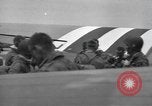
Lieutenant General Brereton bids farewell to U.S. paratroopers leaving RAF Greenham Common to invade Normandy in World War II
American paratroopers depart England for the invasion of Normandy, France (D-Day), during World War 2. U.S. paratroopers of the 502nd Parachute Infantry Regiment, 101st Airborne Division, help each other with their gear, as they stand beside a C-47 aircraft, on RAF Greenham airfield, England. A crew chief cleans the window of the C-47. Two paratroopers, with camouflage painted faces, converse. Three air crewmen, two in leather jackets, pose by the airplane. One, a Lieutenant,holds an oxygen mask and carries a 45 automatic in a shoulder holster. View from inside the cabin, as paratroopers climb aboard the C-47. Lieutenant General Louis H. Brereton, Commander, 9th Air Force, smiles as he offers something to a paratrooper who reaches out from the airplane for it. Brereton laughs and reaches out to shake the paratrooper's hand. The General salutes as the aircraft taxis away and joins a long line of C-47s preparing to take off. Ground crewmen wave to the departing aircraft. The aircraft begin taking off at dusk with their wingtip lights illuminated, bound for the coast of Normandy, France.

Winston Churchill returns to London, England after his convalescence in Morocco during World War II.
Prime Minister Winston Churchill accompanied by Lady Clementine Churchill and daughter, Sarah (in uniform of Women's Auxiliary Air Force), arrives by train in London, after an absence of two months. He had fallen ill following the Tehran Conference and remained abroad to convalesce in Marrakesh, Morocco. A crowd of well-wishers fills the platform. He chats with British military officers and officials and correspondents.
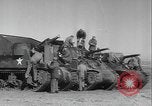
Armored vehicles undergo waterproofing and testing in Bideford, England.
U.S. Army soldiers waterproof U.S. tanks and military vehicles by hand during World War 2. Close up shots of men applying putty to seal the vehicles. Tanks with deep wading exhaust trunks, also called "breathers," are tested and driven in water. The wading snorkels are released off the back of an M4 Sherman tank and M10 tank destroyer as the tanks begin to drive on land.