


 Francais
 Deutsch
 Italiano
Refine Your Search
+"England" +1944 stock footage and images
- Showing 265 to 270 of 413 results more
more Hide
Hide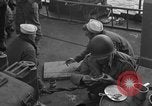
LST (Landing Ship, Tank) makes its way out of harbor at England.
Sailor playing mumblety peg board with jackknife. Sailor eats in the background. Several LST tied up to dock. Buildings in the background. Deck of LST as it makes its way out of harbor. Stern view of LST-75 as it moves out of harbor.
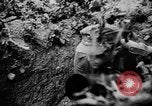
Germany launches V-1 flying bombs against England during World War II
Initial scene shows German soldiers setting up a camera, in a camouflaged location, during World War 2. . Views from the water, of the White Cliffs of Dover, on the English Channel coast. Suddenly, a jet-propelled V-1 flying bomb is seen racing past the camera and disappearing in the distance. Next the camera focuses on another V-1 and tracks it. Its body, wings, and jet engine affixed to its top, are clearly seen. as are pulses of flame from its engine. Another V-1 launches from near the camera and flashes past, disappearing in the distance. The final scene shows a V-1 in flight, even clearer than the earlier views. (Note: The V-1 was also known as a buzz bomb or doodle bug was the first cruise missile used in wartime.)

German V-1 rocket wreckage examined in England (WW2)
World War 2 German V-1 rocket in flight at night. Searchlights find a German V-1 rocket’s trailing exhaust tail over the English coast at night. The jet-propelled V-1 rocket in flight at daytime. V-1 rocket explodes after being shot down. Men examine wreckage of shot-down V-1 rocket. Remains of a V-1 rocket body, with a label reading “R. Ventil”
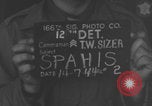
General Jacques Leclerc inspect the 2nd French Armored Division in England (WW2)
2nd French Armored Division Spahis guard at Dalton-Holme, residence of General Jacques Philippe Leclerc during World War 2. General Leclerc walking on the grounds accompanied by an aide. General Leclerc salutes to soldiers during his inspection. General Leclerc and aide board a car. A half-track moving into a forest during a field exercise. M3 half-tracks driving near Sledmere, Yorkshire. An M3 half-track of the 1st Battalion of the Regiment de Marche du Tchad. M3 half-track front-end is written with “TCHAD” (Present-day Republic of Chad). A soldier uses binoculars. An M3 half-tack front-end written “LORRAINE”. 2nd French Armored Division 75 mm Howitzer Motor Carriage M8 moves on the road near Sledmere, Yorkshire.
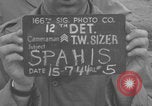
General Jacques Philippe Leclerc inspects French Armored Marine Regiment troops in England (WW2)
French General Jacques Philippe Leclerc and other officers inspect French Armored Marine Regiment soldiers, many of them Spahis, during World War 2. French soldiers play trumpets and present arms. General Jacques Philippe Leclerc arrives with other officials, including Colonel Dics. General Leclerc speaking to a soldier. General Leclerc inspects equipment and soldiers. An officer points out with a stick as General Leclerc inspect troops in line. General Leclerc and other officials inspect soldiers and vehicles. Soldiers board two military vehicles parked beside a Red Cross ambulance. General Leclerc speaking with officers, with the Red Cross symbol behind Leclerc. General Leclerc and officers inspect soldiers in vehicles.
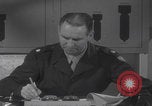
Incendiary bombs moved from United States to England during WW2.
Chemical Warfare Service (CWS) handles the distribution of incendiary bombs in Europe during World War II. Lieutenant Colonel R. N. Isbell of the Chemical Warfare Service (CWS) makes calculations from his desk. An incendiary order addressed to the Commanding General is typed on a typewriter. Buses arrive at the motor pool of the United States War Department, now known as the Pentagon. Women disembark from the buses and head to the War Department. Employees working in the office inside the War Department. Men prepare bombs at an arsenal. Men hauling carts with large incendiary bombs in warehouse. A man stencils labels onto bomb that read, "PT-1 Incendiary," and "Bomb Burster." The United States flag waving on a ship. Ships carry a shipment of incendiary bombs to the United Kingdom. Incendiary bombs inside wooden crates are unloaded from ships. Steam locomotive train running on track as railroad signal activates. Incendiary bombs are removed from train cars. Two munitions are suspended on a crane. Trucks loaded with bombs drive out of the depot, passing past village cemetery. An Air Division Chemical Officer receives new shipment information. The Air Division Chemical Officer reads the document and updates bomb listings on chalkboard.