


 Francais
 Deutsch
 Italiano
Refine Your Search
+"England" +1944 stock footage and images
- Showing 25 to 30 of 413 results more
more Hide
Hide
Allied troops aboard ships and gliders head for Normandy, France for the D-day invasion during World War II.
Allied invasion of Normandy, France during World War II. U.S. General Joseph McNarney, Deputy Chief of Staff at a desk as he outlines the importance of June 6, 1944 the day Allied forces attacked the Germans in Normandy. He speaks about the decision to knock down the Nazis first and then the Japanese during the World War. He says that the invasion of Normandy was planned in November 1943. He also states how General Dwight D. Eisenhower, Supreme Commander of the Allied forces in Europe, planned and executed the invasion. He also speaks about how the U.S. Army Air Forces and the Royal Air Forces aircraft bombarded the coasts of Normandy prior to the D Day invasion. Past events show American soldiers getting onto landing crafts in England as they leave for the invasion. The soldiers aboard the ships in the English Channel. The soldiers read the Bible and comics, sleep and cook aboard the ships. On June 5th , 1944 the ships head towards Normandy for the invasion. In England gliders carrying paratroopers take off from an airfield to bombard the German positions in Normandy. British soldiers receive ration and work on motorbikes. TNT (trinitrotoluene) charges being prepared by soldiers tasked with demolition duties. British soldiers check their guns and other weapons prior to the invasion. Jeep and artillery being loaded onto aircraft.
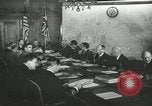
Landing craft, tanks, munitions, and gasoline supplies assembled in England for D-day invasion in World War II
Preparations in year 1943 for the June 1944 invasion of Western Europe by Allied Force during World War 2. Conference at Supreme Headquarters Allied Expeditionary Force in London. U.S. Generals George Marshall, Henry H. Arnold and British Field Marshal Bernard L. Montgomery meet at SHAEF (Supreme Headquarters Allied Expeditionary Force). Montage of war scenes: British Lancaster bombers taking off. British men and women monitors working in a British Command and Intelligence Center, tracking aircraft positions on maps. U.S. B-17 bombers in daylight missions over Germany. Allied pilots and crew members in aircraft. U.S. Army Air Force B-17 aircraft at high altitudes leaving contrails behind. Bombs bursting on German industrial targets. Allied agents being airdropped over France. Allied one-man submarines or solo submarines, torpedo boats and Commandos sampling French beaches and soil conditions in the Normandy region for ability to support 30-ton tanks for the invasion of France. British airman loading reconnaissance camera into a British Spitfire reconnaissance aircraft for photographing the planned invasion region. Woman operating microscope analyzing film. Aerial reconnaissance film images being laid out and attached together to create a large overhead viewing map. Arms and equipment being air dropped to indigenous resistance forces in Nazi-occupied Europe. Mulberry floating harbor segments being designed and built to create invasion ports. Allied landing craft training in Devon, England. Allied aircraft strafing a German ship. Meteorological equipment assessing weather along the invasion coast. Wire netting to pave the beaches. Underwater pipelines to carry gasoline or petrol to France. Allied armored vehicles bearing the White Star. Troops being inoculated or vaccinated. Newly built ship going down the ways at an Allied ship yard that builds Navy warships. View of British intelligence officers with headsets at radio equipment, and personnel monitoring German radio broadcasts. Soviet Embassy in Tehran, Iran, where the Big Three are seen meeting at Tehran Conference to finalize invasion plans. Stalin, Roosevelt, and Churchill sitting on the porch of the Embassy building, in 1943. General Eisenhower and Allied Military leaders planning the D-Day invasion. General Omar Bradley, sitting with a British admiral. General Bernard Law Montgomery Aerial view of formation of U.S. Army Air Force B-17 aircraft, flying through Flak bursts. Pilots in B-17 cockpit .Bombs striking German targets. Polish, Scenes including gun camera footage of Czech, and British in Spitfire aircraft striking German railroads and marshaling yards. B-26 bombers and gunner attacking German Luftwaffe Me-109 aircraft.
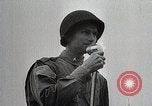
U.S. Paratroopers of 82nd and 101st Airborne divisions preparing to depart England the day before D-day in World War II
Film begins showing Brigadier General James M. Gavin, Commander of the Force A (parachute) contingent of the 82nd Airborne Division, standing on the hood of a jeep, at an airfield, to brief his paratroopers as they prepare for the D-Day invasion, during World War 2. A C-47 transport plane taxis behind the assembled group of troopers. Barbed wire is strung in the foreground. Paratroopers are issued French currency before departure. Some gamble with it using dice. Troops are seen playing volleyball on a field surrounded by trees. On an airfield, one trooper hits ground balls with a soft ball and several others field it. Some other troopers sit in grass next to the ramp, assembling wooden containers for airdrop. Two Army Air Forces mechanics fasten a tow bar on the nose wheel of a British-built Horsa Mk.II glider. They then tow it with a tug. View from above of Horsa gliders and C-47 tow airplanes, all in D-Day paint stripes, lined up on an airfield ramp. Paratrooper tent camp is viewed from above. Then, General Dwight D. Eisenhower and other senior officers are seen visiting paratroopers of the 101st Airborne Division, at the camp, on June 5, 1944, as they prepare to board their aircraft. Famous closeup of General Eisenhower speaking to a tall paratrooper who has his face camouflaged with grease paint.View looking down, as Eisenhower circulates among the troopers. Closeup of him conversing with another one directly.
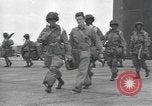
U.S. paratroopers board C-47 airplanes in England for the D Day invasion of Normandy, France in World War 2.
Paratroopers of the U.S. 502nd Parachute Infantry Regiment, 101st Airborne Division, at RAF Station, Greenham Common, proceed, in full battle gear, to board C-47 aircraft for their flight to Normandy, France, on June 5, 1944, during World War 2. Camouflage is seen on their helmets and their faces are blackened. One group is seen boarding C-47, tail number 43-15296. An officer reads briefing notes to them.They don life vests. A Captain and two Sergeants discuss briefing notes.Paratroopers help others who have difficulty climbing aboard the aircraft because of their heavy and ungainly equipment. Ninth Air Force Commander, Lieutenant General Louis H. Brereton speaks to Chaplain, Lieutenant Colonel Louis R. Goodrich, and shakes hands with some of the troopers, wishing them well, as they board C-47 number 42-92847, named, "That's All...Brother."(This was the lead aircraft for the airdrop, just behind the C-47s dropping pathfinders. It was piloted by the commander of the 438th Troop Carrier Group, Colonel John Donalson, and 87th Troop Carrier Squadron Commander, Lieutenant Colonel David Daniel.) The C-47s taxi out for takeoff, as senior officers watch them depart. (Note: There has been confusion about the name of the lead aircraft, C-47, 42-92847, because Colonel Donalson normally flew one named "Belle of Birmingham. " Research, including information from his daughter, indicate that he chose 42-92847, as lead aircraft, because it would have to be cut open to accommodate SCR 717C radar equipment, and he didn't want that done to his favorite airplane.)
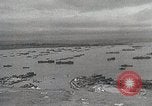
Allies in Britain prepare for D-Day invasion of Normandy, in World War II.
Allied invasion task force loading tanks, vehicles, troops and equipment on ships,at British ports, in readiness for the D-Day invasion of Normandy, in World war 2. Armored vehicle seen loaded onto USS Boone County (LST-389) at Falmouth in Cornwell, England on June 2, 1944, as troops load various ships. Troops near anchored craft USS LCI(L)-84 and another vessel (possibly marked 48 or 49). Tanks, bulldozers, and heavy equipement being loaded. View of Landing Ship Tank LST-621 and then LST-317 being loaded. DUKW vehicles in queue to load. A U.S. Army soldier is hoisted aboard a British Royal Navy ship in a special harness. British sailors around him and another U.S. Army soldier on the deck. Invasion troops from England and the United States spending their waiting time aboard ships. Three seen playing musical instruments: Accordion, guitar, and violin. Several play cards. Two practice gymnastics. Some prepare weapons and ammunition (view of LST-506 or LCI-506 in background). Navy sailors and U.S. Army troops huddled together in tight groups as they are briefed by their respective officers regarding the invasion mission.
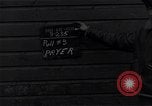
Pilots of the USAAF 334th Fighter Squadron celebrate their victories at Debden Airfield in England, during World War II
Three pilots, Major Gerald Montgomery, Major Howard D. (Deacon) Hively, and Captain Shelton W. "Shell" Monroe, of the U.S. Army Air Forces 334th Fighter Squadron, 4th Fighter Group, discuss a map during World War 2.. Logos of the Eagle Sqadron and the 334th Fighter Squadron displayed above a wall containing small painted German crosses representing enemy aircraft destroyed, probably destroyed, and damaged. Airman stencils two more under the destroyed column. Major Howard D.Hively of Athens, OH.,with another Major looking at record of aerial victories on the wall. Hively holds a sign reading "300 destroyed." He hands it to the other Major who tacks it onto the wall using the butt of his .45 caliber automatic pistol as a hammer. They smile and shake hands. Then Lieutenant Timothy Cronin stencils three more crosses in the destroyed column, under the 300 sign, as Lieutenant Victor Rentschler looks on smiling. The two men each recorded kills on Christmas Day 1944, one of which was the 300th kill for the squadron. (Shelton W. Monroe was later killed in Korea after his plane was shot down on April 17, 1951. )