


 Francais
 Deutsch
 Italiano
Refine Your Search
+"England" +1944 stock footage and images
- Showing 337 to 342 of 413 results more
more Hide
Hide
Floating ports prefabricated and towed across the English Channel for invasion of Europe; D-Day scenes in World War 2
Ships, supplies, troops, and weapons being marshalled for the invasion of Europe. Allied troops under fire wade ashore from landing craft during D-Day invasion of Normandy France. Allied troops on the beaches of Normandy. A floating port, consisting of Phoenix breakwaters, steel piers and related structures, designed in Quebec, Canada, assembled in England, and towed across the English Channel. A dozen Allied fighter aircraft in close formation fly over the floating port convoy. Aerial views of the numerous elements of the floating port. Diagrams of the floating port and building of a Mulberry harbour. Views of the sinking of caissons. Old Allied ships being maneuvered and scuttled to form a breakwater. A floating bridge extending to the beachhead. Trucks moving over the floating bridge. Barrage balloons over the beachhead. A storm inflicts severe damage to phoenixes and the new port. But supply operations resume after repairs are made off the coast of Normandy. Views of war weary U.S. Army troops taking a break for chow in the days after the D-Day invasion. American troops enjoy a hot meal and eat rations. Some smile. A soldier smoking a cigarette. A U.S. soldier cheers on fellow soldiers riding away in an Army truck.
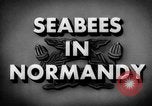
Construction of phoenix units, a Lobnitz pier head, and a pontoon bridge by the Seabees in Normandy, France.
Creation of an artificial harbor and bridges by the Seabees in Normandy, France during World War II. Coast of the English Channel. Phoenix units of the artificial harbor lying off the coast of England. A Lobnitz pier head. A section of whale unit & pontoon causeway. The Lobnitz pier at the end of a pontoon bridge.
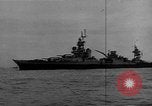
Allied movements including dispatch of Airborne units, the day before D-Day invasion of Normandy in World War II
Final preparations for the D-day invasion of Normandy, France, in World War 2. View of the USS Augusta (CA-31). Allied senior commanders on the Augusta, making decision to delay invasion 24 hours for weather. U.S. Army Airborne troops boarding buses for airfields in England. Formations of B-26 bombers overhead. B-17 bombing lines of communication. Invasion convoy ships underway. Gliders and C-47 tow planes in D-day stripes. C-47 aircrews and glider pilots being briefed. Brigadier General James Gavin, Commander of the 82nd Airborne Division, briefing his paratroopers. Chaplain conducting religious services. General Dwight D Eisenhower visiting paratroopers of the 101st Airborne Division. U.S. paratroopers boarding their C-47 transport planes. Troopers fastening parachute packs (parapacks) of equipment onto a C-47 for airdrop. Paratroopers loading their equipment onto a Waco CG-4A glider. Paratroopers of the 101st Airborne putting on their chutes and equipment. Jumpmaster checking each soldier's chute. The troopers helping one another as they board the aircraft. C-47 tow planes taking off with gliders behind. All planes in D-day white stripes.

German perspective on Allied attack and German defensive actions during the Allied invasion of Normandy, France.
German newsreel about the D-Day Invasion of Normandy. English narration overlaid by the U.S. Office of Strategic Services. German people read bulletin boards and newspapers describing the invasion. A map shows location of England and Germany. Information of assault broadcast in Germany by German radio stations. Announcers shown relaying information at switchboards. Alarm bells ring and German troops in bunkers grab rifles and stand ready to proceed. German antiaircraft guns and artillery fired at incoming Allied aircraft and and explosions seen at night. Allied Airborne troops incoming, according to narration, as nighttime artillery barrage continues. Naval units near mined waters. Germans soldiers in Atlantic Wall fortifications fire artillery and machine guns. Closeup views of German soldier faces, looking determined. Heavy artillery are fired at Allied troop units. Allied naval ships as seen from German perspective on shore in early morning light on D-Day. Shells are loaded into artillery and railroad guns and fired on the Allied warships from German gun emplacements and fortifications on the coast of France. British troops land on shore near the River Orne at the Normandy village of Ouistreham. Heavy bombardment from both sides. Germans examine Allied Landing Craft on the beach. Commentator says the British troops in them were annihilated or taken prisoner. Camouflaged German tanks move into position and fire on invading Allied ground troops. German forces pass wrecked gliders and an Allied parachute hung up in a tree. Allied Airborne troops are shown taken as prisoners by German forces and marched. Pan view of many Allied gliders, some crashed in a large field. British gliders seen. Close views of crashed gliders. German forces roll an intact Allied jeep out of a crashed glider and drive it away. Captured prisoner Canadian troops seen. Shoulder patch of one reads "North Nova Scotia Highlanders", and on another reads "1 Canadian Parachute Battalion Airborne". Interrogation of captured Canadian troops is seen. German holds a prisoner's "Soldier's Pay book". (World War II period).
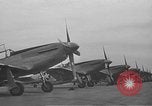
P-51 Mustangs and B-17 Flying Fortress planes attack German aircraft plants during World War II.
U.S. Army Air Force bombers attack Germany during World War II. View of U.S. P-51 Mustang aircraft in flight line at U.S. Air Base in England, United Kingdom. Aerial views of a formation of B-17 Flying Fortress planes and P-51 aircraft in flight over Germany. Bombs fall on German aircraft plants. Ruins of German aircraft plants after facing the bombings. Scene changes to show German war production workers building new Focke-Wulf aircraft (e.g., Fw 190) at production factory in Germany.
Allied paratroopers in gliders continue airborne assault in daytime, on D-day, after initial airborne troop drop the night before, in World War II
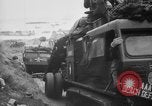
Allied invasion of Normandy, France during World War 2. Allied trucks and equipment move up from beachhead after D-Day. Half-tracks, armed with antiaircraft guns, move up from the beachhead. Back in England, gliders are readied for mission. A long line of Paratrooper medics wearing Red Cross Arm bands, board gliders. View from airplane flying over an airfield filled with C-47 tow planes, and gliders, all painted with invasion stripes. Closeup of Sergeant with British 6th Airborne Division showing Pegasus insignia on his sleeve. British paratroopers boarding a Hamilcar glider. U.S. paratroopers boarding gliders. View from above of Allied gliders being towed across the English Channel View from a ship in the invasion convoy, of tow planes and gliders overhead. View, from aircraft overhead, of invasion flotilla below. Distant view of Allied aircraft shot down by German antiaircraft fire, near the coast of Normandy and exploding in flames upon impact. View from the air of areas flooded by the Germans as a defense measure. Parachutes and gliders on the ground from earlier sorties. Gliders in this wave cut loose from tow planes and maneuver independently. Glimpses of Allied fighter planes moving fast and high above the scene. A glider splashing down in one of the flooded fields. Other fields, studded by the Germans, with poles 12-to 15 feet tall as defense against gliders. Gliders landing. Paratroopers leaving a Horsa glider, after landing.