


 Francais
 Deutsch
 Italiano

Refine Your Search
+"England" +1944 stock footage and images
- Showing 361 to 366 of 418 results more
 Hide
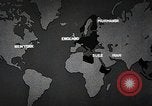
War supplies transported by the U.S. Army and the U.S. soldiers land in islands in the Pacific Theater during World War II.
War equipment and supplies transported to different parts by the U.S. Army in the Pacific Theater during World War II. Animation of a map depicts the routes taken by the ships to supply war equipment in different parts of the world. Men load supplies on donkeys. The donkeys loaded with supplies walk through rocky terrain. An aircraft loaded with supplies in flight. A warship in the Atlantic Ocean. A soldier observes through a binoculars. An aircraft in flight overhead the ship drops bombs. Explosions in water as bombs are dropped. A convoy of ships. American soldiers land in England. The soldiers disembark from the ships. A soldier carries supplies out of the ship. New Caledonia : Soldiers march out of a warship. The soldiers wave standing at the ship rail. Soldiers march holding flag of the United States. Flag of New Caledonia and the United States hanging out of a building. Iran : A stencil mark of USSR on a crate shows materials arrived from Soviet Union. Two soldiers greet and salute each other. Two soldiers standing in front of a vehicle talk. Egypt : Soldiers walk on a gangplank to unload supplies from a ship. Trucks parked. A train pulls past the trucks parked. A U.S. aircraft carrying cargo in flight. A U.S. aircraft stationed. Animation depicts the air routes of the U.S. Army air transport command. Men carry aircraft parts. Men stack crates. A U.S. aircraft drops supplies in isolated areas of New Guinea. Men look skywards as the aircraft drops supplies.
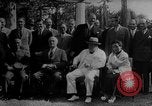
Mixture of scenes from Cairo and Teheran converences with glimpses of Soviet troops on the move and views of bombers and landing craft as well as an atomic test in the Pacific ocean.
Opening scene shows Chinese Generalissimo Chiang Kai-shek seated with U.S. President Franklin D. Roosevelt, British Prime Minister Winston Churchill, and Madam Chiang in their Cairo meeting at a residence of the American Ambassador to Egypt, Alexander Kirk, on November 25, 1943, during World War 2. Foreign ministers of the countries stand behind their leaders. Closeups of the three Country's leaders. Scene jumps to Teheran, with Soviet Leader, Joseph Stalin, President Roosevelt, and Prime Minister Winston Churchill, seated on a veranda of the Soviet Embassy. Suddenly scenes of tanks, trucks, and Soviet troops moving on the Eastern front are seen. Some of the troops move by horse-drawn sleighs through the snow. A line of U.S. Army Air Forces B-17 bombers taxiing on an airfield. View from a B-17 in flight. View f as a cluster of bombs falls from B-17 and explodes on the ground. Animated map illustrating paths of aircraft attacks against the German Atlantic Wall from England. Landing craft underway in an amphibious assault. Brief view from a ship of a post-war test atomic explosion in the Pacific ocean

Demonstration of a camera hidden in a bicycle basket. Cyclists on streets of town
A man fits a hidden camera into the basket of his bicycle, in England. Several other men stand near him. A man hands him bottles and groceries which he uses to cover the hide the camera in the basket. The men ride cycles along a road. Shops in the street. Pedestrians, cars and other cyclists in the background. The man pulls on a small string to make the camera take pictures while he rides. (Showing a method of surveillance and reconnaissance during World War 2)

U.S. Army Air Forces attack of the German fighter plane Messerschmitt bf-109 in the European Theater.
U.S. Army Air Forces VIII Fighter Command Operation in the European Theater during World War II. 1st LT J B England from 362 Sqdn.,357 F.G. attacks Messerschmitt bf 109 aircraft (or Me 109).
Allied Army paratroopers land at Arnhem Netherlands and advance inwards fighting with enemy during World War II.
United States Army and British Army airlifts paratroopers from England to the border of Holland during World War II. British and American transport airplanes and gliders land near Arnhem Holland (Netherlands). Soldiers, tanks and guns supplies offloaded and soldiers begin fighting with the enemy. Soldiers of Dutch Army aid the Allied forces. Allied soldiers rescue injured soldiers and advance towards enemy lines. Allied soldiers meet with Dutch Resistance or Dutch Underground Army members wearing identifying armbands. Group of German Army prisoners is seen including many young boy soldiers. Allied landing draws attention of German units allowing U.S. Army units to cross border into Germany. American soldiers near a bridge and crossing into Germany. They pass near railroad station at Roetgen Germany. Nazi German prisoners use horse carts and bicycle transport while being led away under Allied guard.

Allied B-26 bombers of 9th Air Force of United States Army Air Force raid Nazi French invasion coasts, during World War II.
Allied Air Front invasion bombers of the 9th Air Force of United States Army Air Force raid German held positions on French coast during World War II. B-26 planes take off from a base during dawn and bomb Nazi targets on French coast. Nazi antiaircraft guns fired at them and a plane gets crippled by it. The pilot returns and makes crash landing at the base. Airmen rush for help. The airmen ready planes for another raid on the Nazi French invasion coast. Guided bombs dropped from the bombers destroy Nazi bases. Commanding officer of the 9th Air Force, Major General Lewis H Brereton from the war room in England speaks about the success of Allied bombers in Europe.