


 Francais
 Deutsch
 Italiano

Refine Your Search
+"England" +1944 stock footage and images
- Showing 391 to 396 of 418 results more
 Hide
American troops practice amphibious assaults on English coast during World War II.
Opening scene shows a motor launch being lowered from the transport ship, USS Bayfield (APA-33). View of a Coast Guard Crewman with many U.S. soldiers on deck behind him. Next, the troops are seen descending a landing net over the side of the ship, into Higgins boat landing craft. Waves cause the net to sway out over the water with several soldiers on it. Silhoutttes of landing craft underway in the water with sun rising through haze in background. Landing craft heading toward a beach, and then troops charging ashore over the beach. (World War II; WW II; World War 2; World War Two)
German narrated film shows operations of Allied forces attacking German-held Holland during World War II.
German narrator describes a map of the plan of an Allied aerial and land operation, pointing at locations in the Netherlands including Nijmegen and Arnhem and Eindhoven. British bomber aircraft parked on a British airfield. Still images of British gliders on airfield being loaded with equipment including tanks. Still image aerial view of British glider flying, attached to tow rope. A British airfield filled with parked gliders and a British soldier driving a jeep into the belly of a glider transport.
U.S. gliders taxi and take off one after the other from a British base during World War II.
Preparations for D-Day Invasion of France during World War II. Four days before D-Day, U.S. gliders at a British base taxi and take off one after the other, towed by Douglas C-47 Skytrain aircraft. Insignia of the United States. A hangar in the background. The gliders in flight. They fly over an airfield in formation.
Baseball game being played by British teams in the UK during World War II.
Scoreboard reads ‘Next Saturday - USA Bears Vs Brad Bros’. The opposing teams run side by side toward home plate to start the game. One team's bench with players, and bat boys (some barefoot) seated in front of a picket fence, with spectators on benches and a club house behind them. View of game action from spectators perspective, behind home plate. Batters hitting and driving in a run. A lone American soldier watching in midst of the spectators. Players coming off the field to their bench at end of an inning. Spectators in stand watching the game. Items left after the game include several English shilling coins. A man's hand reaches down and picks up two shillings.
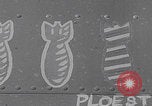
B-24D Liberator “Bomerang” Going-Away party in USAAF Hardwick, East Anglia, UK (WW2)
United States Army Eighth Air Force, Second Air Division celebrate a “Going Away” party for B-24D Liberator “Bomerang” (serial number: #41-23722) (Boomerang) in USAAF Hardwick, East Anglia, United Kingdom during World War 2. B-24 Liberator aircraft named “Bomerang” returns to the United States after completing 53 missions. Graffiti depicting bombs and the word “Ploesti” (referring to the Ploesti oil refinery raid). United States Army soldiers stand in front of a B-24 Liberator with nose art depicting a cartoon kangaroo carrying a bomb in both paws, one held overhead and one held in the kangaroo's pouch and the word “Bomerang”. United States and British pilots gather around a cake in front of B-24 Liberator “Bomerang”. Pilot holding a cake “Bomerang”. A pilot delivers a tribute to B-24 Liberator “Bomerang” in front of a crowd. Crowds cheer after pilot gives his tribute speech. Some pilots are wearing life vests. United States Major General James Pratt Hodges shake hands with pilots. B-24 Liberator “Bomerang” is now covered with written dedications from pilots, maintenance, and combat crews of the “Bomerang”. Men and women write their names, homages, and dedications on the body of B-24 “Bomerang”. B-24 Liberator engines are turned on. “Bomerang”’s pilot, Col. Walter Stewart, looks on. B-24 Liberator “Bomerang” taxiing on the runway on its flight to the United States.
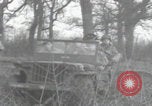
101st Airborne division troops collect air dropped supplies (WW2)
Military Jeep moving around a field where transport planes airdropped containers during World War II. 101st Airborne division troops collect containers from the back of a trailer and lay them on the ground. A soldier rolls a mat on the ground. He retrieves supplies from the mat. He brings the supplies to a stack behind him. They open the containers and separate supplies and ammunitions. Soldiers unload a large container from the back of a Jeep. They throw the container to a pile. A soldier sorts out ammunition.