


 Francais
 Deutsch
 Italiano
Refine Your Search
+"England United Kingdom" +1917 stock footage and images
- Showing 1 to 6 of 17 results more
more Hide
Hide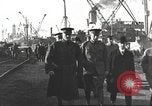
U.S. Army General John Pershing arrives at a base camp and inspects rail road guns in Derby, England, United Kingdom.
Activities of soldiers in Derby, England, United Kingdom during World War I. The U.S. Army General John J Pershing arrives at a military base. The soldiers stand at attention. General Pershing with the staff reviews the soldiers. Views of various heavy rail guns. The General inspects a railroad gun. The soldiers aiming the railway gun to demonstrate it to General Pershing.
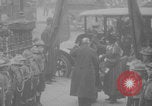
Society figures welcomed by Boy Scouts and crowd in London, United Kingdom during World War 1
British women, wearing thick coats and elaborate headdresses, are being welcomed by a gentleman and two rows of Boy Scouts as they exit a car during World War I. Streetcar behind is labeled "Aldgate Ilford " They enter an unidentified building with a large sign outside advertising "Scouts" Also on on the building is a poster advertising an April, 1917 meeting with "Nourishing Food" and "Come Early" with the partial title "The Lycell ". Two boys in the crowd drink porridge from pitcher and bowl.
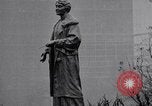
Brief montage of moving images from early 20th Century Women's suffrage and equal rights movement in Great Britain.
Scene opens showing the statue of British Women's suffrage movement leader, Emmeline Pankhurst, located in Victoria Tower Gardens next to the Houses of Parliament, Westminster. (This was erected in her memory, in 1930, two years after her death.) A World War 1 parade of women in clothing of religious orders; nurses; some military; and academics. One group carries a banner reading "Demonstrate-Trained Nurses." It also depicts What appears to be an Angel of Mercy and an appeal to buy war bonds. They are followed by women carrying a large British Union Jack, and by others, in academic garb, carrying banners of academic institutions. (This march was probably organized by the "Women's Party," the 1917 group founded by the Panghursts' to replace their "Women's Social and Political Union." The new party emphasized support for the British war effort.) Scene shifts to suffragist Emmeline Pankhurst (sometimes called a suffragette) viewed from camera behind her right shoulder as she addresses a large crowd. She is standing on a roofed platform in a park-like setting. The audience is mostly civilian, but a soldier is seen here or there. Several London Bobbies are in the audience, close to the speaker's stand. The next scene shows pedestrians gathered near Buckingham Palace, in London. A number of Bobbies (London policemen) are present, some on foot and some on horseback. The Queen Victoria monument is visible in the background. A horse-drawn carriage passes in front of the camera. Next, a woman is seen being arrested by two Bobbies, as passersby watch. An automobile passes and then the woman and police are seen approaching the camera as more officers become involved, keeping spectators away. In the final scene, in the 1920s, a man standing in front of a large group of women, congratulates one (probably Christabel Pankhurst). Closeup shows, from left to right, the man; a somewhat tired-looking Emmeline Pankhurst; and her daughter, Christabel.
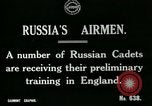
Russian air-cadets get trained in England, during World War I.
Russian air-cadets being trained at the Royal Flying Corps' No 1 School of Military Aeronautics, at Coley Park Aerodrome, Reading, Berkshire, England, during World War 1. Cadets march with their officer to a tarpaulin covered hangar. Next they are seen inside the hangar, removing a double wing from a bi-wing aircraft. . They sit, wearing earphones, at a table outdoors, learning wireless telegraphy. They examine the parts of a Clerget 9B nine-cylinder rotary aircraft engine, and sit for a lecture about inline engines. The instructor holds up a bearing and connecting rods from the inline engine. They look at an aeronautical chart and take notes. Cadets climb aboard a canvas-covered army truck and stand in it. They wave as it drives away.
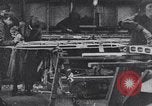
Prince of Wales visits women working in aircraft factory during World War I
British women at work in an airplane factory during World War 1. They are seen working with the framework of wings and other flying surfaces. Young Edward, Prince of Wales (later Edward VIII) in military uniform, examines parts in the factory during a visit with officials. He speaks briefly with a woman at her machine. The next scene shows women making adjustments on a Sopwith Camel aircraft. One tightens bracing on a left wing. Others rotate a propeller showing the movement of the airplane's rotary engine as its cylinders move with the propeller. Several women hold down the tail, as propwash from the running engine blows over them. Various tent-like structures are seen in the background. The number 6003 is seen on the aircraft vertical stabilizer. (WWI; WW1)
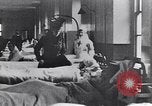
Queen Mary of Great Britain visits wounded soldiers during World War I
Queen Mary of Great Britain, is seen visiting wounded British soldiers at a hospital during World War 1. Change of scene shows her greeting British army officers at a railroad train station during World War I.