


 Francais
 Deutsch
 Italiano
Refine Your Search
+"England United Kingdom" +1918 stock footage and images
- Showing 19 to 24 of 27 results more
more Hide
Hide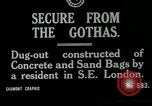
Early air raid shelter constructed with concrete and sand bags in South-East London, England during World War I.
World War 1 era air raid shelter dugout constructed with concrete and sand bags by British civilians to be safe from Gotha attack (German Gotha G.V. bomber) in London, England. People come out of house, stand beside the bomb shelter, and then enter it. They come out of the dugout and look upwards.
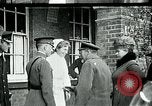
King George V and Queen Mary meet and thank American soldier patients at Red Cross hospital in Dartford, Kent, England.
King George V and Queen Mary of England visit American soldier convalescents at American Red Cross hospital in Dartford, Kent, England, near the end of World War I. King and Queen arrive at hospital. Colonel H.E. Fiske, officers and nurses receive them. King stands past the bed of a patient, touches his leg and talks to him. Queen talks to the nurse. Wounded, recovering soldiers and their attendants stand and talk. World War 1 soldier patients stand and wave. Nurses stand and talk. King and Queen accompanied with others climb down stairs. Queen shakes hands with nurse and an officer. King shakes hands with the officer.
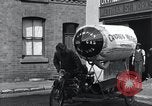
British use coal gas as substitute motor fuel during World War I
Large tank filled with coal gas seen mounted on a motorcycle. Campion Motors Nottingham, is written on side of the tank, and Campion Coal Gas Motors on the front. The motorcycle pulls away from the company works at Mettham Street, Nottingham. The motorcycle and tank structure driving along a highway, with driver plus two men riding on the tank undercarriage. They are accompanied by another man on a motorcycle and one in its sidecar. The cycle with the tank demonstrates its maneuverability. Change of scene shows driver of a coal gas fueled bus refueling from a gas pipe. Fumes surround the connection as he refuels. He disconnects and tucks his refueling hose away. Passengers are sitting in the bus. Closeup of rear of bus shows huge inflatable gas tank atop the bus. "Chapman's, Driven by Coal Gas," written on back of the tank. The bus drives down a village street, as small boys run along beside it. World War 1 period.
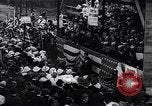
Fourth Liberty Loan Parade, Pittsburgh, Pennsylvania. American celebration and parade in London, England
Several separate scenes from World War I. Brief glimpse of 4th Liberty Loan parade in Pittsburgh, Pennsylvania, during the First World War. The Liberty Loan Committee with group of persons standing in front of their stand. Employees of Heyl & Patterson Inc. carry a banner announcing 100% subscription in the 4th Liberty Loan drive. Sign on street pole tells directions to the American Locomotive Pittsburgh works. Scene changes to London,England, where British Army drummers stand and play in front of a YMCA building. People in crowd behind them wave American flags. Americans, including YMCA workers, soldiers, sailors, nurses, and English friends celebrate in a parade,accompanied by a British Army band and escorted by London Bobbies (policemen). Revelers ride in cars bedecked with American flags. Many ride on Army trucks. U.S. officers ride in staff cars. Another change of scene shows a U.S. Navy cinematographer hand cranking his motion picture camera, while standing in an open car. The car has a sign on its side reading: "Photographic Division, U.S. Navy." Another sailor sits in driver's seat while a third keeps pedestrians clear from the camera line of sight.
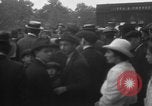
British pacifists gathering in London, England, during World War I
Group of well-dressed pacifists gather in London, England, during World War 1. Sign on building in background reads: "Tea & Coffee." The crowd, including men, women and children, mills about as several British Bobbies (policemen) nudge them along. The crowd ends up near some buildings and shops, including "L Lyons & Co Ltd."
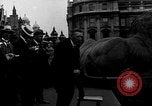
British MP Havelock Wilson urges support for war against Germany during a public meeting (WW1)
United Kingdom Member of Parliament and President of the National Seamen's and Firemen's Union Havelock Wilson argues against pacificism and calls for "Peace with Victory," at a public meeting at Trafalgar Square in London, England (Trafalgar Sq, London WC2N 5DN, United Kingdom) He stands near statue of lion at base of Nelson's Column and addresses a seated audience of men and women. In change of scene, Mr. Wilson poses, using two canes for support, as he speaks in front of a building. Men hold up a sign reading: "Sailors and Soldiers, Don't forget to declare yourselves in favour of the Seamen's Boycott of the Huns." (The Seamen pledged to boycott German maritime activities, following the war as reprisal for German attacks during World War I) Closeup of Havelock Wilson.