


 Francais
 Deutsch
 Italiano

Refine Your Search
+"England United Kingdom" +1943 stock footage and images
- Showing 49 to 54 of 66 results more
 Hide
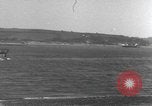
U.S. troops in amphibious training at Crow Point in Devon, England, during World War II.
A joint amphibious training of the United States Army and the Navy at Crow Point in Devon, England during World War 2. A Landing Craft Mechanized ( LCM ) underway at sea as it approaches the beach. United States troops walk past the RR towards the LCM. Men embark onto the LCM. The troops loaded onto the craft and a ramp being raised. All the LCMs carry markings beginning with "NATB."
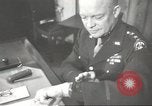
General Eisenhower being photographed upon his appointment as Supreme Commander of the Allied Expeditionary Forces in World War II
General Dwight D. Eisenhower at Headquarter Allied Expeditionary Forces in London, England during World War II. General Eisenhower seated at a desk after assuming the office of the Supreme Commander of Allied Expeditionary Forces. The General at the desk as cameramen record. A woman, in Army uniform, takes down notes as Eisenhower dictates.. General Eisenhower at a wall map. He poses against the map. He talks to officers. Eisenhower poses and smiles.

General Eisenhower delivers brief remarks upon his appointment as Supreme Commander, Allied Forces, in World War II
U.S. General Dwight D. Eisenhower is besieged by correspondents and photographers in London, upon his appointment as Supreme Commander Allied Expeditionary Forces during World War 2. He us seen pointing at a wall map of Europe. Then, with flags of Great Britain and the United States behind him, he makes remarks from his desk. He expresses pleasure at the Joint nature of the allied command, and the effectiveness of the U.K. and U.S. forces. He extols the advances made on the Eastern front by Soviet forces. Finally, he expressed confidence in the ultimate victory of the United Nations.
U.S. 8th Air Force activities at RAF Station Chelveston, England, in World War II
U.S. 8th Air Force B-17 Flying Fortress bombers in England during World War 2. Interiors of an operations building shows an operations officer making a call on a phone. Displayed on a board is a chart of the airfield, RAF Chelveston (USAAF Station 105) in Northamptonshire, England. Airmen inside the operations building measure distances on a large wall map. A tower operator fires a flash signal gun. British and American airmen stand on an observation platform and watch B-17s overhead, while several aircrew members sit in the grass below. A British airman on the platform holds a very pistol.
B-17s of the U.S. 91st Bomb Group, returning to their base at RAF Bassingbourn, England in World War II
B-17s of the U.S. 91st Bombardment Group, returning to their home base at RAF Station Bassingbourn following a bombing mission,in World War 2. B-17, tail number 41-24617, named "Southern Comfort," taxiing on outboard engines, only, after landing with a large chunk of its rudder shot away. Crew members and other airmen gather around the battle-damaged aircraft. Closeups of the damage to its rudder. Dim views of the B-17, "Memphis Belle," tail number 41-24485, with skin missing from wing exposing its internal ribs. It also has holes in its rudder and its nose. Closeup of a B-17 engine stained by fire-fighting foam. Other views of battle damage to a B-17.
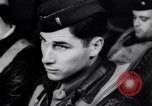
CO of USAAF 56th Fighter Group briefs P-47 pilots B-17 escort mission to Bremen, Germany, in World War II
Operations of the U.S. Army Air Forces (USAAF) 56th Fighter Group stationed at RAF Halesworth, Southwold, Suffolk, England, during World War 2. A Lieutenant pilot of 56th Fighter Group, writes notes on back of his hamd during briefing by Group Commander about "ramrod" (escort) mission to accompany B-17 bombers to Bremen, Germany. Intelligence officer briefs on enemy flak and fighters, and tells aircrews to watch out for German twin engine rocket planes from below. Weather officer briefs on anticipated conditions. Aircrews synchronize watches. (Narrator remarks about "Ramrod to Emden, suggesting that footage may contain mix of scenes from different missions.) Pilots board jeep ankle deep in mud, piling their chutes on the hood. Jeep stops near a P-47 abd oilot climbs into its cockpit. Propeller seen rotating. P-47C, 41-6271 “Rat Racer” of the 61st Fighter Squadron is seen. Planes taxiing.