


 Francais
 Deutsch
 Italiano
Refine Your Search
+"Ettersberg Germany" +1945 stock footage and images
- Showing 13 to 17 of 17 results
Young boy prisoners and liberated male prisoners suffering from emaciation and maladies at Buchenwald Concentration Camp in Germany.
Prisoners at Buchenwald Concentration Camp near Ettersberg and Weimar Germany, a few days after its liberation by American forces in World War 2. Prisoner shows emaciation. Man with crutches in the background. Other prisoners show deformation from malnutrition, atrocities, and abuse suffered in the camp. A prisoner suffering from emaciation is held up by another man. A four year old boy prisoner. The child wears a cap and a coat with a 'P' sign on it, and has been given a U.S. Army Infantry crossed rifles pin which he wears on his right lapel. Close up of the boy prisoner's face as he smiles. A group of boy children prisoners who were imprisoned for a year and a half stand together in a group. They are singing.
Liberated prisoners cook and eat food, a Polish prisoner prays and view of barbed wire fence at Buchenwald Concentration Camp in Germany.
The prisoners at Buchenwald Concentration Camp near Ettersberg and Weimar Germany several days after its liberation by U.S. Army forces in World War 2. Group of prisoners around fire cook and eat food. Prisoners cook food in a kettle. They sit in a group around fire. The elderly prisoners seated. An eldery Polish prisoner cries and prays. A barbed wire fence enclosed around the prison camp. The prisoners stand inside the fence.
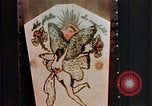
Examples of tattooed human skin at Buchenwald Concentration Camp in Germany.
Evidence of atrocities at Nazi concentration camp. Examples of tattooed skin of dead prisoners at Buchenwald Concentration Camp in Germany, near Ettersberg and Weimar, several days after the liberation of the camp by American Army forces. Close view of a tattoo on human skin. A finger points to areas on a tattoo. A piece of human tattooed skin. The tattoo shows a flying dragon and a soldier killing it. A finger points out an area of the tatoo with soldier and dragon. A sketch or tattoo of a woman. (World War II period).
Examples of Nazi atrocities at Buchenwald: Book about tattoo methods; human skins with tattoos, lateral cutaway human head in glass jar.
Evidence of Nazi atrocities at Buchenwald Concentration Camp near Ettersberg and Weimar Germany. U.S. soldier in U.S. Army jacket shows a German book entitled "On the Question of Tattooing". View of human skins of atrocity and human experiment victims with various tattoos displayed on a table. Shrunken human head of a prisoner. The head is mounted on a pedestal. Another head of a prisoner. A laterally cut human head in a glass jar filled with liquid. A soldier turns the jar to show the external and internal view of the cutaway head. (World War II period).
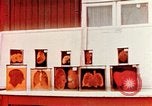
Various cutaway specimens of human bodies preserved at Buchenwald Nazi Concentration camp in Germany.
Laterally cutaway specimens of human body parts and organs displayed at Buchenwald Concentration Camp, as evidence of Nazi atrocities in World War 2. Various specimens of the human body, including a human head and other organs cut laterally and in preservation display cases. They are arrayed on a table at the Conentration Camp, liberated by American forces four days prior.