


 Francais
 Deutsch
 Italiano
Refine Your Search
+"Europe" +1917 stock footage and images
- Showing 7 to 12 of 52 results more
more Hide
Hide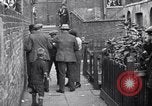
Events that initiated World War I and animated map showing involvement of nations from 1914 through 1918
Opening scene shows a man being roughed up by a group of men in an alleyway with pushing and shoving as they fight. A slate comments (in French) that when nations are bellicose, an assassination can cause a world war. Next, a slate shows picture of the world and states (in English) "One murder may start a world war." Another slate (in French) states that In 1914, while Europe's armies and fleets were more powerful than they had ever been, the nephew of the Emperor of Austria (Archduke Ferdinand) was assassinated. A front page is shown of newspaper, "Journal De Geneve" carrying the story. Next scene is a view of the city of Sarajevo. The ancient Emperor's Mosque dominates the scene. A slate appears asking Where is Sarajevo? It is followed by a map of Europe in 1914, which zooms in on Austria and Serbia and identifies and labels Sarajevo,in Austria, close to the Serbian border. Slates (in French) says Austria accused Serbia of War and other nations enter the melee. Animated World map shows the nations getting involved, starting with the German Empire in 1914, including its African colonies, and then successively showing Russia, France, Belgium,Great Britain, Japan, and the Ottoman Empire. Map advances to 1915, showing the Italian empire, Bulgaria,and Central Arabia. In 1916 it adds Portugal, Roumania. Next, the U.S.A. is added in, 1917, along with Central and South America, Greece, Siam, and China. Finally, the slate shows the war ending in 1918. Slate shows Armistice Day, the 11th hour of the 11th day of the 11th Month (November), with time shown on hands of Big Ben in London.
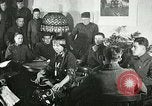
U.S. soldiers watching the performance of Tsianina Redfeather (a.k.a. Tsianina Blackstone), during World War I .
Tsianina Redfeather (also known as Tsianina Blackstone), a famous Creek-Cherokee Native American Indian mezzo-soprano, plays the Hawaiian guitar and sings for U.S. soldiers in YMCA- sponsored entertainment for the troops in a canteen, 1917-1918, during World War 1. (Historic note: While sailing to Europe in 1918 as a member of the American Expeditionary Forces, her vessel, the HMS Carmania, was struck by a torpedo. She continued the journey, entertained thousands of troops, and received a commendation for her service. Her interest in entertaining the troops, according to her autobiography, rested in the fact that so many American Indian soldiers were fighting overseas-- around 17,000. After her return to the U.S. her career continued to escalate. This clip perhaps represents the only surviving footage of this truly remarkable individual.)
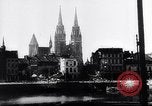
Britain attempts to recover its defensive capabilities following equipment losses in the evacuation at Dunkirk, France, in World War II
Opening scene shows a cathedral and houses near the English Channel coast in World War 2. German troops, part of a force of 100 Divisions, are seen advancing through French towns toward the coast. A German army band leads some. Others march through the countryside. Close-up of some ot the marchers, along with a Sd.Kfz.9 Half-Track pulling an artillery field piece. A column of German army trucks raising dust on a French country road and many waiting in line to cross a canal. A covered German halftrack pulling a covered trailer across a partially collapsed bridge. View from a moving railroad train with German troops and one manning an MG-08 machine gun on an open flat car. German soldiers in a "bucket brigade" passing cargo, including jerry cans, being off-loaded from a German Junkers Ju-52 transport plane at a grass airfield in France. A German Krupp K5 railway gun being run up an elevated rail. Imaginative animated map showing Nazi-dominated Europe in contrast to the British Isles. British troops marching. Change of scene to the beachhead at Dunkirk, France, during the mass evacuation of British forces ahead of approaching German armies. View from a British Destroyer of troops wading out through the water towards it. Close-up of two British soldiers being pulled from the water onto a boat, by two men in fowl weather gear. In skies above, British and German aircraft are engaged in aerial dogfights. A British Destroyer filled with soldiers evacuated from Dunkirk. Vickers/Maxim Octuple QF 2-pounder Mark VIII guns being fired by a British warship. British soldiers, some covered with oil, on the deck of a destroyer. Scene shifts to armor and weapons abandoned by the retreating British forces, including trucks, tanks, anti-aircraft guns and armored cars. Scene shifts to England where rescued soldiers begin ascending a gangway from the crowded deck of a warship to a pier above. Smiling British soldiers relaxing as they arrive on a pier. Many rescued soldiers getting organized on land. Narrator mentions that the losses of war materiel leave Britain short of its needs. Soldiers standing around a British Infantry Tank Mk.III Valentine. Soldiers manning a coastal defense machine gun position. Views of the British English Channel coastline. A British battleship (or Battle Cruiser) showing two forward triple gun turrets, is seen underway, ahead of an aircraft carrier. Silhouetted distance views of several British destroyers, and closer view on one escorting a supply shiip. (Narrator notes the British navy was absorbed in protecting supply lines all over the globe.) Animated map illustrates the overwhelming superiority of German Air Forces directed against Britain. view of British airfield displaying flag with Union Jack and RAF roundel. Several RAF personnel stand around an Avro Anson twin engine airplane, parked on the ramp. Several Supermarine Spitfire aircraft are seen parked on an airfield. Close-up of two flying in formation. View of St. Paul's Cathedral in the heart of London, England. British people are seen in a city and at home engaged in ordinary activities, scrubbing floors, chatting over drinks at a Pub, and waiting on a customer in a lady's shop. A farmer tends sheep in a field next to a church, where he converses with the Vicar. A baby crawls across pavement to his mother who reaches out from a doorway. New recruits in uniform mingle with people on a sidewalk. Mature women in uniform walk along with British Army officers in uniform. British sailor and an officer walk past the camera. A boy and older men at work in a field. Four businessmen dressed in civilian clothes are next seen in military uniforms, shouldering rifles. Home Guard civilians carrying rifles are trained in close order drills on a lawn. A home guard man points to a drawing of a tank as he asks a question during an outdoor training session. Recruits watch demonstrations with Browning M1917 water-cooled machine gun, and hand grenade launcher on Enfield rifle. A recruit takes his turn firing a single round (to save ammunition) from a Thompson M1921 submachine gun. He hands the weapon back to the instructor and returns to his place.
World War 2 film promoting public investment in War Bonds and stamps to aid the war effort and temper inflation
World War 2 era film that also includes some World War 1 scenes. Show girls or chorus girls in follies-like show, costumed as U.S. silver dollars and marching to tune and lyrics alluding to dramatic increase of currency in circulation, over the years. Animation with stacks of coins shows increase in national income from $46 billion,in 1933, to $71 billion, in 1939, and $142 billion in 1943. Back to the "follies dollars," a boy asks why, and then scenes of the Japanese attack on Pearl Harbor,are shown, with U.S. battleships being sunk. Wartime arms plants are shown. An M2A3 Light Tank rolls off a production line. Ships being constructed in a shipyard. B-24 Liberator bombers being built in a factory. Artillery shells being produced. Defense workers receiving their pay. The "follies dollars" group themselves to illustrate the fractions of income devoted to taxes and savings. But other spending is curtailed by wartime shortages. A woman talking with clerk in a drug store. U.S. Army troops crossing a pontoon bridge in open trucks, towing 75mm M1A1 howitzers. Infantry on the march. Animation showing industrial production devoted to war materiel and lots of dollars chasing few civilian goods. A grocery clerk offers to sell a woman customer butter for more than the established price, and she agrees. The "follies" performers then introduce the idea of an "inflationary dollar," and some history of past U.S. inflations. Animated examples of price inflation are shown. Glimpses of World War I scenes are seen, circa 1917 -1918, including: a 12-inch railway gun firing; a huge explosion from shell bursting near the camera; various scenes of United States infantry soldiers and French soldiers in battle action, running to bomb craters for cover and emerging from trenches to go up "over the top" into no-mans land during combat. Meanwhile, singing narration refers to the home front inflation due to competition for limited civilian goods. Map shows Europe and singing narration cites rising prices for food in occupied France and other countries suffering ravages of World War II. Montage of scenes showing needy civilians obtaining food in those countries. Animation shows increases, by 1944, in cost of U.S. civilian goods since the Pearl Harbor attack. "Follies" character called "Double-duty dollar," appears explaining he serves the war and curtails inflation on the home front by being saved through investments in War Bonds and stamps.
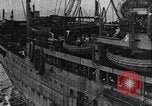
Soldiers march on streets holding rifles during World War I and veterans return to farming and dairying in United States.
A United States troop transport ship at sea during the first World War. U.S. Army troops (aka dough boys) aboard the ship. U.S. Army soldiers march in formation in a large city square area in Europe (likely France) holding rifles during World War 1. United States troop ships being loaded with American soldiers for World War I, and scenes of U.S. troops in WWI marching in the streets of a European city. Scenes from earlier during combat in the war. World War I allied soldiers on battle front in France. Soldiers run to a bomb crater area for shelter when crossing no man's land. Soldiers fire artillery. Artillery shells explode. Allied soldiers running across a battlefield as tanks run beside them toward the German enemy. People wave U.S. flags as First World War war ends with Armistice. Large crowd gathers in New York celebrating WWI armistice. Newspaper held high by a man with headline "Germany Surrenders". Views in the United States of hard times in American towns after World War I ended and war industries were no longer providing money. View of forests. Girl draws water from a well. Man and a boy operate a grindstone sharpening a saw. Farmers plowing fields with horse drawn plows during great depression era. People do agricultural works at fields. White farmer tilling a field. African American farmers working in fields and harvesting hay with help of a horse. African American farmers at cotton office. Cattle in field. Man and a woman milk cows with hands. Man pours milk in vessels. Milk processing before bottling including pouring milk through a cooling device. Men on tractor at fields. A board reads 'For the common defense'. Views of a factory. A man operates a switch on a switchboard for generating electricity. Views of a power generation plant. Narrator describes how America will prevent a slide into hard financial times again after World War 2 ends. From a 1942 production with footage from 1917 through 1942.
America enters World War I against Germany
A ship blows up at sea (presumably torpedoed by a German submarine). Newspaper of April 2, 1917 announces the United States and Germany at War. U.S. Secretary of War, Newton D. Baker, speaking on a public platform, outdoors.. General John J. Pershing, Commander of American Expeditionary Forces in World War 1, is seen seated behind Secretary Newton. Scene shifts to U.S. President Woodrow Wilson signing papers his his desk at the White House, Washington, DC. Next, Red Cross women are seen serving coffee into the mess of American soldiers about to embark for Europe. Another Red Cross woman carries a basket of baked goods. The soldiers are checked off by officers at the pier, and then embark on a troop ship. View of the troop ship in camouflage paint, moving away from the pier Scene shifts to glimpse of a town in France, where an American officer and some soldiers are seen walking past French inhabitants on a street corner Other American soldiers stand near a large canvas covered army truck. They salute as the American officer passes them.