


 Francais
 Deutsch
 Italiano
Refine Your Search
+"Europe" +1918 stock footage and images
- Showing 49 to 54 of 72 results more
more Hide
Hide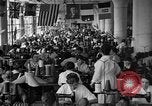
Workers attach nose clamps, head straps, mouthpiece and breathing tubes to the face pieces of masks at a factory in France.
Manufacturing of gas masks in Europe during World War I. A large group of French women stitch rubberized fabric. A worker cuts the fabric after marking it. Rubber rimmed eyepieces are cemented in place. A worker attaches nose clamps, head straps, mouthpieces and breathing tubes to the face pieces of masks. French women workers give finishing to the gas masks. A U.S. soldier stands with the finished product.
World War I comes to an end after armistice.
Events and end of World War 1. A newspaper headline about the end of World War I after the armistice. Cheering masses of people gather on streets in Europe and in the United States in New York City and other cities to celebrate the end of World War I. French and American soldiers celebrate at the war front in France. Two soldiers exchange their hats.
America enters World War I against Germany
A ship blows up at sea (presumably torpedoed by a German submarine). Newspaper of April 2, 1917 announces the United States and Germany at War. U.S. Secretary of War, Newton D. Baker, speaking on a public platform, outdoors.. General John J. Pershing, Commander of American Expeditionary Forces in World War 1, is seen seated behind Secretary Newton. Scene shifts to U.S. President Woodrow Wilson signing papers his his desk at the White House, Washington, DC. Next, Red Cross women are seen serving coffee into the mess of American soldiers about to embark for Europe. Another Red Cross woman carries a basket of baked goods. The soldiers are checked off by officers at the pier, and then embark on a troop ship. View of the troop ship in camouflage paint, moving away from the pier Scene shifts to glimpse of a town in France, where an American officer and some soldiers are seen walking past French inhabitants on a street corner Other American soldiers stand near a large canvas covered army truck. They salute as the American officer passes them.
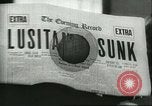
Men aboard U.S. merchant ships underway at sea in the United States after the declaration of war in World War I.
The legislative and maritime history of the U.S. Merchant Marines. Newspaper headlines in the United States read: 'SS Vigilancia', 'Torpedoed', 'US declares war' during World War 1. Women march in a parade with a banner "Wake Up America". President Woodrow Wilson with military and other officials marching on a New York City street decked out for a parade. U.S. infantry and cavalry pass led by General Pershing on streets of Paris France. Buildings along the sides of an American city street decorate with bunting for a parade. U.S. Army soldiers pass in parade review. Soldiers aboard a ship. The U.S. troop carrier ship underway at sea bound for Europe. Women and families on shore dock wave hands and scarves to the departing U.S. forces heading for the war front. Supplies being loaded onto a ship. Shipbuilders quickly working to build both steel and wooden ships to carry forces in the war, due to a lack of transport ships. A newly completed ship slides down the ways and takes float. Men standing on the deck of the ship. A newspaper headlines reads: 'War Ends'. A busy American shipbuilding and port area crammed with ships of all sizes. Ships sitting idle after World War I and some in disrepair including one with name "America" on the bow.
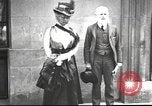
King George V and Queen Mary attend thanksgiving service at St. Paul's Cathedral to celebrate Armistice ending World War I
James Bryce (1st Viscount Bryce) and Lady Bryce, are seen briefly, posing, in their old age. Then, Admiral William Sims, Commander of U.S. Naval Forces in Europe, is seen stepping from a car, in London, England. He poses with two of his staff officers. Change of scene shows a sunny day in London, and sidewalks packed with spectators, who cheer as a double-decker bus passes, carrying men in uniform on the top deck, waving flags and celebrating the armistice ending World War 1. The next scene shows Britain's Royals and notables proceeding under a canopy to Saint Paul's Cathedral for a thanksgiving service to celebrate the armistice. Among the many seen are: The Lord Mayor of London, Horace Brooks Marshall; members of Parliament; Military officers; the Rector of St. Paul's; King George V (in Navy uniform) and Queen Mary; and other dignitaries. After the service, the Rector is seen conversing with the King and Queen as they leave the cathedral. The next scene shows a British officer standing in front of a formation of Colonial officers. Spectators outside the cathedral are seen standing behind an English Bobbie (policeman). An American soldier is in the group. Final scenes show a memorial set up in a garden. Flags of the Allied nations are displayed at the top of the structure. British and American soldiers are arranging many flowers at the base of the memorial. Several veterans, using crutches, approach the memorial. Soldiers escort little children who place flowers on the site. (World War I; World War 1; WWI; WW1)
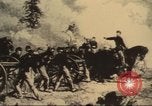
Union soldiers print the first issue of Stars and Stripes newspaper during the Civil War in the United States.
The history of the Stars and Stripes newspaper. Union soldiers print the first issue of Star and Stripes newspaper in a captured press in the U.S. on 9th November,1861 during the Civil War. World War I scenes show soldiers disembarking from a ship and advancing on a battlefield. Commanding Chief of the American Expeditionary Force John J. Pershing writes for the newspaper. Soldiers greet the Chief and wish him luck. After the end of World War I newspaper publication is ceased. During World War II the newspaper publication starts in London, England in 1942. Publication of the Pacific Stars and Stripes newspaper after the end of hostilities in Europe. Headlines in various editions of the Stars and Stripes.