


 Francais
 Deutsch
 Italiano
Refine Your Search
+"Europe" +1941 stock footage and images
- Showing 7 to 12 of 44 results more
more Hide
Hide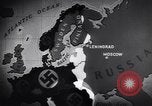
German Operation Barbarossa on the Eastern front in World War II
Animated map shows extent of German controlled areas in Europe following their conquest of the Balkans in World War 2. Norway is under their control and German forces threaten Leningrad and Moscow. A soviet defense line is shown on the map. The German attack is shown to come from 5 directions on June 22, 1941, with the launch of German Operation Barbarossa. A sky filled with German Heinkel He 111 bombers is shown. German Panzer III tanks with 75 mm guns. Army trucks carry German troops into battle. German soldiers on motor cycles and infantry advance under fire. Animated map shows principal German targets as Leningrad, Moscow, and Kiev. It then shows beginning a drive from the North to encircle Leningrad. Arrows show where German Marshal Fedor von Bock's forces drove 480 miles into Soviet territory. Slates identify cities being overrun by German invaders, including: Pskov, Novgorod, Brest-litovsk, Minsk,Mogilev, and Vitebsk. On July 17, 1941, a German tank is seen entering Smolensk, past the Dnieper River threatening Moscow, itself. To the south, German forces, under Marshal Gerd von Rundstedt, cut deep into the Ukraine. Newspapers world-wide consider the Soviet forces close to defeat. Slate shows communique from the German High Command stating: "The issue in the East is already settled. Smolensk is the last halt on the road to Moscow." German infantry marching. Scene shifts to heavy artillery being fired by Soviet forces in a snowy scene clearly later in the year. Animated map shows German forces very close to Moscow on October 15, 1941, forcing the Soviet Government and all foreign missions to move to Kuibyshev, 700 miles to the east. Adolf Hitler, in a speech on October 3, 1941, states that the enemy is broken and will never rise again. Animated map shows 500 thousand square miles of Soviet territory occupied by German forces. Views of fires burning in Russia. Damaged and abandoned Soviet industrial plants. A German guard atop a hill looks down on thousands of Soviet people in the occupied areas of Russia. Damaged and abandoned Soviet T-26 tanks. Glimpse of damaged Soviet aircraft and field artillery. Headline in New York World Telegram newspaper reads: "Berlin Admits Russ War May Last Winter." Another headline reads: "Red Army Holds Push On Moscow." Weary German soldiers traveling in horse-drawn wagons, pulling field artillery. Soviet and German war planners are seen at work. Slate quotes Adolf Hitler saying: "A single blow must destroy the enemy, without regard for losses... A gigantic all-destroying blow." German armor moving along a road. Animated map shows this technique in the German invasions of Poland, France, the Balkans, and Yugoslavia. In contrast, the Soviet planners are seen, as map illustrates how they intend to take advantage of the vast area of their land by holding lines of defense an falling back as necessary to keep engaging the invaders across interior of the Soviet Union. Soviet infantry are seen marching along a road. German troops riding atop their tanks. Soviet troops forcing German invaders into close combat in her cities. Soviet soldiers running in a city and firing heavy machine guns. Bomb damage and rubble inhibit German armor mobility in cities. Cities where this kind of Soviet resistance prevailed were: Rostov, Kharkov, Kiev, Kursk, Smolensk. German troops leaving a city with heavy black smoke rising in the background. More views of cities where Soviet troops are engaged German forces in House-to-house battles, including: Odessa, where the Old Opera Theater building is shown sandbagged and relatively undamaged. The Odessa NI tank, created from an STZ-3 agricultural tractor.
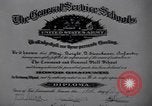
The military career of General Dwight D Eisenhower from 1926 to World War II
Film starts showing Dwight D. Eisenhower's diploma as honor graduate of the Army Command and Staff School, in 1926. Image of Major Eisenhower (in civilian clothes) Narrator says he was assigned to France, to prepare a guide book on American battlefields in Europe. Image of Eisenhower as a member of General Douglas MacArthur's staff in the Philippines, where MacArthur was Commander-in-Chief of the Philippine army. Glimpse of headquarters building there. MacArthur in his office helping the Commonwealth of Philippines work out a plan for its military defense. Image of Lieutenant Colonel Eisenhower in 1939, serving as Executive Officer of the 15th Regiment, at Fort Lewis, Washington, View of the Regiment's Headquarters building. Scene shifts to 1940, showing German forces invading Holland and Belgium. German tanks are seen in action. German Junkers 87 Stuka dive bombers and Heinkel 111 bombers drop bombs. After passing of the Selective Service draft act, President Franklin D. Roosevelt is seen at a public ceremony on October 29, 1940, where Secretary of War Henry L. Stimson drew from a bowl the capsule containing the first draft number of World War 2. Views of Lt. Col. Eisenhower as Chief of Staff of the Army 3rd Division and later as Chief of Staff of the Ninth Corps. Next, he is seen as Chief of Staff to General Walter Kreuger, who in 1941 led the Third Army in the most realistic maneuvers held by American troops (The Louisiana maneuvers). Views of American troops engaged in those maneuvers. Image of Eisenhower as a Brigadier General. Views of the Pearl Harbor bombing during Japanese attack on December 7, 1941.

Eva Braun and Hanni Morell enjoy the view of snow covered mountains in Europe.
German Chancellor Adolf Hitler's companion Eva Braun in Bavaria, where a feature film (Der Laufende Berg) is being made during World War II. She created the slate for her own home movie, with the same title, and containing illustration of fir trees running down a mountain. (The feature film was released in March, 1941.) This personal movie shows snow covered mountains and scenery much like that seen in the feature film. Eva Braun is seen seated with Hanni Morell in chairs as they smile. Other persons are seen including one on skis.
British Prime Minister Winston Churchill in many meetings before and after America's entry into World War II
Opening slate reads: "Quebec Conference August 1943." The English battleship, Prince of Wales, is seen in fog off the Coast of Newfoundland, in August 1941. View of sailor on fore-deck of the British ship. View inside engine room of the ship where sailor manipulates her power. Closeup of engine crankshaft stopping as she drops anchor in Placentia Bay. View of Prime Minister Winston Churchill, greeting U.S. President Franklin D. Roosevelt aboard the Prince of Wales. He proffers a letter to the President, from the King of England. View of Roosevelt and Churchill seated on deck with their respective military leaders standing behind them. Admiral Ernest King, U.S. Chief of Naval Operations converses with U.S. Army Chief of Staff, George Marshall, as they stand behind Churchill and Roosevelt. Wider camera view shows the larger military entourage accompanying the Prime Minister and the President. Glimpse of prisoners and enslaved workers taken by Nazi Germans in Europe. Glimpse of bombs falling from an airplane. Classic film views of the Japanese attack on Pearl Harbor in December 7, 1941. Bombs exploding along "Battleship Row." Heavy smoke rising from the bombed ships. The USS Arizona tilted heavily and burning. Camera pans along the path of destruction, as the voice of President Roosevelt is heard in the background, asking the Congress to declare that the Japanese attack created a state of War between the United States and the Japanese Empire. View of President Roosevelt speaking to the U.S. Congress. Seated behind him are Vice-President Henry Wallace and Speaker of the House, Sam Rayburn. Glimpse of Congress members applauding. Change of scene shows President Roosevelt and Winston Churchill meeting in Washington, DC, in December of 1941, during World War 2. Views of war preparations in the United States, including the building of new war production plants and facilities. A large steel ingot being forged into an artillery gun barrel. Machinist at work turning a gun barrel on a lathe in a munitions factory. Views of manufacturing plants in operation and steel being made. A railroad train carrying new Army trucks. Another meeting of Churchill and Roosevelt in Washington, D.C. June, 1942. Standing behind them is President Roosevelt's special assistant, Harry Hopkins, a British naval officer, and an American navy Captain. American soldiers boarding a troop ship, and closeups of them as they enter the ship, looking out of portholes, and waving from the ship's deck. Glimpse of Washington Monument and its image in the reflecting pool in Washington DC. Closeup of a book entitled, "Time Table for Invasion." General George Marshall with several of his generals doing preliminary planning. Series of scenes involving senior military officers engaged in war planning. A convoy of warships is seen at sea during the Operation Torch Allied invasion of French North Africa during 8–16 November, 1942. Views of Allied Navy ship guns firing. Allied troops riding in landing craft, and advancing from beached craft on shore of Algiers. Aerial view of a flight of Douglas Dauntless bombers in formation. "Bombs away" view from Allied airplane dropping bombs. Allied troops firing camouflaged antiaircraft guns from sandy positions near shore. Enemy shells or bombs exploding nearby. Two U.S. Army soldiers holding a document in French entitled, "Message from the President of the United States.
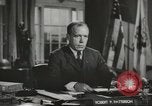
American Undersecretary of War speaks to difficulties facing Allies in confronting Germany and Japan in World War II
Undersecretary of War, Robert Porter Patterson, Sr. speaks about a report from the General staff outlining the needs for combating Germany and Japan in World War 2. He cites Operation Husky, the invasion of Sicily, as an example of what will be needed. He continues to narrate in the background as an animated map appears showing the buildup of supplies and Allied forces in North Africa; Allied air forces flying 60 thousand sorties over Sicily and, the direct amphibious assault using 3,200 vessels. Map also depicts opposing forces of 12 (“unwilling”) Italian Divisions and 3-1/2 German Divisions. View of Allied troops carrying some of their 31 thousand casualties on stretchers from field ambulances. Allied medics attending to the wounded. Some are seen lying on stretchers in a row on the ground near a wall. Interior of a field hospital where surgeons and other medical personnel treat the wounded. Animated map shifts to Europe with Germany at its center, showing , in contrast to Sicily that was only an “outpost,”, the heavily fortified perimeter of Axis controlled areas; the axis industrial might; and the disposition of 300 German Divisions (mostly on the Eastern front) defending the region. Next, the map illustrates Japan’s defended regions in the Pacific Image returns to Undersecretary Patterson i n his office, speaking of the Allied offensives planned for next year (1944), and emphasizing their challenge and difficulty. Scene shifts to General Jonathan Wainwright and his garrison at Corregidor, in the Philippines, surrendering to Japanese forces in 1941. Japanese military camera pans over the Americans being taken prisoner. Other Americans and Filipinos are seen being marched together under guard. Scene shifts to classic views of the Japanese attack on Pearl Harbor, Hawaii, on December 7, 1941. View of Japanese soldiers executing two Chinese civilians in 1937. Dangling bodies of persons hung by Nazis during Operation Barbarossa in Russia, in 1941 A Russian soldier comforts a little girl as he escorts her across a snowy landscape. Time bomb left by German forces retreating from Naples, Italy, in 1943, blows up a Post office building . Views of damage to building and bodies of victims. American Military Police assisting a victim. American soldiers carrying an injured civilian on a litter. Scene shifts to British Foreign Minister, Anthony Eden, Soviet Foreign Minister, Vyacheslav Molotov, and U.S. Secretary of State, Cordell Hull, entering a hall in the Spiridonovka Palace, during the 1943 Moscow Conference in Russia. Close-up of the American, Soviet, and British flags on a table. View of many delegates seated around the table. Close-up of Molotov, Eden, and Hull signing conference document.
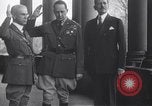
General Douglas MacArthur in 1930-1945; training of the Philippine Army; leading Allied troops against Japanese forces (WW2)
General Douglas MacArthur is appointed Chief of Staff, with rank of full General, in 1930. United States troops marching with the American flag. General MacArthur with two French military officers, during a tour of Europe. He is decorated by French Officials. MacArthur visits Germany and inspects German troops. U.S. President Roosevelt reappoints MacArthur as Chief of the Staff. MacArthur speaking to an audience in Washington DC. Scenes of MacArthur's headquarters in the Philippines. Filipinos walking outside MacArthur’s office. MacArthur at his office in the Philippines with Eisenhower at his side. MacArthur talks on the telephone. Flags of the United States and the Philippines. Filipino troops marching at Fort Santiago inside the walled city of Intramuros in Manila. MacArthur supervises the creation of a Philippine Army before World War 2. Philippine Army cadets perform outdoor calisthenics and attend a meeting. Philippine Army cadets train in knife fighting together with U.S. soldiers. View of Japanese attack of U.S. Navy ships and airfields at Pearl Harbor in December 1941. Japanese bombardment of the Philippines in December 1941 and into early 1942 as Japanese occupy Philippines during World War II. View of Corregidor Island. U.S. Army and Filipino soldiers on Corregidor load and fire artillery at the Japanese before the fall of Corregidor. U.S. soldiers in the Bataan peninsula. Face of MacArthur superimposed over a montage of American factory workers manufacturing ammunition and military vehicles. Start of the Bataan Death March. PT boat carrying MacArthur leaves Corregidor. War equipment prepared in factories. A battleship underway to Australia. MacArthur in Australia. U.S. convoy moves towards Japanese held islands in the Pacific. Allied soldiers land on the islands. A soldier lands on a beach and raises the American Flag. MacArthur points to the Philippines on a map and discuss war strategy. In accordance with the plan key positions in the Pacific are attacked. MacArthur looks on as United States soldiers land on the islands. MacArthur while smoking a pipe inspects the landing of Allied soldiers on islands behind heavy bombardment. Amphibious tractors land on the beach of Palo, Leyte. Allied paratroops make a landing. United States troops sail on rubber boats towards the beach of Palo, Leyte. Paratroopers on parachutes landing in Leyte. MacArthur confers with Allied Commanders. Allied troops walk past a destroyed Bahay Kubo nipa hut. Japanese soldiers are taken as prisoners in the Philippines.