


 Francais
 Deutsch
 Italiano
Refine Your Search
+"Europe" +1944 stock footage and images
- Showing 97 to 102 of 226 results more
more Hide
Hide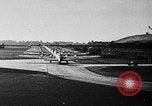
Allied air invasion of Europe during World War II.
Allied invasion of Europe during World War II. Allied aircraft take off to invade German targets during World War II. United States Consolidated B-24 Liberator bombers and Curtiss P-40 Warhawk fighters in flight. Allied aircraft including the British Royal Air Force Aircraft (RAF) bombard the German highways, oil refineries and production centers. Allied infantry also advances towards the German territory. Paratroopers land as their parachutes descend. Allied aircraft take off. P-51 Mustangs flown by Poles and Mitchell by men of British Commonwealth. Aircraft strafe German installations and drop bombs causing a pillar of smoke to rise.
Allied ships in the English Channel during the invasion of Europe, World War II.
Allied invasion of Europe during World War II. A U.S. Army Major General, with other officers, standi next to a communications vehicle on a landing ship in the English Channel. They all wear flotation belts around their waists. The General speaks into a microphone from the communications vehicle. A 173 foot Patrol Craft displaying the number 17, moves near a sunken landing craft.
World War II. USAAF P-61 'Black Widow' night fighters in Europe. U.S. Navy testing of JATO on several aircraft in the USA
A short U.S. Army feature entitled,"Black Widow" AND "Jato." Introduction is overlayed on map of Europe. Opening sequence features P-61 Black Widows of the 422nd Night Fighter Squadron, stationed at Florennes/Juzaine (A-78), Belgium, during World War 2, Some of the aircraft are identifiable: P-61A 42-5577 (later nicknamed "Tactless Texan") and "Wandering Wench" (P-61A 42-5590). Narrator states their mission is to intercept German "flying bombs." Mixed footage of P-61s at various places and times, includes some with D-Day invasion stripes. Separate JATO-related footage features USN personnel fitting jet-assisted takeoff bottles on a Grumman F6F-3, possibly at NAS Patuxent River facility, Maryland. Later sequences show a JATO takeoffs by a Douglas SBD, and an F6F-3; and normal takeoff by a Grumman TBF, and a JATO takeoff by a Grumman F4F.
Admiral Halsey inspects sailors and marines on board a ship in Europe (WW2)
'US Navy speeds fighting planes to war fronts'. Admiral William Halsey inspects sailors and marines lined up on board a ship in Europe during World War II. Deck crew places P 40 fighter planes in formation. Planes taxi along and take off. Planes in flight. 'Eagles quit RAF to fly with Yanks'. Pilots of Eagle Squadron stand in ranks on board a ship. Brigadier General Frank Hunter pins up insignia onto them. Pilot parade and American flag hoisted.
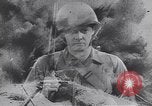
Training and mental preparation of U.S. soldiers for fighting in Europe during World War 2
A film on the logistics and the psychology of war. Primarily shows training exercises, combat simulations, and dramatizations. Images of soldier and explosions. A U.S. sailor firing a Mark 4, 20 mm. anti aircraft. Gun from a ship. A U.S. M3 Stuart light tank heading toward the camera. American soldiers ostensibly falling to enemy explosions and gunfire. A shell exploding where American troops are hunkered down. Artillery batteries firing at night. A soldier cutting barbed wire and triggering a booby trap. . Troops under fire during amphibious assault. Soldiers manning an M1919A4 .30-caliber Light Machine Gun. Troops advancing through forest under fire. Some fall. Staged encounter between U.S. infantrymen and German soldier. The kill each other. Entire battle front erupting in explosions and smoke. Newspaper article by Ernie Pyle about too little training of U.S. troops. New York reporter's article noting that U.S. soldiers in Europe don't understand why they aren't fighting the Japanese who attacked America. Staged hand to hand combat between a German soldier and two American soldiers.
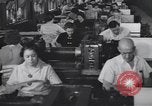
Armed Service Forces men and women ready for invasion of Europe in World War 2, including printing of invasion money.
Armed Service Forces (ASF) personnel at work in the United States during World War 2. Interior of a building. Men and women working. They print invasion money (temporary currency for use in Europe after the Allied invasion, until local currencies can be stabilized). Bills passing through printing machinery. The plan of actions is seen being typed on a typewriter and passed through the ASF network command. An officer talks on phone.