


 Francais
 Deutsch
 Italiano
Refine Your Search
+"Europe" +1944 stock footage and images
- Showing 115 to 120 of 226 results more
more Hide
Hide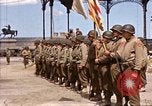
Presentation ceremony of French tricolor flag to Mayor of Cherbourg after Allied Invasion of Europe in World War II
Allied troops in Cherbourg after the Normandy Landings on D-Day in World War 2 . The first official ceremony in France after the Invasion of France. Allied soldiers lined up. A statue in the background. Dignitaries outside a building. U.S. General Joseph Collins presents the French tricolor flag to the Mayor of Cherbourg. Soldiers of the 7th Corps in clean uniforms for the ceremony. French people on the street. Colonel of the Signal Corps with war correspondents including Scripps-Howard Newspapers' Ernie Pyle, Burt Brandt, Cecil Cons, and John Leglinsee
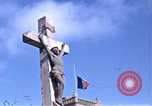
The fishing village of Barfleur shortly after the Allied invasion of Europe (WW2)
Allied troops moving forward during the Allied invasion of France in World War II. Crucifix statue in front of the Church of Saint Nicholas (Église Saint-Nicolas, Rue Saint-Nicolas, 50760 Barfleur, France). View of the Church of Saint Nicholas in the fishing village of Barfleur, which had been spared by retreating German forces. French flag on a building. Boats in the harbor. Barrage balloons in the sky. Buildings on the shore.
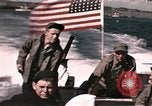
U.S. War Correspondents touring in France in the months after the Allied invasion near end of World War II in Europe
U.S. war correspondents in France toward the end of World War II. A U.S. Navy patrol boat underway in the Atlantic Ocean with sailors aboard it. A war correspondent comes out of a house and poses near a truck. A young French girl poses with him. Shots of a a busy downtown street from a moving vehicle. Large building at the end of the street has an advertisement sign "Joselli" atop the building. A sign on a building reads 'Theatre' and the name of the Theatre, is partially obscured by a draped American flag. A French flag flies beside it. US, French, and British flags together on various buildings. A war correspondent stands on a building balcony in a city area and smiles for the camera. Another war correspondent on a village street poses for the camera and puts on sunglasses. He is joined by the correspondent who had posed with the girl, and they walk up a street beside row houses, to a parked, covered U.S. Army personnel carrier truck.
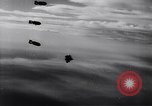
Air war over Germany in final phases of World War II in Europe. B-17s bomb railroad tracks, marshaling yards and numerous other targets.
Relentless bombing of Germany by Allied Forces in World War 2. Bombing on important roads and buildings in German cities by the bombers of the United States Army Air Force. B-17 bombers of the 306th Bomb Group,out of Thurleigh, England (Triangle H tail code) seen in formation. They drop bombs from high altitude on a German city. Black flak clouds and contrails are seen. Immense explosions and destruction on ground from saturation bombing. Serial blasts at a railway marshaling yard, on a road. Bombs gliding towards target leaving a smoke trail behind. Buildings bombed by Allied bombers.

Fighter aircraft of the U.S. 8th Air Force engage German aircraft and ground targets in Europe during World War II
A film titled 'Activities in European theater of operations' shows gun camera films from U.S. P-47 Thunderbolt and P-51 Mustang fighter planes shooting down German planes during World War II.In one, the German pilot is seen bailing out and falling away from his airplane. In another, the German plane explodes and its wing falls off. One sequence shows the German plane trying evasive maneuvers and then rolling over as the pilot bails out. His chute is seen opening moments later. Other scenes show aircraft losing wings, and one exploding into a ball of fire. One scene shows a strafing run at a steam locomotive pulling a train. The locomotive billows white smoke. Two more attacks against trains result in huge fiery explosions.
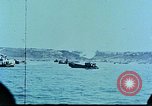
United States soldiers aboard LCM ship landing in Normandy, France as part of operations for Invasion of Europe
On or soon after D-Day invasion of Normandy France, a United States LCM ship approaches and hits the coast in Normandy, France as ramp splashes in water. B-26 bombers fly over head. Troops stand in a ship. LCVP (Landing Craft Vehicle, Personnel) or Higgins boat underway in water. It is seen turning around and returning from shore to ship as three men bail out with buckets. A dead man is seen floating in the water. United States Coast Guard rescue boat USCG-59 approaching a ship. Two medical staff work on an injured soldier partially covered in a blanket. (World War II period).