


 Francais
 Deutsch
 Italiano
Refine Your Search
+"Europe" +1944 stock footage and images
- Showing 145 to 150 of 226 results more
more Hide
Hide
Black United States soldiers talking to elderly sailors, young black soldier reads a French book (WW2)
African American U.S. Army soldiers on board a ship heading for Europe during World War 2. Black United States soldiers speak to two French merchant sailors on deck of ship. Two black soldiers together. Young black soldier smiles as he listens to French sailor. The French sailor and African American soldier laugh together. A young black soldier reads a U.S. Army-issued French language book. A black soldier manning a crow’s nest alongside anti-aircraft gun.
African American and white U.S. Army soldiers attend a religious service on board a ship (WW2)
African American U.S. Army soldiers on board a ship heading for Europe during World War 2. A senior black soldier hands out night identifying light devices to two young black soldiers to clip on their life jackets. Two black soldiers look at each other. Senior United States black soldier helps attach a night identifying light device onto the life jacket of the soldier. Life jackets read “Board of Trade STANDARD LIFE JACKET”. Young black soldier smiles as he glances at the night identifying light device. Two black soldiers test the buttons of their light devices. Black and white soldiers sitting on ship’s deck. White soldiers sit behind black soldiers. Soldiers attend a religious service on deck. A Christian chaplain (holding his life jacket) conducts religious service for soldiers. Young black soldiers listen to religious service.
Incendiary bombs moved from United States to England during WW2.
Chemical Warfare Service (CWS) handles the distribution of incendiary bombs in Europe during World War II. Lieutenant Colonel R. N. Isbell of the Chemical Warfare Service (CWS) makes calculations from his desk. An incendiary order addressed to the Commanding General is typed on a typewriter. Buses arrive at the motor pool of the United States War Department, now known as the Pentagon. Women disembark from the buses and head to the War Department. Employees working in the office inside the War Department. Men prepare bombs at an arsenal. Men hauling carts with large incendiary bombs in warehouse. A man stencils labels onto bomb that read, "PT-1 Incendiary," and "Bomb Burster." The United States flag waving on a ship. Ships carry a shipment of incendiary bombs to the United Kingdom. Incendiary bombs inside wooden crates are unloaded from ships. Steam locomotive train running on track as railroad signal activates. Incendiary bombs are removed from train cars. Two munitions are suspended on a crane. Trucks loaded with bombs drive out of the depot, passing past village cemetery. An Air Division Chemical Officer receives new shipment information. The Air Division Chemical Officer reads the document and updates bomb listings on chalkboard.
Major General Maxwell Taylor decorates 101st Airborne Division soldiers (WW2)
Major General Maxwell D. Taylor decorates a soldier of the 101st Airborne Division, 502nd Infantry Regiment in Europe during World War II. Side view of the soldier shows the heart symbol on his helmet and a patch of the 101st Airborne Division. General Taylor and the soldier shake hands and salute to each other. General Taylor decorates more officers and men of the 101st Airborne Division. Four soldiers with flags stand behind the line of soldiers being decorated by Taylor. A hand picks up and shows one of the medals on the table. General Taylor gets out of a sedan staff car. He walks to review the position and salutes the colors. 101st Airborne Division salute the colors.
Preparations for allied invasion of Normandy France during World War II.
'Normandy: Air borne invasion of fortress Europe ' Allied invasion of Normandy. Lieutenant General William S Knudsen introduces the film to be presented, expressing thanks to makers of the glider aircraft used in the invasion, who are the intended audience of the film. Field Order no1, 9th Troop commander Carrier. A man puts a Top Secret seal on the order. The Captain of United States 82nd Air Borne Division briefs men about the terrain with the help of a mosaic. A map of Europe shows principle cities of the continent. Map and narrator describe German Atlantic Wall coastal defenses on European continent. A giant concrete coastal gun emplacement. A large German railroad coastal gun moved out of a concrete shelter. Various concrete structures, sandbag structures of coastal guns. A concrete base gun turret revolves. Huge coastal guns protrude from concrete gun emplacements. Huge steel and concrete tank barriers stretched across. Large concrete and steel structures built along the coast to prevent assault craft from landing. Combined Chiefs of staff of the United Nations at a meeting. George Marshall and Henry Arnold at the head of the table during the meeting. A map shows invasion area near Le Harve. Troop Carrier units departing for Allied invasion on Sicily, Africa on 10 July, 1943. The United States C-47 aircraft take off towing gliders from an airfield in Africa. Troops transported from British 1st Air Borne division and United States 82nd Air Borne division. Dust rises as aircraft take off from a desert field. Demolished gliders on field and beside water. Multiple views of demolished gliders. C-47 in flight and paratroopers jump from the plane in New Guinea. Instructor trains paratroopers in United States. Discussion and demonstration of improvements in glider equipment and usage after Sicily Invasion and prior to D-Day Normandy invasion. Two men attach link nose chain to glider. Parachute extended and held open by men. Pilot of a glider talks to the pilot of the plane towing the glider over intercom.
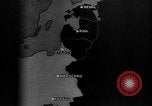
German soldiers fire machine guns at Soviet enemy forces and advance with tanks on the eastern front in World War 2
View of map showing Riga, Tilsit, and Warsaw. German soldiers advance with tanks and Assault Guns in eastern Europe. A German soldier looks through binoculars. Slit trench with boards at bottom for protection against mud. German soldiers walking through a trench and then climbing out of trench to surface. Two German soldiers, one with a machine gun and the other with a rifle. The soldier fires the machine gun at enemy Soviet Union forces. German StuG III assault gun and troops advancing forward. Four German soldiers pull a dead soldier along a tarpaulin. Troops fire flamethrower towards a bunker.