


 Francais
 Deutsch
 Italiano
Refine Your Search
+"Europe" +1946 stock footage and images
- Showing 25 to 30 of 32 results more
more Hide
Hide
United States 1st Infantry Division soldiers fight to counter the German attack on Ardennes during World War II.
The role of United States 1st Infantry Division in various campaigns during World War II. United States 1st Infantry Division men fight in Hurtgen forest. Artillery being fired among trees. Soldiers help an injured soldier. Soldiers of the 1st Infantry Division advance amidst extreme weather conditions. Soldiers get a rest in Belgium. A map of Europe shows the German attack in Ardennes during World War II. Soldiers advance and fight in the counter attack.
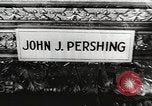
U.S. Generals and other officials discuss with soldiers on battlefields in the European Theater.
The history of West Point Military Academy. Battle memorials in Europe are shown. U.S. Army General John J. Pershing talks to soldiers. A soldier reads books in an army library. 'The 1909 Howitzer' written on a book. Books on shelves in the background. He reads about various soldiers and their achievements. The soldiers fire artillery. U.S. Army General Dwight D. Eisenhower talks to the soldiers. U.S. Army General Douglas MacArthur discusses with other officials. The soldiers march on a field.
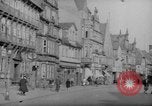
German people stroll along the streets in front of 15th century buildings in Hamlin, Germany, soon after the end of World War 2.
The British Zone of Occupation in Germany, shortly after the end of World War II in Europe. Hamlin (Pied Piper town) near Hanover shows 15th century buildings. German people stroll along the streets.
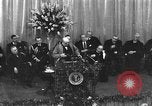
Winston Churchill's "Iron Curtain speech" regarding USSR and Eastern Bloc, at Westminster College in Fulton, Missouri
Iron Curtain speech by Winston Churchill at Westminster College in Fulton, Missouri, early in the Cold War. British Leader Winston Leonard Churchill at podium addresses the gathering in his "Sinews of Peace" speech. Officers seated on a platform in the background. Churchill speaks of the Union of Soviet Socialist Republic (USSR) and the creation of the Eastern Bloc. He places certain facts about the present position in Europe. The Opposition Leader states that Soviet Russia does not desire war but the indefinite expansion of their power and doctrines. The gathering applaud. He continues his speech by insisting on the permanent prevention of war and the establishment of conditions of freedom and democracy. He declares that a good understanding on all points with Russia under the general authority of the United Nations Organization should be made.
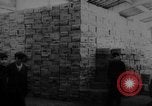
UNRRA personnel distribute food and clothes donated by the United States to people facing hunger in Poland after WW2
Polish men, women, and children receive new clothing and food from the United States through the UNRRA (United Nations Relief and Rehabilitation Administration) after World War 2. In Europe, men unload relief aid boxes from UNRRA. UNRRA personnel distributes clothing from America to Polish men. Polish women sort through a box of shoes donated by the United States. A Polish woman dresses her boy with new clothes received from UNRRA. Smiling children after receiving new set of clothes. Polish boys smiling. A female UNRRA personnel distributes food to hungry children. A Polish boy licks off sauce from a can of food. Boy consumes food straight from the carton. A young Polish boy eats a chocolate bar. Polish children walk by ruined buildings destroyed from bombings in World War 2. Children joyfully running down a wrecked city street.
WWII refugees arrive in New York City Harbor aboard the SS Marine Flasher.
Former Nazi German concentration camp victims and refugees arrive in New York City from Europe after World War 2. Refugees wave and cheer in excitement as the SS Marine Flasher approach New York City, with the Statue of Liberty and the New York City skyscrapers seen from the ship. Refugees waving from deck. A little girl standing beside two women waves in front of the camera. Relatives of refugees waving from harbor upon the ship’s arrival. From the ship, a woman tries to reach out her arm to her relative. Happy male refugees waving at the camera. Two Jewish women show cameramen and reporters their arms with tattoo entry numbers from Auschwitz Concentration Camp. A Jewish woman with child. Entry numbers tattooed in arms of two Jewish women. Polish Catholic priests previously imprisoned in Dachau Concentration Camp. A Jewish military chaplain poses with his Torah. An orphaned girl eats a bar of Hershey’s chocolate. Orphaned children and infants onboard. Mothers holding their babies. Refugees rush to hug relatives and friends upon disembarking. Man kisses a woman. An old woman kisses man on the cheeks. Two women hugging each other. Woman hugging her relatives during their reunion after World War 2.