


 Francais
 Deutsch
 Italiano
Refine Your Search
+"European Theater" +1945 stock footage and images
- Showing 103 to 108 of 113 results more
more Hide
Hide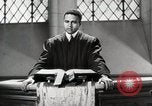
A film in the United States shows the commencement of World War II in Europe and Asia and Japanese attack on Pearl Harbor.
A film in the United States about achievements and role of African American soldiers during World War II. A dramatization depicts An African American priest at a church as he addresses people about the outbreak of World War II. Nazi eagle symbol. Past events show German Chancellor Adolf Hitler and Japanese officers conferring at a map. A Japanese flag flies. A building being bombed during World War II. Smoke rises. Civilians being hanged to death by the Nazis in the European Theater. Japanese aircraft bombard areas in Asia. Asian civilians rush as bombs explode. Dead and injured civilians after the bombings. Injured being loaded onto a truck. Japanese attack on Pearl Harbor. Naval guns being fired at Japanese aircraft in flight during the attack. An African American machine gunner fires at Japanese aircraft.
African American U.S. Army soldiers in transport, on the front, and in battle during World War II.
A film about achievements and role of African American soldiers during World War II. A map of the Atlantic Ocean. Nazi German and Japanese flags. Allied soldiers liberate cities in Europe and civilians welcome them. African American Army soldiers walk up troop ship gang plank onto a troop carrier ship for transport to the war front. An Allied invasion convoy underway in the Atlantic Ocean. Equipment and food supplies being carried to troops. Supplies being unloaded at a beach in the European Theater. Airstrips, roads and bridges being constructed. Trees being cleared at the Alcan Highway. African American soldiers in combat fire rifles and fire artillery at enemy positions. A Japanese enemy airplane in flight as an African American soldier fires an anti aircraft gun at the aircraft. Explosions occur at a battlefield.
Trials of war criminals in Germany after World War Two. Belsen local trial.
"The Guilty." Animation depicts person being hanged. View of an angry crowd on a road. People beat captured German soldiers and collaborationists. Mob of Italian partisans in Italy raising dead bodies of Mussolini and others up to hang from their heels in public after their execution. Foreign Minister Vyacheslav Molotov and British Foreign Secretary Sir Anthony Eden signing the Moscow Declaration in November, 1943. The declaration is signed to preserve the authority of law in Europe and to ensure fair and orderly trials for war criminals. Next scene shows Allied soldiers at a liberated Concentration Camp near the end of World War 2 in Europe. Military jeeps in the background. Military photographer takes pictures as officials arrive to tour the concentration camp. Man opens a crematorium oven, revealing bones of a corpse inside. Pile of dead victims of a concentration camp. Elevated view of a room full of documents that are in review for war trials. Officials search documents to identify war criminal suspects. Nazi officers and officials who committed suicide are shown, including a German admiral, the body of Heinrich Himmler, and the bodies of the Mayor of Leipzig and his wife. War criminals being summoned for the various war crime trials. Scenes from the Belsen Trial in September 1945, held in a Lüneburg gymnasium, to decide the fate of German guards and SS officials from the Auschwitz and Bergen-Belsen concentration camps. A defendant being brought to trial on a stretcher. Soldiers guard the court room. View of defendants including many women SS-Gefolge members. German Commandant Josef Kramer during his trial, and German doctor Fritz Klein beside him. The court trial underway for the war criminals. Guilty war criminal brought to the gallows to be hanged, black cover placed over his head and he is hanged. View of dead bodies of concentration camp victims. View of a crowd amassed at a hanging execution of several German officers, possibly in the Soviet Union.
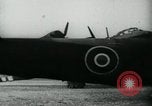
1st Allied Airborne Army troops land in Germany during Operation Varsity in World War II.
The successful airborne crossing of the Rhine river by the 1st Allied Airborne troops during World War II. Aircraft lined up at an airfield in England, United Kingdom. British 6th Airborne Division gliders, British Halifax bomber aircraft and British Sterling bomber aircraft, together with U.S. Army Air Forces C-47 and C-46 aircraft take off from an airfield in the UK. British aircraft taking off and British soldiers waving as they pass by on the airfield. British 6th Airborne Division troops in the field. Airborne troops who will be parachuting to targets are briefed by officers as they stand in a group. Soldiers synchronize their watches. Soldiers put on equipment as they prepare to take off. Airborne troops fully loaded with gear ascend stairs to board propeller aircraft. Narrator points out visible tape placed over sharp corners and protrusions on the aircraft to ensure that no parachutes or equipment are caught and damaged. Soldiers entering through doorways of C-46 aircraft. Personnel at the control tower order aircraft to take off. Aircraft and gliders take off. An aircraft taxis for take off but partially loses control, hits some wheeled carts to the side of the runway, and finally comes to a rest off the runway without severe crash damage. Aerial views of aircraft in flight. Narrator notes that the forces flying from the British airfields are merging south of Brussels with similar Allied forces taking off from bases in France. Troops aboard an airborne aircraft. Allied paratrooper soldiers jump from both doors of C-36 aircraft and their parachutes are seen descending. View of pilot in a towing aircraft as he pulls back lever to cut his towed glider loose. A glider coming to rest in a field on landing. An allied aircraft falling to the ground in flames after being hit by German antiaircraft flak fire. Another allied aircraft is seen exploding upon crashing (with farm barn buildings in foreground partially blocking the view.) Troops in prone position beside gliders after landing, as they secure areas and regroup. Allied British and American Army soldiers enter a village and take German prisoners. Lines of Allied soldiers and equipment advancing near the Rhine.
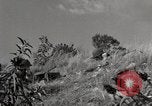
U.S. Marine Artillery Battery firing 105mm howitzers. Buildings being destroyed by artillery fire.
U.S. Marine artillery battery firing 105mm howitzers. Smoke arises due to the firing. Marine watches through the binoculars. View of buildings being destroyed by artillery bombardment. Montage of artillery, machine guns, troops advancing at end of film. (World War II period).
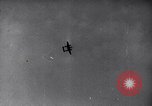
P-38 planes complete mission and land at base, including crash landing
P-38 planes over German targets. U.S. Pilots destroy enemy targets by firing aircraft machine guns. A P-38 plane pilot contacts U.S. Air Force Base for crash landing. P-38 plane hits the surface and burns. Other P-38 plane contacts for emergency landing. Ground officers observe the burned P-38 plane. (World War II period).